Dark Matter by Blake Crouch: quantum vertigo and the quest for identity
In the world of scientific thrillers, certain works transcend genre boundaries by brilliantly combining breathless suspense with profound philosophical questions. Dark Matter by Blake Crouch fits perfectly into this category of works that shake our certainties while keeping us on the edge of our seats from the first page to the last.
Published in 2016, this novel quickly won over a wide audience through its ability to make complex scientific concepts accessible while exploring universal themes like identity, life choices, and the roads not taken. A plunge into a narrative where quantum physics becomes the playground for a dizzying existential adventure.

A fascinating premise
The story begins with Jason Dessen, a physicist turned physics professor at a modest Chicago institution. His life is simple but happy: he’s married to Daniela, a talented artist, and father to a teenager named Charlie. One evening, while returning home after celebrating a former colleague’s success, Jason is kidnapped by a masked man who takes him to an abandoned warehouse.
The question his captor asks him resonates as the tipping point of the narrative: “Are you happy with your life?” Before losing consciousness, Jason is confronted with this question that will prove to be the guiding thread of the entire adventure to come. When he wakes up, he discovers an alternate reality where he never married Daniela, where his son doesn’t exist, but where he’s become a famous physicist who achieved a major scientific breakthrough.
What makes this premise so powerful is its ability to transform a science fiction concept—parallel universes—into an intimate exploration of the “what ifs?” that mark our existence. Crouch doesn’t simply exploit a narrative device from SF; he uses it as a mirror for the deepest human questions.
A narrative in service of vertigo
One of Crouch’s great achievements lies in his ability to maintain a frantic pace while developing complex scientific concepts. The first-person narration plunges us directly into Jason’s disoriented mind, making us experience his anguish, confusion, and determination.
The writing style is characteristic of the author: short sentences, often fragmented, that create palpable urgency. The brief paragraphs and concise chapters propel the reader into a narrative whirlwind that perfectly reflects the quantum chaos explored in the story. This narrative technique sometimes recalls the nervous prose of certain Michael Crichton novels, but with a more intimate and psychological dimension.
"I watch my house recede.
My street.
My life."
These minimalist lines perfectly illustrate how Crouch manages to create strong emotional tension with remarkable economy of words. This stylistic approach admirably serves the book’s purpose: the fragmentation of the text echoes the fragmentation of the protagonist’s reality and identity.
Science as narrative vehicle
Dark Matter distinguishes itself by the way it integrates challenging scientific concepts without ever falling into didactic exposition. The many-worlds theory, derived from Everett’s interpretation of quantum mechanics, becomes a formidable narrative engine here.
Crouch achieves the feat of popularizing quantum physics without distorting it. The “multiverse” isn’t just a simple plot device, but the very heart of the novel’s philosophical questioning. Does each decision we make create a new universe where we made a different choice? And what if we could travel between these alternate realities?
The “box,” this invention that allows navigation between parallel worlds, becomes a powerful metaphor for the infinite possibilities available to us and the consequences of our choices. It’s not unlike certain narrative devices from Philip K. Dick, but Crouch anchors it in a more tangible scientific reality, which reinforces the impact of his message.
Beyond the thriller: an existential reflection
While Dark Matter works admirably as a gripping thriller, its true strength lies in its philosophical dimension. Through Jason’s journey to find his family and his world, Crouch explores several fundamental questions:
Identity and its multiple facets
Who are we really? Are we defined by our choices, our relationships, our accomplishments? By confronting Jason with alternate versions of himself, the novel questions the very nature of identity. The protagonist discovers that what defines him isn’t so much his professional achievements as the bonds he’s formed and the choices he’s made.
The roads not taken
One of the novel’s most powerful themes is that of “potential lives”—those existences we could have led if we had made different choices. Jason is literally confronted with the life he would have had if he had prioritized his scientific career over his family life. This exploration of possibilities echoes Robert Frost’s famous poem, “The Road Not Taken,” but gives it a fascinating science-fictional dimension.
The paradox of choice
The more Jason travels through the multiverse, the more he discovers a troubling truth: the multiplicity of choices can become a trap. In a universe where all possibilities exist simultaneously, how do we determine which one has the most value? This reflection on paralysis in the face of infinite options resonates particularly in our contemporary society saturated with choices.
Characters with multiple facets
The strength of Dark Matter also lies in the depth of its characters, starting with Jason Dessen himself. Far from being a simple hero of a scientific thriller, he embodies the complexity of human aspirations. His dilemma between professional accomplishment and family happiness touches on a universal question that many readers can feel intimately.
Daniela, his wife, also escapes stereotypes. An artist who put her career on pause to raise their son, she isn’t presented as a victim of sacrifice, but as a woman who made choices she stands by, with their joys and regrets. Her relationship with Jason is depicted with nuance, showing how love is built over time and through trials.
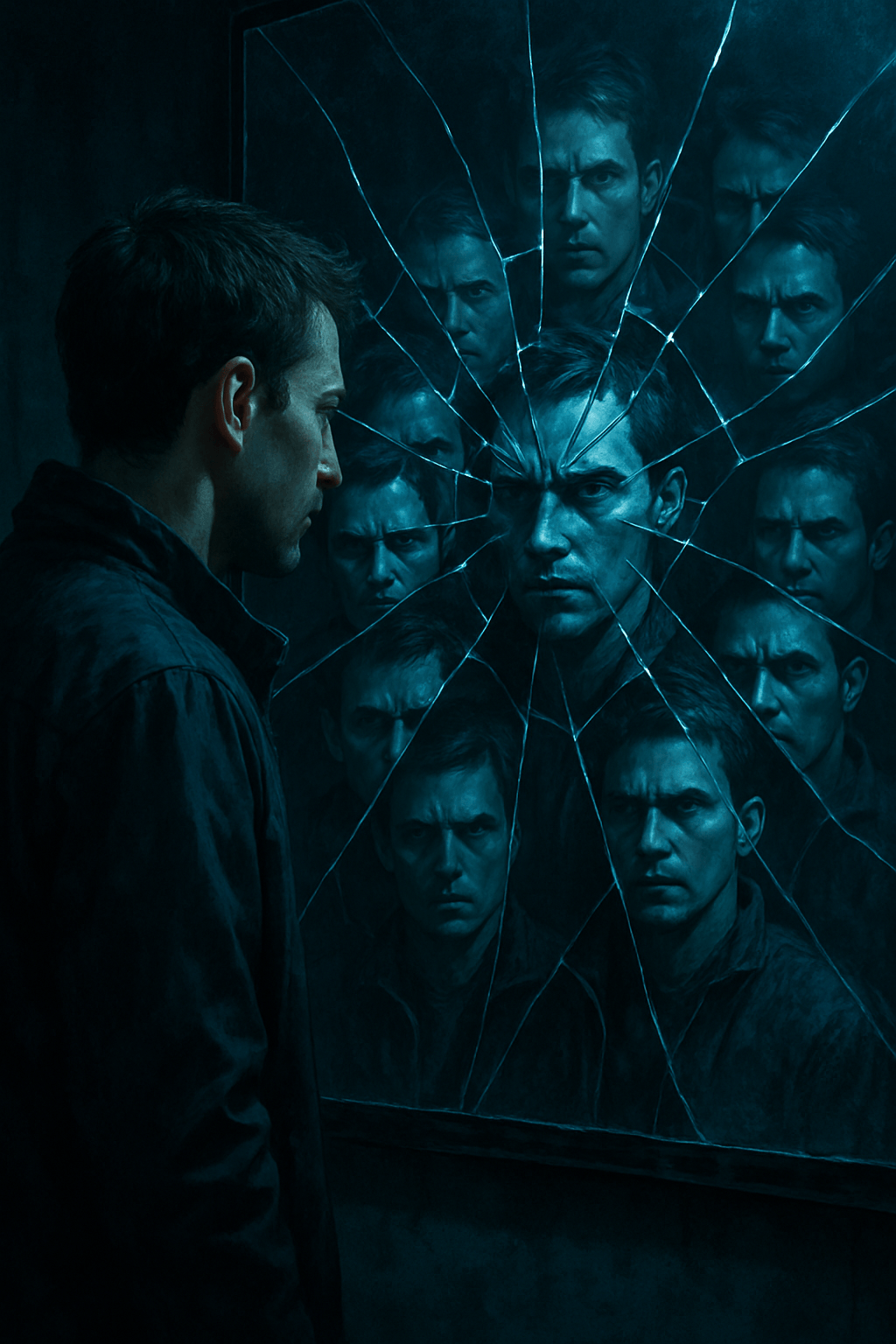
But Crouch’s tour de force is perhaps his ability to give life and depth to the “other Jasons”—those alternate versions of the protagonist who followed different paths. These doppelgängers aren’t simple antagonists, but complex reflections that force the hero (and the reader) to question their own life choices.
An ingenious narrative structure
The novel’s construction also deserves highlighting. Crouch organizes his narrative in three distinct acts that reflect the protagonist’s evolution and his progressive understanding of his situation:
- Disorientation: Jason discovers he’s been displaced into an alternate reality and tries to understand what’s happening to him.
- Exploration: Armed with the “box,” he travels through the multiverse searching for his world of origin.
- Confrontation: Facing a dizzying multiplication of Jasons all seeking to return to the same life, he must determine who truly deserves to go “home.”
This narrative progression allows Crouch to gradually increase the stakes, both in terms of action and philosophy. The novel’s climax, where dozens of versions of Jason converge toward the same reality, constitutes a perfectly orchestrated moment of conceptual vertigo that pushes the book’s premise to its ultimate consequences.
A significant cultural impact
Since its publication, Dark Matter has enjoyed considerable success, crossing the usual boundaries of science fiction to reach a wider audience. Sony Pictures quickly acquired the film adaptation rights, confirming the visual and narrative potential of this story.
The work has also contributed to popularizing quantum physics concepts and the multiverse among the general public, joining other contemporary works like Alex Garland’s Devs series or the Daniels’ film Everything Everywhere All at Once in the creative exploration of these scientific theories.
Conclusion: a quantum mirror of our existences
Dark Matter achieves the rare alchemy of combining high-flying entertainment with philosophical depth. Using the narrative possibilities offered by quantum physics, Blake Crouch invites us into a dizzying introspection on our life choices and what truly constitutes happiness.
What remains after reading, beyond the twists and fascinating scientific concepts, is this lingering question that everyone can ask themselves: if we could see all the lives we could have led, would we be at peace with the one we chose? And if the answer is no, what are we prepared to do to change our trajectory?
In a world where we’re constantly encouraged to compare ourselves to others and imagine more satisfying alternative lives, Dark Matter reminds us that the value of our existence perhaps lies less in what we accomplish than in the connections we form and in our ability to appreciate the journey traveled, with its imperfections and moments of grace.
Also by the author: Wayward Pines and Recursion