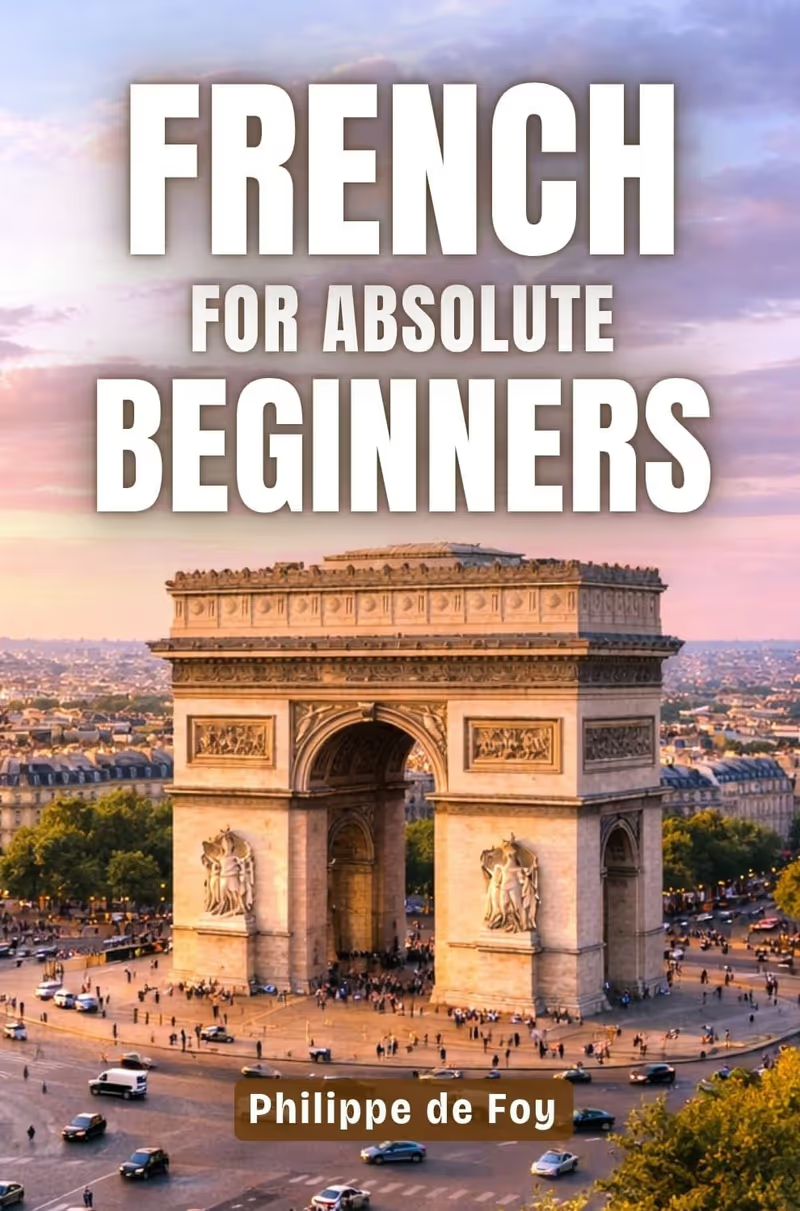
French for Absolute Beginners: A1 Textbook for American Learners
French for Absolute Beginners is a structured, 18-lesson A1 course designed specifically for American English speakers who are starting from zero. No prior knowledge of French is assumed. No prior knowledge of formal grammar is required.
- Paperback edition — Amazon
- Kindle edition — Amazon (available with Kindle Unlimited)
Who Is This Book For?
The short answer: anyone who speaks American English and wants to learn French from scratch.
More specifically, the book was written for self-study learners who want a clear, logical progression rather than a collection of disconnected vocabulary lists and conversation snippets. It suits adults returning to language learning after years away from a classroom, college students looking for a solid foundation before a trip or a semester abroad, and anyone who has tried apps or online courses and found them too shallow to build real confidence.
The book does not assume that you remember anything from a high school French class. If you do, great. If you don’t, you won’t be at a disadvantage.
The Core Principle: Sequencing Above All
The most common frustration in language learning at the beginner level is being asked to do something you haven’t been taught yet. An exercise asks you to conjugate a verb whose forms haven’t been introduced. A translation requires vocabulary from three lessons ahead. The answer key uses a grammar structure that won’t appear until much later in the book.
Every lesson in French for Absolute Beginners was built around a strict sequencing principle: nothing appears in an exercise that has not already been introduced, either in the current lesson or in a previous one. This applies to vocabulary, verb forms, pronouns, conjunctions, and grammatical structures. The exercises were audited item by item to ensure compliance with this principle.
This sounds obvious, but it is surprisingly rare in practice. Most textbooks, even well-regarded ones, contain sequencing errors that create silent confusion for the learner who doesn’t yet know enough to recognize the problem. This book was built to eliminate that confusion at the source.
What the Book Covers: 18 Lessons from Zero to A1
Lessons 1 and 2 cover the basics of French nouns: gender (masculine and feminine), number (singular and plural), and the article system. You learn the difference between definite articles (le, la, les), indefinite articles (un, une, des), and the construction il y a (there is, there are).
Lesson 3 introduces the verb être (to be) in full, along with the all-important distinction between tu and vous. American learners often struggle with this distinction because English lost it centuries ago. The lesson addresses it directly and gives you the practical tools to navigate it in real situations.
Lesson 4 introduces avoir (to have), including the essential French expressions built around it: avoir faim (to be hungry), avoir soif (to be thirsty), avoir peur (to be afraid), avoir besoin de (to need), avoir l’air (to seem), and more.
Lesson 5 covers all three major groups of regular verbs in the present tense: the -er verbs (like parler, to speak), the -ir verbs (like finir, to finish), and the -re verbs (like attendre, to wait for). By the end of this lesson, you can conjugate the vast majority of regular French verbs.
Lesson 6 tackles one of the concepts that trips up English speakers most reliably: the partitive article. When do you say du café rather than le café? The lesson explains the distinction between talking about a thing in general and talking about an amount of it.
Lesson 7 covers negation in full, including not just the basic ne… pas construction but also ne… jamais (never), ne… plus (no longer), ne… rien (nothing), ne… personne (nobody), and ne… que (only).
Lesson 8 is devoted to adjectives: their forms, their position, and agreement with the noun they describe. The lesson covers colors, sizes, ages, and evaluative adjectives, along with the irregular forms that are most commonly encountered.
Lesson 9 introduces five essential irregular verbs (aller, vouloir, pouvoir, savoir, connaître) along with stress pronouns and the near future construction (aller + infinitive).
Lesson 10 covers possessive adjectives (mon, ma, mes, ton, ta, tes, and so on) along with demonstrative adjectives (ce, cet, cette, ces).
Lesson 11 covers prepositions of place and the contractions of à and de with the definite article (au, aux, du, des). You learn how to describe where things are located, give and follow directions, and use the pronoun y (there).
Lesson 12 introduces reflexive verbs: se lever (to get up), se laver (to wash), s’habiller (to get dressed), se coucher (to go to bed), and more. These verbs are particularly important for talking about daily routines.
Lesson 13 covers the imperative mood: how to give instructions, make suggestions, and issue commands, both positive and negative.
Lesson 14 is dedicated to questions: forming yes/no questions with est-ce que, subject-verb inversion, and information questions with où, quand, comment, pourquoi, combien, qui, que, and quel/quelle.
Lesson 15 covers numbers, time, days of the week, months, seasons, and dates, with particular attention to the genuinely difficult parts of the French number system: 70 (soixante-dix), 80 (quatre-vingts), 90 (quatre-vingt-dix).
Lesson 16 introduces devoir (to have to, must) and the impersonal expression il faut (it is necessary, one must) — essential for talking about obligations and rules.
Lesson 17 covers direct object pronouns: le, la, l’, les, me, te, nous, vous. The lesson explains how to identify a direct object, how to place the pronoun correctly in the sentence, and how negation and modal verbs affect its position.
Lesson 18 introduces indirect object pronouns and addresses the single most important distinction at this level: the difference between a direct and an indirect object, and the resulting difference between le/la/les and lui/leur.
How the Lessons Are Structured
Each lesson follows a consistent format. The grammar explanation comes first, written in plain English without unnecessary technical jargon. All column headers in grammar tables are in English.
The vocabulary section follows, organized thematically and calibrated to the lesson’s content. New words are introduced only when they are needed for the exercises.
The exercises form the core of each lesson — four or five exercises of increasing complexity, moving from mechanical production (fill in the blank, conjugate the verb) through sentence-level translation and longer connected discourse.
The answer key is complete and appears at the end of each lesson. The book is fully self-contained: you do not need a teacher or a classroom to use it effectively.
What Makes This Book Different
The sequencing is strict. Every exercise item was verified against the complete list of vocabulary and structures introduced up to that point. Nothing is tested before it is taught.
The grammar explanations are calibrated for American English speakers. This is not a generic French textbook translated into English. It was written with a specific audience in mind: adults whose first language is American English, with a particular set of strengths (a large shared vocabulary, familiarity with Romance language roots) and a particular set of challenges (the partitive article, the tu/vous distinction, the reflexive verb system, gendered nouns).
The exercises cover the vocabulary they introduce. Vocabulary items introduced in a lesson’s word list are verified against the exercises to ensure they appear in productive contexts, not just on a passive reference page.
The book addresses the direct/indirect object pronoun distinction directly. Rather than treating it as a side note, the book devotes two full lessons to the subject and provides a dedicated comparison table showing all object pronouns side by side.
Who This Book Is Not For
French for Absolute Beginners covers the A1 level of the CEFR. It does not cover the past tense (passé composé), the imperfect, the conditional, or the subjunctive. If you are already comfortable with present-tense French and are looking to add narrative tenses, this book will feel too elementary.
It is also not a conversation phrasebook. It teaches you how the language works, not just a set of phrases to memorize. If you want to be able to construct new sentences and understand why they are correct, this book will serve you well.
What Comes Next
A companion volume at the A2 level is in development, covering the passé composé, the imperfect, the conditional, …
- Paperback edition — Amazon
- Kindle edition — Amazon (available with Kindle Unlimited)
On y va !