Christmas in Russia: Why Is It Celebrated on January 7th?
Did you know that Russians don’t celebrate Christmas on December 25th? They wait until January 7th. Behind this thirteen-day gap lies a story spanning a millennium of Slavic Christianity, a revolution that tried to erase God, and a cultural resurrection that testifies to the strength of popular traditions in the face of political upheaval. Russian Christmas (Рождество́ Христо́во) is not merely a date on a calendar: it is the symbol of a religious identity that survived seventy years of state atheism.
The explanation for January 7th comes down to a calendrical equation. For centuries, Russia lived according to the Julian calendar (юлиа́нский календа́рь), established by Julius Caesar in 45 BCE. This calendar accumulates an error of approximately eleven minutes per year — which seems negligible, but which produces a one-day discrepancy every 128 years.
In 1582, Pope Gregory XIII corrected this drift by introducing the Gregorian calendar (григориа́нский календа́рь), which removed ten days at once to make up for the lag accumulated since antiquity. Catholic Europe adopted this new calendar immediately. Orthodox Russia, however, refused: accepting a reform imposed by Rome would amount to recognizing papal authority. It therefore kept the Julian calendar.
Over the centuries, the gap grew. By the 20th century, it had reached thirteen days. When 1918 arrived and Lenin imposed the Gregorian calendar on Soviet Russia for practical reasons, the Orthodox Church maintained its refusal. It continued to live according to the Julian calendar. The mechanical result: December 25th of the Julian calendar now falls on January 7th of the Gregorian calendar. Russian Orthodox Christians therefore do celebrate the Nativity of Christ on December 25th — but their December 25th. For the rest of the world following the Gregorian calendar, it is January 7th.
The Tsars’ Christmas: A Major Imperial Holiday
Before 1917, Orthodox Christmas reigned supreme over the Russian winter. In Imperial Russia, the Nativity of Christ held a central place in both the liturgical and popular calendar. Cities adorned themselves with lights, churches overflowed with worshippers, and families rigorously observed the Nativity Fast (Рождественский пост), which begins on November 28th and extends over forty days.
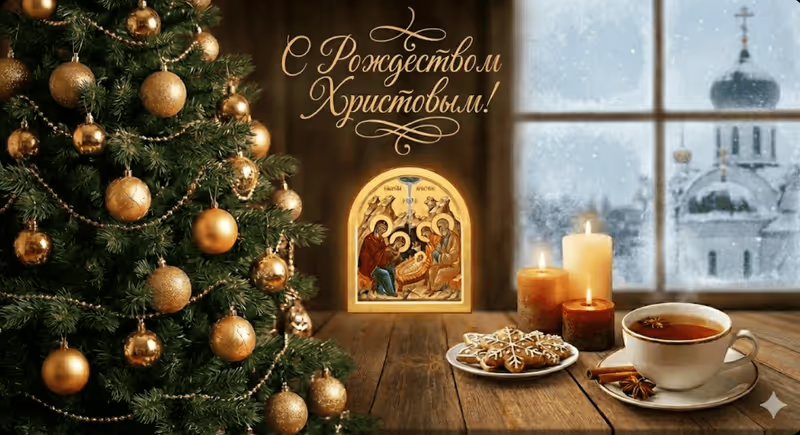
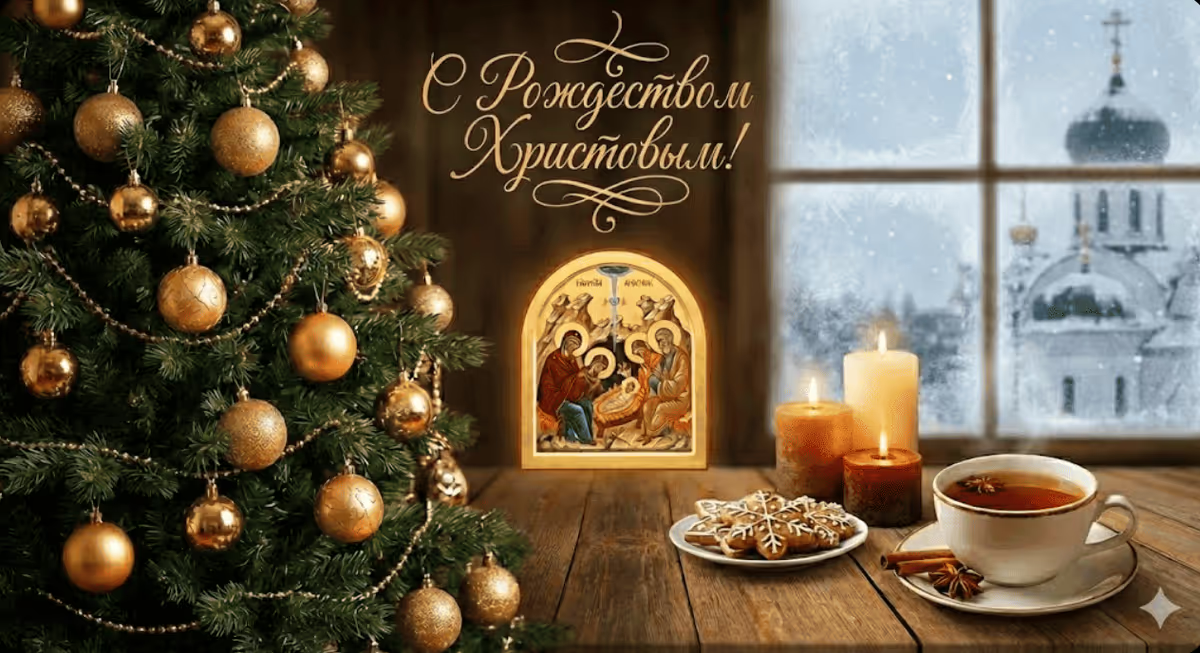
Christmas Eve, called Sotchelnik (Сочéльник), imposes a strict fast until the appearance of the first star in the night sky — that star which recalls the Star of Bethlehem. Tables are then covered with hay beneath a white tablecloth, a direct evocation of the manger where Christ was born. The first dish served, which is mandatory, is sochivo (со́чиво) or kutya (кутья́): boiled wheat grains mixed with honey, poppy seeds, nuts, and dried fruit. This ritual dish, whose name comes from the Russian word “sok” (juice), opens a meal of twelve Lenten dishes — one for each apostle.
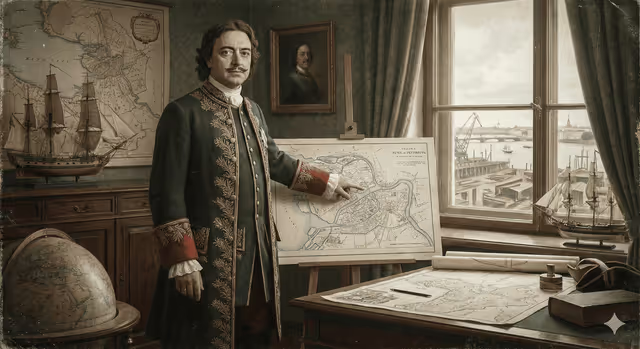
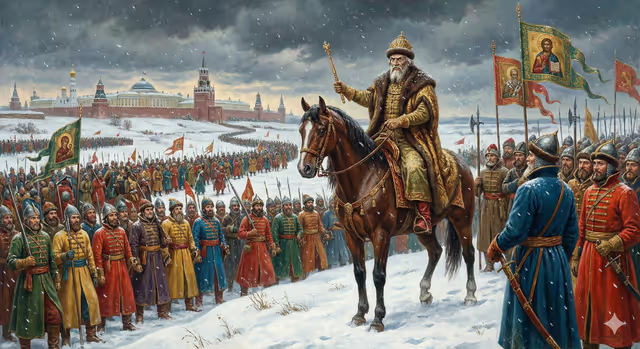
Peter the Great, at the beginning of the 18th century, had already imposed an initial modernization: he fixed New Year’s Day to January 1st in 1700, in the European fashion, breaking with the tradition that celebrated it in September. But Christmas retained its religious and festive primacy. In palaces as in peasant huts, the night of January 6th to 7th resounded with sacred songs. The Koliadki (Коля́дки), traditional songs inherited from pagan times, saw costumed groups going from house to house, carrying a star atop a pole and wishing health and prosperity to the inhabitants. Failing to receive them brought bad luck.
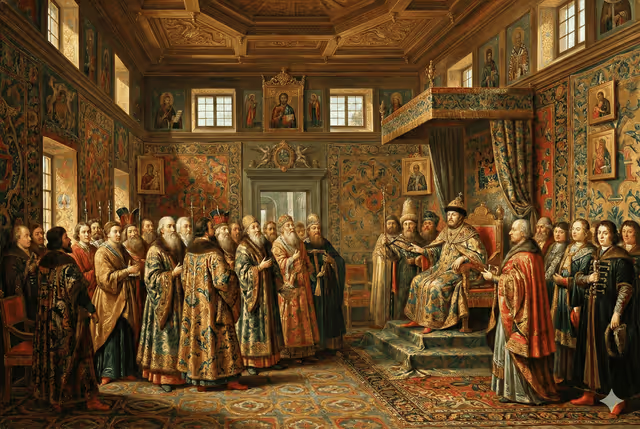
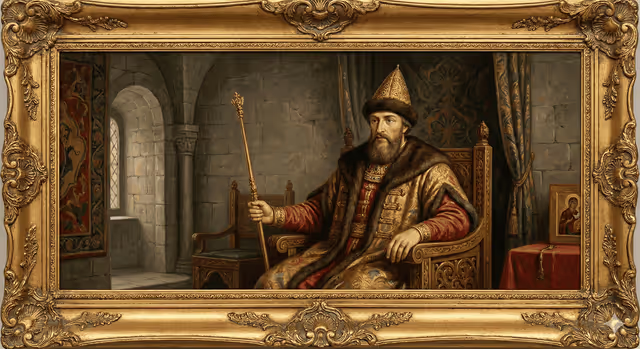
The Tsar himself participated in these traditions. Nicholas II, the last emperor, personally distributed alms on Christmas Eve, visiting prisons and hospices. The Christmas tree, imported from Germany by the Germanic communities of Saint Petersburg in the mid-19th century, gradually spread throughout the empire. By the end of the century, decorating a fir tree for Christmas had become an established custom among well-to-do urban families, even though the tree remained associated with death in traditional peasant imagination.
The Revolution Shatters the Icons
February 1917: the monarchy collapses. October 1917: the Bolsheviks seize power. In January 1918, Vladimir Lenin imposes the Gregorian calendar on Soviet Russia for pragmatic reasons — international trade, diplomatic relations. Overnight, thirteen days vanish from the civil calendar. January 31st becomes February 14th.
But the Russian Orthodox Church refuses this change. For it, adopting the Gregorian calendar would mean yielding to the power that persecutes it. It keeps the Julian calendar. The mechanical result: December 25th Julian now falls on January 7th Gregorian. Christmas finds itself after the civil New Year — a reversed order that persists to this day.
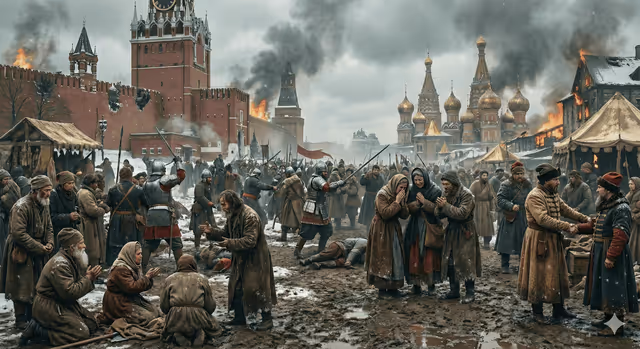
This calendrical inversion suits the Bolsheviks. New Year’s Day moves ahead of Christmas. Better still: in 1929, Joseph Stalin intensifies his anti-religious campaign. He outright bans the celebration of Christmas and abolishes the January 7th public holiday. Henceforth, it is an ordinary workday. Those who stubbornly celebrate in secret risk their jobs, or even their freedom.
The regime deploys formidable creativity to eradicate the Christian holiday. Carnivals by young Komsomol communists mock religious beliefs. “Anti-religious Christmas trees” are organized with satirical decorations. The state invents its own “Red holidays” to replace the liturgical calendar. For decades, millions of Russians celebrate Christmas in secret, in fear and silence.
In 1935, a strategic reversal occurs. Soviet power rehabilitates… the fir tree and gift-giving, but for New Year’s. Ded Moroz (Дед Моро́з), Grandfather Frost, a traditional character from winter folklore, is secularized and transformed into the Soviet equivalent of Santa Claus. He now arrives on December 31st, accompanied by his granddaughter Snegurochka (Снегу́рочка), the Snow Maiden. The attributes of Christmas — the fir tree, gifts, family festivities — migrate to New Year’s. In 1947, January 1st officially becomes a public holiday. The substitution is complete.
The Orthodox Renaissance
December 1991: the Soviet Union disintegrates. For the first time in sixty-two years, Russians can celebrate Christmas openly. Churches, closed for decades, reopen their doors. The Cathedral of Christ the Saviour in Moscow, dynamited on Stalin’s orders in 1931, is rebuilt in the 1990s. On the night of January 6th to 7th, 1992, crowds throng into churches for the Nativity service.
The Patriarch of Moscow celebrates the midnight office before television cameras — a spectacle unthinkable just a few years earlier. Nativity icons reclaim their place on the iconostases. The Nativity Fast, never entirely forgotten by clandestine believers, becomes a visible practice once more. For forty days, the faithful abstain from meat and dairy products, thus preparing their body and spirit to welcome the coming of Christ.
Today, Orthodox Christmas remains above all a religious holiday. Unlike Western Christmas, which has become largely commercial, the Russian January 7th retains a sacred character. Liturgical services multiply from the eve: the Royal Hours, Vespers, the Divine Liturgy. Some faithful attend the all-night vigil, then the Nativity Liturgy in the morning. At midnight, a procession circles the church to commemorate the birth of Christ.
After the service, families return home for the Sacred Supper that concludes the fast. The twelve Lenten dishes appear: kutya, vegetable soups, beets, dried mushrooms, fish, blinis, Lenten bread. No meat, no dairy. The meal begins only after the first star has been seen — a tradition maintained for centuries. For the vast majority of non-practicing Russians, January 7th remains simply an additional day off within the ten public holidays running from January 1st to 10th.
Traditions That Endure
Russian Christmas does not end on January 7th. It opens a twelve-day period called Sviatki (Свя́тки), which extends until January 19th, the day of Theophany or the Baptism of Christ (Богоявлéние). These twelve days intimately blend Christian traditions and pagan survivals, testifying to the historical depth of Russian customs.
Koliadovanie (Колядовáние), the door-to-door caroling, persists in villages and certain urban neighborhoods. In costume, groups go from house to house singing Koliadki, those songs of unknown authorship transmitted orally for centuries. They wish happiness and prosperity, symbolically driving away demons. In exchange, inhabitants offer money, pirogis, or gingerbread.
Divination occupies an important place during Sviatki. This period is considered auspicious for questioning the future, particularly for young women seeking to know their future husband. Methods vary: some throw their boot outside on the evening of January 6th — if the toe points outward, marriage will come within the year. Others lean over mirrors by candlelight, hoping to glimpse the face of their future husband. These practices, officially condemned by the Church as pagan superstitions, continue to fascinate.
Sviatki concludes on January 19th with Theophany, which commemorates the baptism of Christ in the Jordan. On this day, thousands of Russians plunge into holes cut in the ice of rivers and lakes — the jordan (Иорда́н) — to purify themselves in blessed water. Despite temperatures often below minus twenty degrees, this tradition attracts growing crowds each year.
January 13th brings another calendrical curiosity: the Old New Year (Ста́рый Но́вый год). This is the Julian New Year, the one the Orthodox Church celebrates according to its own calendar. Falling between January 13th and 14th of the Gregorian calendar, this semi-official holiday combines secular New Year traditions with Sviatki customs. Koliadki are sung again, divination is practiced, families gather around lavish tables. The Old New Year is not an official holiday, but many Russians celebrate it as a final farewell to the winter festivities.
The Old Believers and the Calendar Question
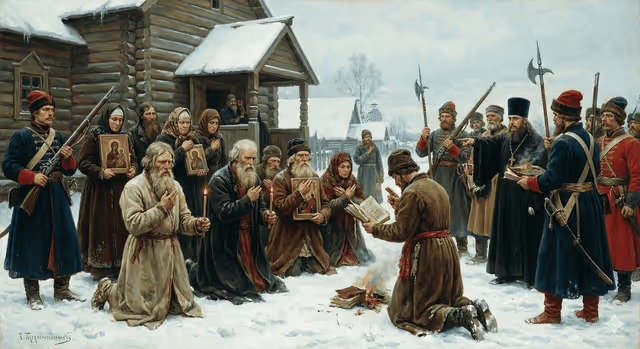
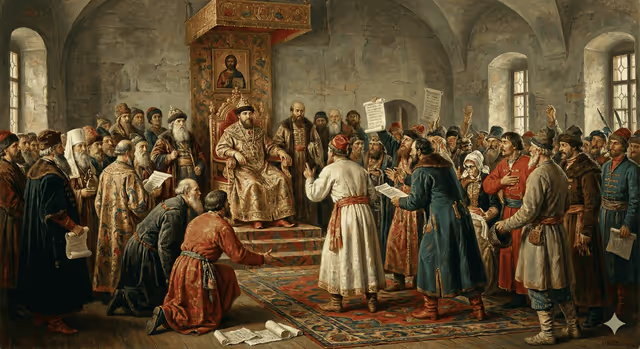
The Old Believers (старообря́дцы) deserve special mention in the history of Russian Christmas. Emerging from the Raskol (Раско́л), the great schism of 1666–1667, they rejected the liturgical reforms imposed by Patriarch Nikon — making the sign of the cross with three fingers instead of two, singing the alleluia three times instead of two, modified prostrations. Persecuted, they fled into the forests of the North, to Siberia, to Poland. Some were burned alive, like Archpriest Avvakum in 1682; they considered themselves the guardians of the “true faith” against a corrupted Church.
But contrary to what one might imagine, the Old Believers celebrate Christmas on exactly the same date as the official Orthodox Church: January 7th of the Gregorian calendar, which is December 25th of the Julian calendar. The reason is simple: the 1666 schism concerned liturgical rites, not the calendar. At that time, all of Russia — the official Church and dissidents alike — lived according to the Julian calendar. It was only two and a half centuries later, in 1918, that Lenin imposed the Gregorian calendar on civil Russia. When this change occurred, the official Orthodox Church and the Old Believers reacted in exactly the same way: they both refused to adopt this “new calendar” imposed by an atheist regime.
Thus, Old Believers and official Orthodox Christians today share the same Julian liturgical calendar and celebrate Christmas on the same day. Their differences remain ritual: in Old Believer churches, they still make the sign of the cross with two fingers, prostrate themselves to the ground, and sing the alleluia twice. But the kutya is served at the same hour, after the appearance of the first star, and Nativity icons shine in their churches just as they do in those of the Moscow Patriarchate.
The Persistence of a Dual Temporality
The Russian Orthodox Church still refuses to adopt the Gregorian calendar, unlike certain other Orthodox Churches such as Greece’s. The debate resurfaces periodically. In 1982, a preparatory document for the 2016 Pan-Orthodox Council proposed the adoption of the “new calendar,” acknowledging that it was astronomically more precise than the Julian one. The Russian, Serbian, and Jerusalem Churches firmly opposed this, citing pastoral difficulties and the faithful’s attachment to tradition.
The Ukrainian Orthodox Church, in a gesture as political as it was religious, authorized its communities in October 2023 to celebrate Christmas on December 25th if they wished — a way of distancing itself from the Moscow Patriarchate, perceived as an ally of the Kremlin. For Russians, however, January 7th remains a strong identity marker.
This persistence of the Julian calendar creates paradoxes. The Council of Nicaea, in 325, had established rules so that Easter would be celebrated after the Jewish Passover. Yet the Julian calendar no longer respects this rule, as the astronomical discrepancy has increased over the centuries. Despite these technical inconsistencies, the emotional force of tradition prevails over calendrical rationality.
The result is a Russia that lives a dual winter temporality: a secular, festive, family-oriented New Year on January 1st, with Ded Moroz and Snegurochka distributing gifts under the fir tree; then a religious, austere, and contemplative Christmas on January 7th, marked by fasting, the midnight service, and the ritual twelve-dish meal. Between the two, ten public holidays during which the country goes into hibernation, extending a festive atmosphere that dates back to the imperial era.
This unique configuration, the product of the turbulent history of 20th-century Russia, makes Orthodox Christmas far more than a religious celebration. It is an act of cultural resistance, a thread stretched between the imperial past and the post-Soviet present, a moment when contemporary Russia touches the millennial continuity of its Orthodox identity, beyond the political ruptures that have marked its recent history.