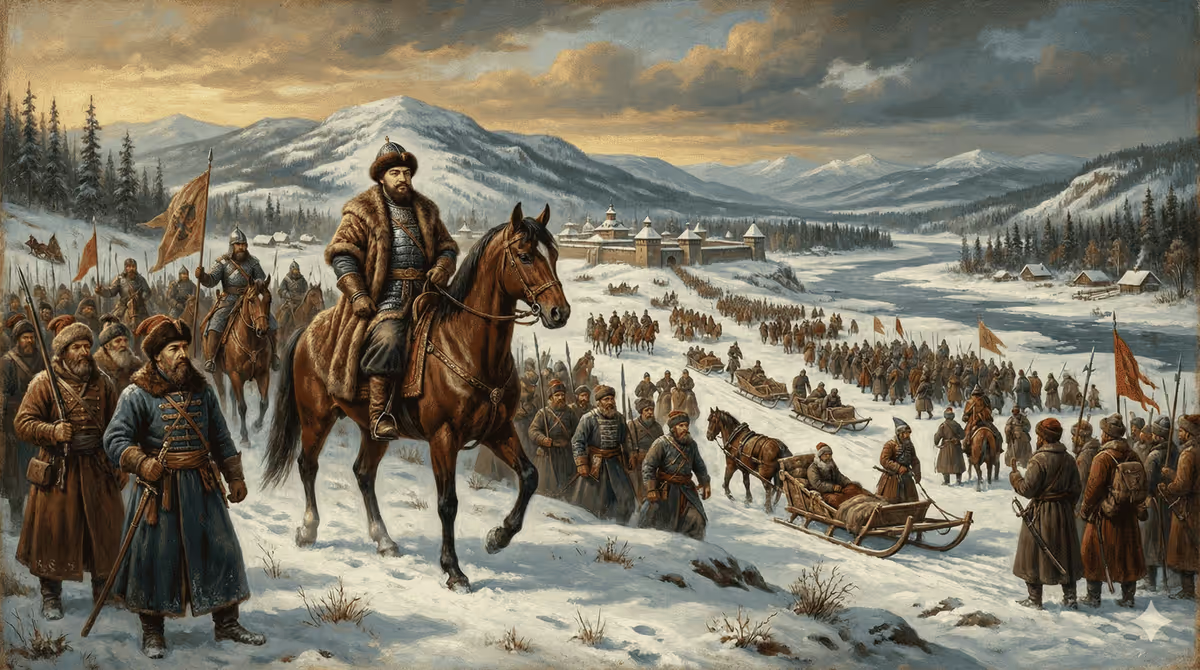
Alexis I the Most Serene: Russian expansion (1645–1676)
The paradox of the serene tsar
How can a sovereign nicknamed “the Most Serene” preside over thirty years of incessant wars, massive territorial conquests and internal upheavals? Alexis Mikhailovich (Алексе́й Миха́йлович), the second tsar of the Romanov dynasty, bears a nickname that seems to contradict his reign.
The Russian word Tishayshiy (Тиша́йший) literally means “the most quiet”, but also designates a spiritual quality, a gentleness of character that by no means excludes political firmness. In 1645, when this sixteen-year-old mounted the throne, Russia was just emerging from the traumas of the Time of Troubles. His father, Mikhail Romanov, had restored order, but the empire remained fragile, encircled by enemies, contested from within. Alexis inherited a state to rebuild and chose two paths to assert his power: expansion to the East, into the Siberian vastness, and confrontation with Poland-Lithuania to the West.
A fragile empire in the hands of an adolescent
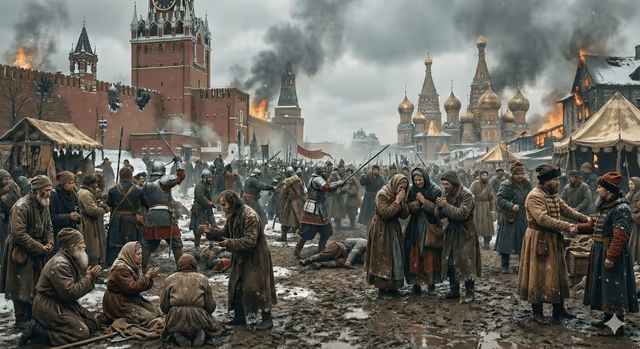
On 13 July 1645, Alexis Mikhailovich became tsar at his father’s death. He was only sixteen. Around him, a court divided between boyars (traditional nobles) and new men competed for power. The young sovereign chose as his mentor Boris Ivanovich Morozov (Бори́с Ива́нович Морóзов), a cultivated boyar who dominated the early years of the reign. Morozov immediately launched fiscal reforms to replenish the coffers exhausted by decades of civil war. He raised taxes on salt, an essential commodity for preserving food in a country of harsh winters. In 1648, anger erupted. In Moscow, a crowd invaded the Kremlin, demanding the heads of Morozov and his allies. The rioters set fire to entire districts of the capital. Alexis had to hand over several of his advisers to popular fury in order to save Morozov, whom he discreetly exiled.
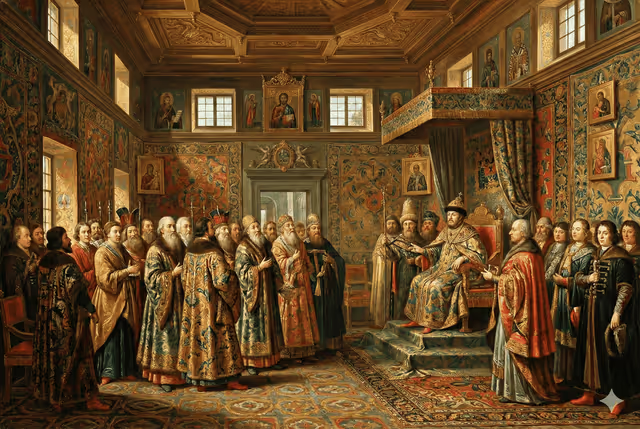
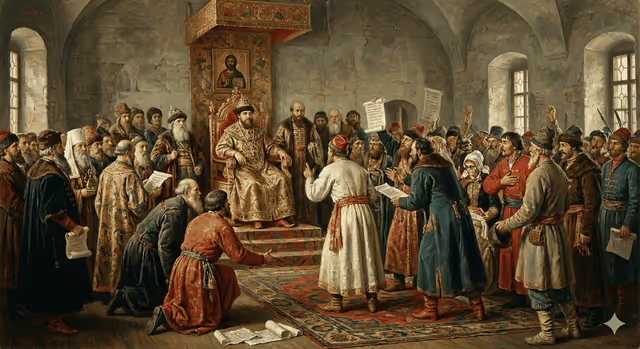
This crisis revealed the fragility of tsarist power. To calm tensions and contestation, Alexis convoked in 1648 a Zemsky Sobor (Земский собóр), a consultative assembly bringing together representatives of the nobility, clergy, merchants and even some cities. The objective: to draft a new code of laws. In January 1649, the Sobornoye Ulozheniye (Собóрное уложéние) was promulgated. This text of nearly a thousand articles fixed the legal structures of the empire for two centuries. Above all, it codified serfdom: peasants were henceforth permanently bound to the land and to their lord. Fugitives could be searched for without time limit. The code froze Russian society in a rigid hierarchy, but gave the tsar the legal tools to govern his immense territory.
The march eastward: conquering Siberia
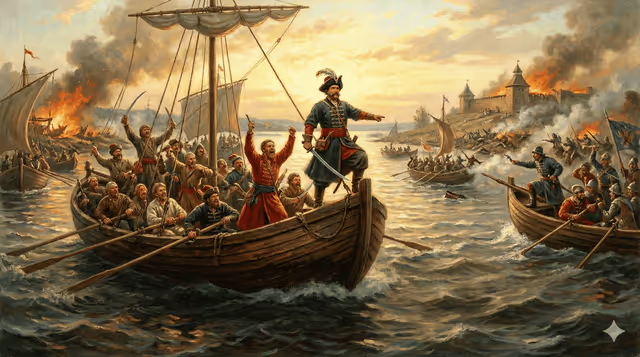
While Alexis consolidated his power in Moscow, men armed with muskets and dreams of fortune were pursuing the conquest of Siberia, launched since the reign of Ivan the Terrible. These Cossacks and merchant-adventurers sought one thing: furs. Sable, ermine and silver fox were worth their weight in gold on European markets. Each year, expeditions ascended the Siberian rivers, founded ostrogi (острóги) — those wooden palisaded forts that became so many anchoring points of Russian authority.
In 1648, the Cossack Semyon Dezhnev (Семён Дежнёв) crossed the strait separating Asia from America, without even knowing it. He was simply looking for a passage to still-virgin hunting grounds. His exploit would not be recognised until a century later, when the strait would bear another explorer’s name. In 1652, Yerofei Khabarov (Ерофе́й Хабáров) descended the Amur River with a band of Cossacks, seized Daur villages and clashed with Qing empire troops. These skirmishes at the edge of the world triggered a diplomatic conflict with China. Beijing protested against these intrusions. Alexis preferred to temporise: Siberia could wait — the priority lay to the West.
The Siberian conquest under Alexis was not an enterprise planned from Moscow. The central government merely registered the conquests, appointed voivodes (воево́ды) — military governors — in the new forts, and above all collected the yasak (ясáк), the fur tribute imposed on local populations. The Yakuts, Buryats and Tungus were compelled to deliver their finest pelts. Some resisted, others collaborated, becoming intermediaries between the empire and their neighbours. By 1676, at Alexis’s death, Russia stretched to the Pacific. This colossal expansion had taken place almost without the tsar’s direct intervention, driven by the profit motive of thousands of adventurers.
The Thirteen Years’ War against Poland-Lithuania
But it was to the West that the true destiny of Alexis’s reign played out. In 1648, the Cossacks of Ukraine, led by Bohdan Khmelnytsky (Богда́н Хмельни́цкий), revolted against Polish domination. Khmelnytsky, a military leader of the Zaporozhian Cossacks, inflicted defeat after defeat on Polish armies. But he knew that his small Cossack state could not survive alone. He was looking for a protector. In 1653, he sent an embassy to Moscow, offering the allegiance of Ukraine to the tsar. Alexis hesitated. Accepting meant war with Poland-Lithuania, a formidable power that had occupied Moscow only a few decades earlier. Refusing meant abandoning Orthodox brothers to the hands of Catholic lords.
On 1 October 1653, a new Zemsky Sobor convened in Moscow. Boyars, bishops and merchants debated for weeks. Finally, the decision fell: Russia accepted the protection of the Cossacks of Ukraine. In January 1654, at Pereyaslav, Khmelnytsky and his officers swore allegiance to the tsar. This Rada (Рáда, assembly) of Pereyaslav marked Ukraine’s entry into the Russian orbit. Historians still debate the exact meaning of this act: a simple protectorate or definitive annexation? The Cossacks believed they were retaining their autonomy; Alexis saw it as permanent submission.
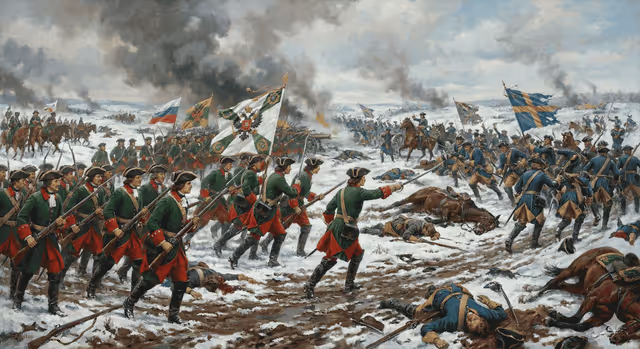
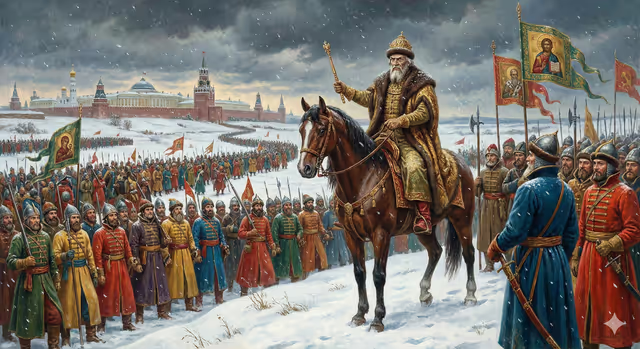
War broke out immediately. Russian armies invaded the territories under Polish control. In 1654, Smolensk, lost in 1611, was retaken after a three-month siege. Alexis entered the city in triumph. The following year, Russian troops took Vilnius, the capital of Lithuania. Victory seemed total. But Poland resisted. Sweden, seeing Poland weakened, invaded Polish lands in turn. Alexis had to juggle multiple enemies. In 1656, he turned against Sweden, attempting to seize the Baltic ports that would give Russia access to the sea. The siege of Riga failed. The war bogged down.
In Ukraine, the situation grew complicated. Khmelnytsky died in 1657. His successors fell out with each other. Some leaned toward Poland, others toward Russia, others still dreamed of full independence. Ukraine became a permanent battlefield where Poles, Russians, Cossacks, Crimean Tatars and Turks clashed in a bloody chaos. Villages burned, populations fled or were massacred. The Cossacks changed allegiances according to circumstances. Alexis had to send army after army to maintain a precarious authority.
The turning point came in 1667. After thirteen years of war, Russia and Poland signed the Truce of Andrusovo (Андрýсово). Russia kept Smolensk, Seversk and above all the left bank of the Dnieper with Kiev, officially for only two years. In reality, Kiev would never be returned. Poland kept the right bank. Ukraine was cut in two. This partition would last for decades, each bank evolving differently. For Alexis, it was a major diplomatic victory: Russia recovered territories lost since the Time of Troubles and established itself as protector of the Orthodox.
Governing an empire in turmoil
During these wars, Alexis had to manage domestic crises. In 1662, a new revolt erupted in Moscow. The government had issued copper coins to finance the war, triggering runaway inflation. The people rose up, marched on the tsar’s summer palace at Kolomenskoye. Alexis came out to meet them, promised reforms. But as soon as the crowd withdrew, he had the ringleaders massacred. Hundreds of Muscovites were hanged or exiled. The serene tsar knew how to be ruthless when his power was threatened.
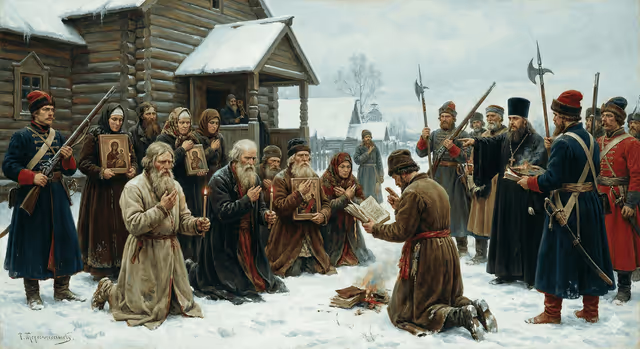
The great crisis of the reign, however, remained the Raskol (Раско́л, the Schism). Patriarch Nikon (Никóн), appointed in 1652 with Alexis’s support, undertook to reform Orthodox rituals to align them with Greek practices. He changed the way of making the sign of the cross, modified certain liturgical formulas, and corrected the holy books. For believers attached to old traditions, these changes were a betrayal. A group of priests and believers, led by Archpriest Avvakum, refused the reforms. They became the Old Believers. Alexis initially supported Nikon, then opposed him on questions of power. Nikon wanted the Church to dominate temporal power. In 1666, a council deposed Nikon but maintained his reforms. The Old Believers were persecuted. Avvakum would end up burned alive in 1682. Thousands of believers fled to the borders of the empire, refusing to submit.
Alexis had a passion for Western innovations. He invited foreign craftsmen, doctors and engineers. In Moscow, an entire quarter, the Nemetskaya Sloboda (Немéцкая слободá, the German Quarter), housed these foreigners. Young Peter, Alexis’s son, would spend his childhood there and draw from it his love of the West. The tsar created a court theatre, attended plays performed by German actors. He reorganised the army on the European model, trained by foreign officers.
The legacy of a contradictory reign
Alexis died on 8 February 1676, at forty-seven. He left a considerably enlarged empire: Siberia to the Pacific, left-bank Ukraine, Smolensk reconquered. The population had grown, fiscal resources had developed through the fur trade and agricultural expansion southward. But this empire remained fragile, crossed by religious tensions, shaken by popular revolts, structured by an increasingly oppressive serfdom.
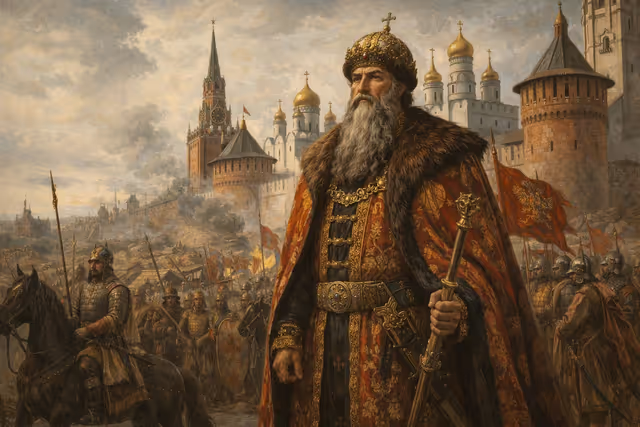
The nickname “Most Serene” reflected less his reign’s character than his personal piety, his Orthodox devotion, his reputation as an accessible and fair sovereign. Contemporaries described him as a cultivated man who spoke several languages and had a passion for books and music. He also knew how to be cruel when necessary, crushing revolts without mercy. His son Fyodor succeeded him, then his other son Peter would radically transform the empire. But the foundations laid by Alexis — territorial expansion, cautious openness to the West, the legal consolidation through the 1649 code — structured Russia for the following century. Between Siberian steppes and Ukrainian plains, between Orthodox tradition and foreign innovations, the reign of Alexis I embodied the contradictions of an empire at the crossroads.