Russian for advanced beginners (A2): master the six cases and core verbs
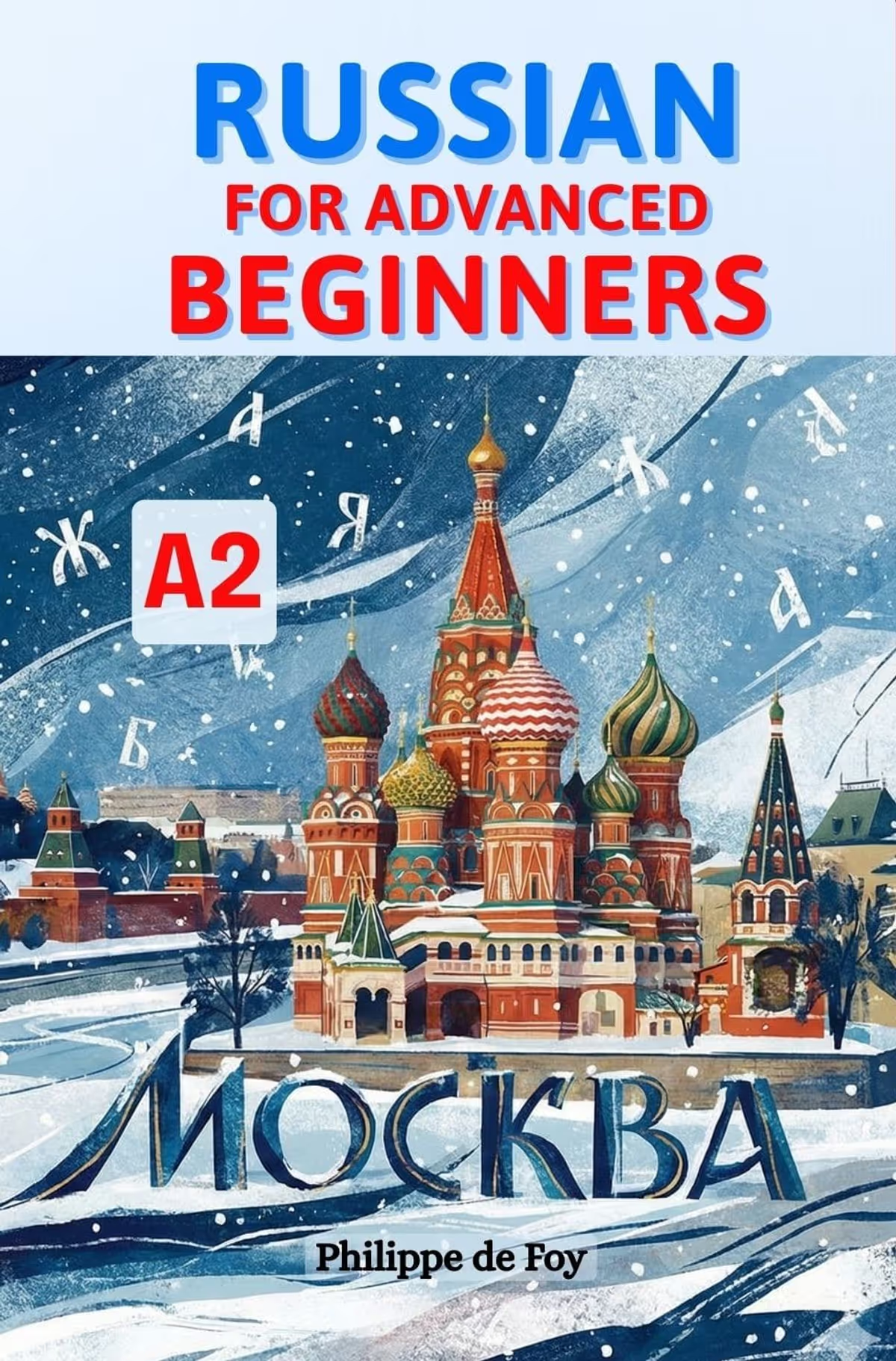
Learning Russian is one of the most rewarding linguistic challenges you can take on, and getting past the absolute basics is where many learners hit a wall. That’s exactly what my new book, Russian for Advanced Beginners (Level A2): Master the Six Russian Cases and Core Verbs with Ease, is designed for. It continues directly from where the A1 volume left off, guiding you step by step through the grammatical structures that will unlock the Russian language for you.
Who is this book for?
This book is for anyone who already knows the Cyrillic alphabet and has a basic grasp of Russian grammar — a present tense conjugation, a handful of vocabulary words, perhaps some simple sentences. If that sounds like you, you’re ready for A2 level (according to the European language proficiency standards). You don’t need to have used the A1 volume specifically; any solid beginner foundation will do.
The approach throughout is the same as in the first volume: clear rules, gradual progression, and plenty of exercises with answer keys so you can work independently.
What you will learn
The core of the book is the Russian case system. Russian has six grammatical cases, and each one changes the endings of nouns, adjectives, and pronouns depending on their role in the sentence. This might sound intimidating, but with the right method, the logic becomes clear quickly.
The nominative plural
The nominative plural is where the book starts, teaching you how to form the plural of Russian nouns across all genders, including irregular forms and the spelling rules that govern certain endings.
In Russian, the plural endings vary depending on the gender of the noun and whether it follows certain spelling rules. For masculine nouns, you’ll typically add -ы or -и (e.g., студе́нт → студе́нты, музе́й → музе́и). Feminine nouns often change -а to -ы or -я to -и (e.g., кни́га → кни́ги, неде́ля → неде́ли). Neuter nouns typically change -о to -а or -е to -я (e.g., окно́ → о́кна, мо́ре → моря́).
Understanding these patterns and the exceptions is crucial before diving into the case system, as you’ll need to decline both singular and plural forms across all six cases.
The accusative case
The accusative case introduces the all-important animate/inanimate distinction: in Russian, whether a noun refers to a living being or an object determines which ending it takes as a direct object. Mastering this distinction is essential for building correct sentences.
For inanimate masculine and neuter nouns, the accusative looks identical to the nominative: Я ви́жу дом (I see a house) uses the same form as Дом большо́й (The house is big). But for animate masculine nouns, the accusative matches the genitive case: Я ви́жу студе́нта (I see a student), where студе́нта takes the genitive ending -а.
Feminine nouns change their endings in the accusative regardless of animacy: -а becomes -у and -я becomes -ю (e.g., кни́га → кни́гу, неде́ля → неде́лю).
This case is used after verbs like ви́деть (to see), знать (to know), люби́ть (to love), чита́ть (to read), and many others that take direct objects.
→ Read more: Accusative case singular in Russian: direct object and movement
The locative case
The locative case (sometimes called the prepositional case) is used to indicate where something is located or about what you are speaking. The book covers its use with the prepositions в and на for place, and о/об for topics of conversation.
The endings are fairly straightforward: most masculine and neuter nouns take -е (в до́ме - in the house, в окне́ - in the window), while feminine nouns in -а change to -е (в шко́ле - in school). Feminine nouns ending in -я or -ь typically take -и (в Росси́и - in Russia, в тетра́ди - in the notebook).
One important distinction to learn is when to use в versus на. Generally, в means “in/inside” and на means “on/at,” but certain locations idiomatically require на even when you’d expect в (e.g., на рабо́те - at work, на заво́де - at the factory, на ста́нции - at the station).
→ Read more: Prepositional case singular in Russian: location and topic
The genitive case
The genitive case is the most versatile of all. You will learn to express possession (the equivalent of ‘s in English), absence and negation, quantities, and origins. The genitive is also required after many common prepositions such as у, до, из, без, and для, all of which are covered with examples.
For possession, Russian doesn’t use an equivalent of “to have.” Instead, you use the genitive with the preposition у: У меня́ есть кни́га (literally “At me there is a book” = I have a book).
The genitive is essential for expressing negation: Здесь нет студе́нта (There is no student here) uses the genitive студе́нта instead of the nominative. It’s also used with quantities: два студе́нта (two students), ма́ло вре́мени (little time), мно́го люде́й (many people).
Typical endings include -а/-я for masculine and neuter singular (студе́нт → студе́нта, окно́ → окна́), -ы/-и for feminine singular (кни́га → кни́ги, неде́ля → неде́ли), and various plural endings that require careful study.
→ Read more: Genitive case singular in Russian: possession, negation and quantity
The dative case
The dative case expresses the indirect object — the person to whom something is given, said, or shown. It also appears in impersonal constructions used to express feelings, necessity, or age, which are among the most natural and frequently used structures in everyday Russian.
The dative answers the question “to whom?” or “for whom?”: Я даю́ кни́гу студе́нту (I give a book to the student). Common verbs that require the dative include дава́ть/дать (to give), помога́ть/помо́чь (to help), звони́ть/позвони́ть (to call), писа́ть/написа́ть (to write).
Impersonal constructions with the dative are particularly important: Мне хо́лодно (I’m cold - literally “To me it is cold”), Ему́ ну́жно рабо́тать (He needs to work), Ей три́дцать лет (She is thirty years old - literally “To her are thirty years”).
Typical endings include -у/-ю for masculine and neuter singular (студе́нт → студе́нту, окно́ → окну́), and -е/-и for feminine singular (кни́га → кни́ге, неде́ля → неде́ле).
→ Read more: Dative case singular in Russian: indirect object and recipient
The instrumental case
The instrumental case covers the means by which something is done, accompaniment, and professions or roles. It appears after the prepositions с (with), за, пе́ред, под, над, and ме́жду, and is also used to describe what someone works as.
The instrumental indicates the instrument or means: Он пи́шет ру́чкой (He writes with a pen). It’s used for accompaniment: Я иду́ с дру́гом (I’m going with a friend). It describes professions with the verb быть (to be): Он рабо́тает инжене́ром (He works as an engineer), Она́ ста́ла врачо́м (She became a doctor).
Typical endings include -ом/-ем for masculine and neuter singular (студе́нт → студе́нтом, окно́ → окно́м), -ой/-ей for feminine singular (кни́га → кни́гой, неде́ля → неде́лей), and -ами/-ями for plural across all genders.
→ Read more: Instrumental case singular in Russian: means and accompaniment
Adjective agreement
Throughout these lessons, adjective agreement is treated in parallel with the nouns, so you learn how adjectives change alongside the words they describe. The interrogative adjective како́й (what kind of, which) is also declined in full across all cases, giving you a practical and frequently used model to work with.
Russian adjectives must agree with the nouns they modify in gender, number, and case. This means that if you learn the six cases for nouns, you must also learn six corresponding sets of adjective endings. For example, но́вый (new) becomes но́вого in the genitive masculine/neuter, но́вому in the dative, но́вым in the instrumental, and so on.
The good news is that adjective endings follow regular patterns, and once you master them, you can apply them to thousands of descriptive words.
Verbal aspect: a concept unique to Russian
One chapter that students often find both challenging and fascinating is the one on verbal aspect. In Russian, almost every verb exists in two versions: the imperfective aspect, used for ongoing, habitual, or repeated actions, and the perfective aspect, used for completed, one-time, or result-oriented actions. There is no direct equivalent of this distinction in English or French, and learning to use it correctly is one of the defining milestones of Russian fluency.
Consider the verbs чита́ть (imperfective) and прочита́ть (perfective), both meaning “to read.” If you say Я чита́л кни́гу (imperfective), it means “I was reading a book” or “I used to read a book” — the focus is on the process. But Я прочита́л кни́гу (perfective) means “I read (and finished) the book” — the focus is on the completed result.
This distinction affects how you describe past events, make requests, give instructions, and talk about future plans. The book explains the concept clearly and provides aspectual pairs with exercises to help you internalize the difference. You’ll learn common perfective prefixes like по-, про-, вы-, на-, за-, and с-, and how they sometimes change the meaning of the base verb.
For example:
- писа́ть/написа́ть (to write/to write and finish)
- де́лать/сде́лать (to do/to complete doing)
- говори́ть/сказа́ть (to speak/to say something specific)
- покупа́ть/купи́ть (to buy habitually/to buy once)
Verbs of motion: going, running, swimming, carrying
Perhaps the most uniquely Russian topic in the book is the chapter on verbs of motion. Russian makes systematic distinctions that other languages simply don’t: going on foot versus going by vehicle, a single directional trip versus habitual or back-and-forth movement, and the moment of departure versus the ongoing journey. These distinctions apply not only to walking and driving, but also to running, swimming, flying, carrying objects by hand, leading someone, transporting something by vehicle, and even rolling.
The most fundamental pair is идти́/ходи́ть (to go on foot). Идти́ is unidirectional — you’re going somewhere right now in one direction: Я иду́ в магази́н (I’m going to the store). Ходи́ть is multidirectional or habitual — you go places regularly or you went and came back: Я ча́сто хожу́ в магази́н (I often go to the store), Вчера́ я ходи́л в магази́н (Yesterday I went to the store [and came back]).
Similarly, е́хать/е́здить work the same way for going by vehicle: Я е́ду на рабо́ту (I’m going to work [right now, by car/bus/etc.]) versus Я е́зжу на рабо́ту ка́ждый день (I go to work every day).
Each pair of verbs is explained with its conjugation and illustrated with practical examples:
- бежа́ть/бе́гать (to run)
- лете́ть/лета́ть (to fly)
- плыть/пла́вать (to swim, to sail)
- нести́/носи́ть (to carry by hand)
- вести́/води́ть (to lead, to drive)
- везти́/вози́ть (to transport by vehicle)
The book also introduces prefixed verbs of motion like прийти́/приходи́ть (to arrive on foot), уйти́/уходи́ть (to leave on foot), войти́/входи́ть (to enter), вы́йти/выходи́ть (to exit), which add directional meaning to the base verbs.
Understanding verbs of motion is essential for describing everyday activities, and while it takes time to master, the systematic nature of these verbs makes them learnable with practice.
The imperative mood
The final major topic is the imperative mood, used to give orders, make polite requests, offer advice, extend invitations, and express prohibitions. The book covers all three forms — the familiar singular, the formal or plural form, and the collective “let’s” form — along with the most common polite expressions and fixed phrases you will encounter in daily life.
The imperative is formed from the verb stem. For the familiar singular (ты), you typically add -й, -и, or -ь depending on the verb: чита́й (read!), пиши́ (write!), говори́ (speak!). For the formal or plural (вы), add -йте, -ите, or -ьте: чита́йте, пиши́те, говори́те.
The “let’s” form uses дава́й/дава́йте plus the infinitive (imperfective) or the first person plural (perfective): Дава́й чита́ть (Let’s read [in general]), Дава́йте прочита́ем э́ту кни́гу (Let’s read this book [and finish it]).
Common polite imperatives include:
- Скажи́те, пожа́луйста (Tell me, please)
- Повтори́те, пожа́луйста (Repeat, please)
- Помоги́те мне (Help me)
- Не беспоко́йтесь (Don’t worry)
For prohibitions, use не plus the imperfective imperative: Не говори́ (Don’t speak), Не чита́й (Don’t read).
Structure of the book
Each chapter follows the same reliable structure: a clear grammatical explanation, tables summarizing the rules, examples in Russian with stress marks and translations, and a set of exercises with a full answer key. Stress marks are included on all Russian words of more than one syllable throughout the book, which is essential for pronunciation at this level.
The book also includes thematic vocabulary sections covering topics such as professions, nationalities, everyday objects, family members, activities, and more, so that the grammar is always anchored in real, usable language. You’ll learn not just abstract case endings, but how to say things like “I work as a teacher,” “I’m going to my friend’s house,” “I bought bread and milk,” and “I need to call my mother.”
Part of a complete series
This volume is part of a growing series designed to take learners from zero to an increasingly confident command of Russian. You can find the full series here: Russian Language Learning Series on Amazon.
If you’re just starting out, the A1 volume will introduce you to the alphabet, basic pronunciation, first conjugations, and the fundamentals of Russian sentence structure before you move on to the cases covered here.
Ready to take your Russian further?
Whether you are learning for travel, culture, family, or the sheer pleasure of it, this book gives you the solid grammatical foundation that Russian requires. The case system and verbal aspect are the two pillars on which everything else rests, and once they click, Russian opens up considerably.
The A2 level is where Russian truly starts to feel like a real language you can use, rather than a collection of rules and tables. With the six cases at your command, you’ll be able to express possession, location, direction, purpose, and relationships between ideas with precision and confidence. Add verbal aspect to the mix, and you can talk about actions with the same nuance that native speakers use.
Get your copy of Russian for Advanced Beginners (A2) on Amazon
Whether you work through it page by page or use it as a reference to clarify specific points of grammar, this book is designed to be your companion on the journey from beginner to intermediate Russian. Each chapter builds on the last, and every exercise reinforces what you’ve learned, so that by the end, the six-case system will feel not like an obstacle, but like a natural and logical part of how Russian works.
Related articles
To deepen your understanding of each case covered in the book, explore these detailed guides:
- Russian Cyrillic alphabet: complete guide for beginners — Master the Russian alphabet before starting with cases
- Accusative case singular in Russian: direct object and movement — Complete guide to the accusative case and the animate/inanimate distinction
- Prepositional case singular in Russian: location and topic — Learn to express location with в and на
- Genitive case singular in Russian: possession, negation and quantity — The most versatile case in Russian
- Dative case singular in Russian: indirect object and recipient — Express the indirect object and impersonal constructions
- Instrumental case singular in Russian: means and accompaniment — The case of means, accompaniment, and professions