Catherine II: a German princess who became empress
How a young German woman without fortune became one of the greatest sovereigns of the Russian empire
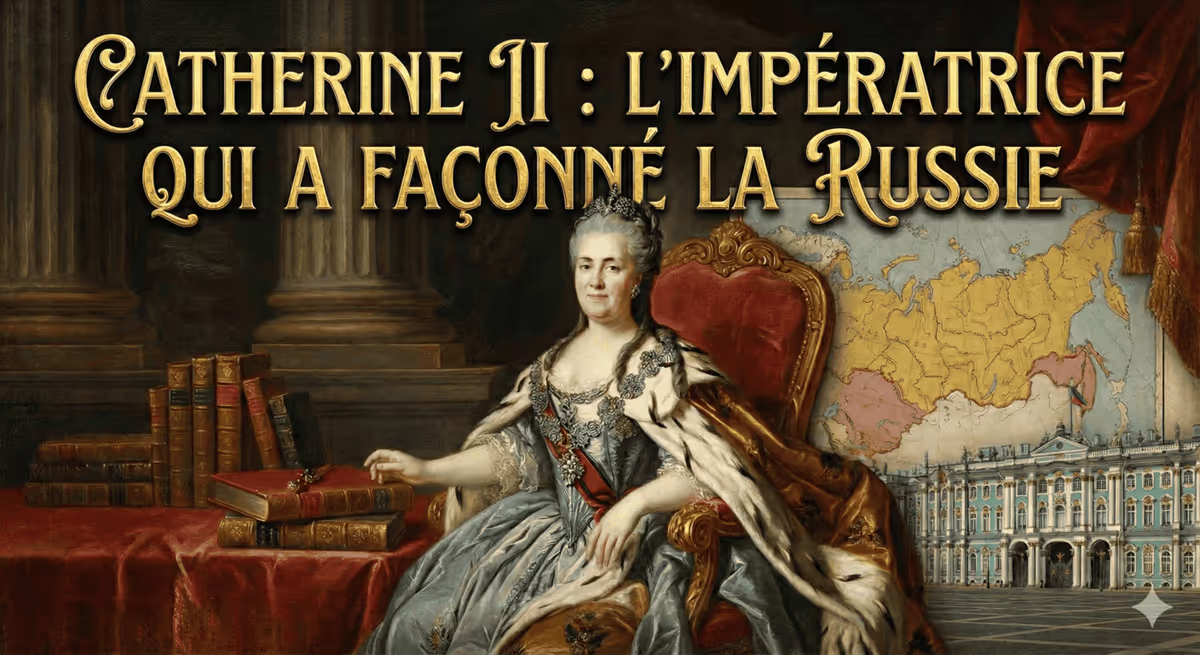
In 1744, a fifteen-year-old girl arrived in Saint Petersburg. Her name was Sophie of Anhalt-Zerbst; she came from a tiny German principality, and her family had neither money nor particular prestige. Thirty-four years later, that same woman ruled the world’s largest empire, corresponded with Voltaire and Diderot, enlarged her territory by 500,000 square kilometres and had herself called Catherine the Great (Екатери́на Вели́кая). How can such a stupefying trajectory be explained? How could a foreigner embody the greatness of Russia to the point of eclipsing almost every Russian-born sovereign? And above all, was she truly that enlightened sovereign admired by Enlightenment Europe, or rather the ruthless despot revealed by a close examination of her reign?
Learning to rule: a German woman transforms herself into a Russian
Sophie Friederike Auguste of Anhalt-Zerbst was born on 21 April 1729 in Stettin, in Prussian Pomerania. Her family belonged to the minor German nobility, with no notable fortune. In 1744, Empress Elizabeth Petrovna (Елизаве́та Петро́вна), daughter of Peter the Great, summoned her to Russia to marry her nephew and heir, Grand Duke Peter Fyodorovich (Пётр Фёдорович). The choice might seem strange: why choose such a modest princess? The reason lay precisely in that modesty. Elizabeth wanted a docile wife for her capricious heir, a young woman without political support who could never threaten the established order.
Sophie understood the stakes immediately. From her very arrival, she launched into a methodical apprenticeship that astonished the court. She studied Russian with such determination that she fell ill from exhaustion after entire nights of revision. She converted to Orthodoxy with an apparent fervour that won over the clergy, taking the name Catherine Alexeyevna (Екатери́на Алексе́евна). Unlike her future husband, who openly displayed his contempt for everything Russian and his admiration for Frederick II’s Prussia, Catherine displayed an ostentatious love for her adopted homeland. She prostrated herself before icons, learned court customs, cultivated relations with the great noble families.
The marriage with Peter took place in 1745. It proved disastrous. Peter, immature and unstable, preferred playing with toy soldiers in his apartments and made no secret of his disdain for his wife. The couple did not consummate the marriage for nearly nine years. Catherine compensated for this humiliation by building a network of allies at court. She read voraciously, corresponded with French philosophers, frequented Saint Petersburg’s intellectual circles. She also took lovers, with a calculated discretion that preserved her reputation while securing political support. In 1754, she finally gave birth to a son, the future Paul I (Па́вел I), whose real paternity remains uncertain.
The coup d’état of 1762: six months to overthrow an emperor
On 25 December 1761, Empress Elizabeth died. Peter III ascended the throne. His six-month reign sufficed to unite against him almost every force in the Russian empire. Peter multiplied disastrous decisions: he signed a hasty peace with Prussia just as Russia was on the verge of winning the Seven Years’ War, thereby humiliating the army that had conquered Berlin. He imposed brutal Germanic reforms that offended the nobility and clergy. He publicly displayed his contempt for Catherine, going so far as to insult her at an official banquet, and spoke openly of repudiating her to marry his mistress Elizabeth Vorontsova.
Catherine observed, listened, waited. Around her formed a group of conspirators: Grigory Orlov, a guards officer and her lover, his brothers also officers, Count Nikita Panin, tutor to her son Paul, and Princess Dashkova, a brilliant and passionate intellectual. In the night of 28 June 1762, the guards regiments rose. Catherine, dressed in a guards uniform, rode at their head to the Winter Palace. Peter, sheltering at Oranienbaum, attempted to negotiate then abdicated without resistance. A few days later, on 6 July, he died in suspicious circumstances at the Ropsha estate. Officially, a colic. In reality, very probably a murder arranged by Alexei Orlov, Grigory’s brother.
Catherine found herself in a legally precarious position. She had no dynastic right to the throne. The legitimate heir was her son Paul, then eight years old. But the guards regiments, the Senate and the Holy Synod proclaimed her reigning empress. She justified her power through a subtle political fiction: she would be only a temporary regent, guardian of her son’s rights. In fact, she never yielded the throne to him and reigned for thirty-four years.
Enlightened despotism put to the test: reforms and contradictions
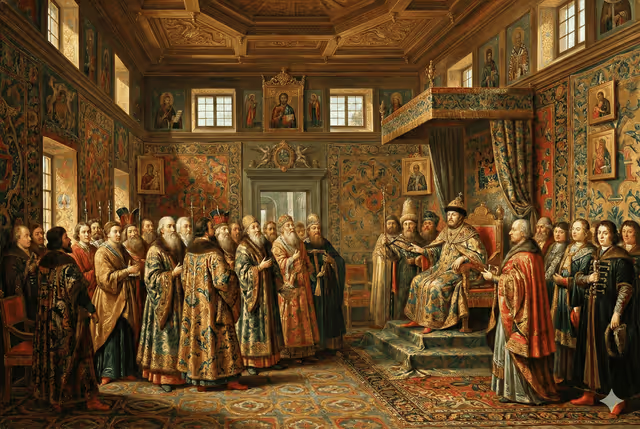
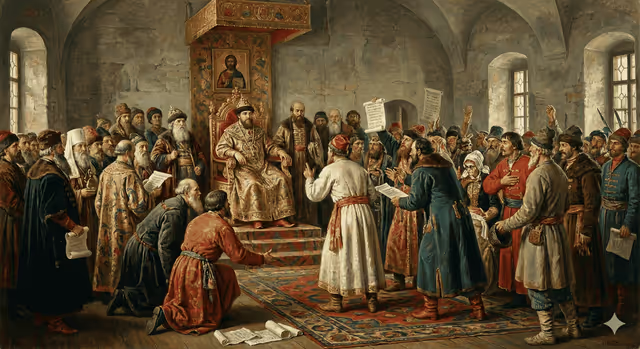
The first years of the reign testified to genuine reforming ambitions. Catherine had read Montesquieu, Voltaire, Diderot and the French encyclopédistes. She corresponded regularly with the philosophers of the Enlightenment, who celebrated her as the model of the enlightened despot. In 1767, she convoked a Grand Legislative Commission bringing together more than 500 delegates from all the empire’s classes: nobles, merchants, Cossacks, free peasants, and even some non-Russian representatives. She herself drafted the Nakaz (Нака́з), a text of 655 articles drawing directly on The Spirit of the Laws and advocating progressive principles: equality before the law, abolition of torture, respect for human dignity.
Yet the Commission quickly bogged down in sterile debates. The nobles refused any reform that would reduce their privileges. The question of serfdom, the central institution of Russian economy and society, proved untouchable. Catherine retreated. In 1768, she dissolved the Commission without any major reform having been adopted. Serfdom, which kept millions of peasants in a condition close to slavery, not only persisted but intensified under her reign. Catherine distributed land populated by serfs to her favourites and generals in reward for their services. Between 1762 and 1796, more than a million free peasants were reduced to serfdom.
On other fronts, reforms progressed. Catherine reorganised provincial administration in 1775, dividing the empire into governorates and districts endowed with more efficient local institutions. She promoted education, opened schools, founded the Smolny Institute for the education of noble young women in 1764. She supported the arts and sciences, considerably enlarged the collections of the Hermitage Museum (Эрмита́ж), attracted European artists and scholars. In 1785, she promulgated the Charter of the Nobility (Жа́лованная гра́мота дворя́нству), which codified and guaranteed noble privileges, making them a legally distinct class exempt from compulsory service and taxation.
This Charter reveals Catherine’s fundamental strategy: she governed not against the nobility but with it, in exchange for its absolute support. Enlightened despotism in its Russian version consisted less in transforming society than in modernising the elites while preserving the hierarchical social order. The peasants, representing 90% of the population, remained excluded from any improvement in their condition.
Imperial expansion: wars and conquests
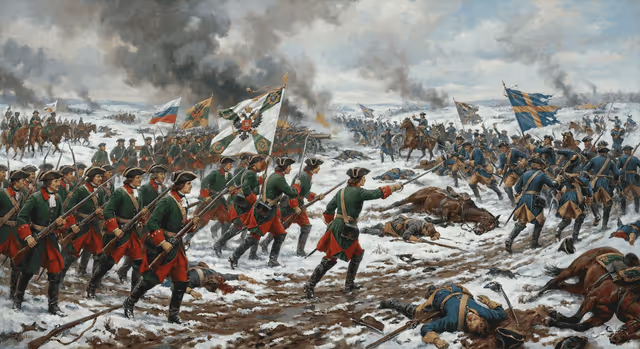
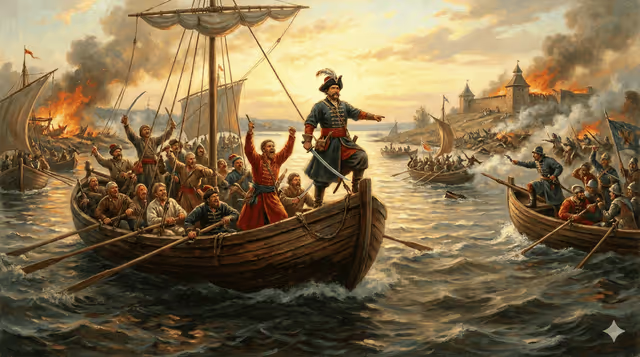
Catherine’s reign transformed the map of Eastern Europe. Between 1768 and 1774, the first Russo-Turkish War pitted the Russian empire against the Ottoman Empire. Russian armies, commanded by Peter Rumyantsev and Alexander Suvorov, won decisive victories in Moldavia and on the Danube. In July 1770, the Russian fleet, commanded by Alexei Orlov, destroyed the Ottoman fleet at Çeşme in the Aegean Sea. The Treaty of Küçük Kaynarca in 1774 gave Russia access to the Black Sea, the fortress of Azov, and a de facto protectorate over Orthodox Christians in the Ottoman Empire.
In 1783, Catherine simply annexed the Khanate of Crimea (Кры́мское ха́нство), ending three centuries of Tatar independence. Her favourite, Grigory Potemkin, governor of New Russia (Новоросси́я), undertook the colonisation and development of these southern territories. He founded new cities such as Kherson, Nikolaev and Sebastopol, built arsenals and a new Black Sea fleet. In 1787, Catherine made a triumphal journey to Crimea, where Potemkin presented her with prosperous villages and smiling peasants. The legend of the “Potemkin villages” (Потёмкинские дере́вни), cardboard stage-sets meant to conceal real poverty, was born of this journey, although historians still debate its accuracy.
A second Russo-Turkish War (1787–1791) confirmed Russian dominance over the Black Sea. Suvorov won the bloody victory of Izmail in 1790, where Russian troops massacred more than 20,000 Turks. The Treaty of Jassy (Я́сский мир) in 1792 further extended Russian territory to the Dniester.
To the west, Catherine participated in the three partitions of Poland (1772, 1793, 1795) alongside Prussia and Austria. These partitions erased from the map a nation that had for centuries been a major Russian rival. The Russian empire absorbed Belarus, Lithuania, part of Ukraine and Courland. By the end of Catherine’s reign, the empire counted 36 million inhabitants, against 19 million at her accession.
The great fear: Pugachev and the hardening of the regime
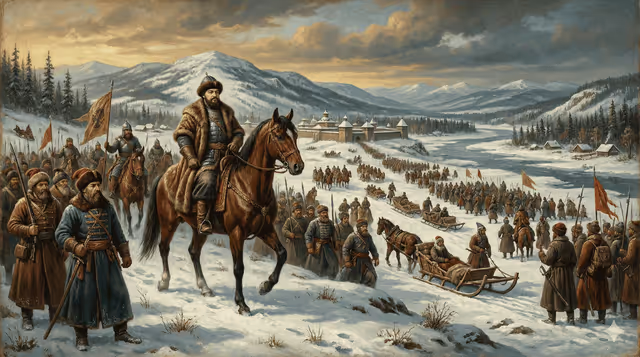
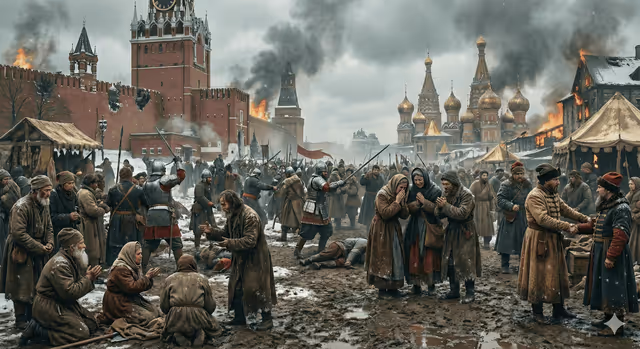
In September 1773, a Don Cossack named Yemelyan Pugachev proclaimed himself Tsar Peter III, supposedly miraculously saved from the 1762 conspiracy. He launched a call to revolt against the nobility and the usurper empress. The rebellion set the Urals, the Volga and the southern steppes ablaze. Tens of thousands of Cossacks, serf peasants, mining workers and non-Russian peoples (Bashkirs, Tatars, Kalmyks) joined his army. Pugachev promised the abolition of serfdom, redistribution of land and an end to taxes. His troops massacred nobles, burned estates and took cities. In July 1774, he besieged Kazan and set the city on fire.
Catherine took the threat very seriously. She dispatched elite regiments commanded by Suvorov. In September 1774, Pugachev was betrayed by his own lieutenants, captured and handed to the authorities. He was brought to Moscow in an iron cage. On 10 January 1775, he was beheaded and quartered on Bolotnaya Square (Боло́тная пло́щадь). Catherine had his native village destroyed, banned the mention of his name, and renamed the Yaik River — where the revolt had begun — the Ural River.
This revolt marked a turning point. Catherine understood that her power rested on a fragile balance, and that any impulse toward social reform could trigger an explosion. The peasants represented an immense mass, capable of submerging the state if they rose. Henceforth, Catherine abandoned all thought of limiting serfdom. On the contrary, she extended its domain and reinforced its mechanisms of control. “Enlightened” despotism turned into plain despotism.
The French Revolution, from 1789, completed this evolution. Catherine, horrified by the execution of Louis XVI in 1793, broke off relations with revolutionary France. She had Alexander Radishchev arrested, a writer who had dared to criticise serfdom in his Journey from St. Petersburg to Moscow (Путеше́ствие из Петербу́рга в Москву́). She banned French books, kept close watch on nobles who might sympathise with the new ideas. The protector of the Enlightenment became its enemy. In 1795, she even considered sending an expeditionary force to fight the French Republic, but the project came to nothing.
The death of an empress and the ambiguous legacy of a reign
Catherine died on 6 November 1796, at the age of sixty-seven, of a stroke. Her son Paul, whom she had always despised and kept from power, finally succeeded her after forty-two years of waiting. He promptly set about systematically dismantling his mother’s political legacy, promulgating a law henceforth forbidding women from reigning in Russia.
What remains nonetheless from Catherine’s reign? In territorial terms, a considerable expansion that made Russia a leading European power. The empire now controlled the entire northern coast of the Black Sea, had absorbed a large part of former Poland, and stretched from the borders of Prussia to Alaska. In cultural terms, a remarkable flourishing: Saint Petersburg became a refined European capital, the Russian aristocracy became French-speaking, and the Hermitage housed one of Europe’s finest art collections.
But in social terms, complete immobility coupled with regression. Serfdom, far from retreating, had extended and hardened. The millions of Russian peasants remained in a condition of near-slavery that contrasted brutally with their sovereign’s enlightened discourse. Administrative and judicial reforms had benefited only the nobility and urban elites. The gulf between the people and the upper classes had widened.
Was Catherine herself aware of this contradiction? Probably. But she had made a pragmatic choice: to reign was her primary objective, and to reign in 18th-century Russia, one had to accommodate the nobility and leave serfdom untouched. Enlightened despotism proved to be an intellectual luxury, incompatible with the realities of autocratic power in an agrarian empire with rigid social structures.
A German princess without fortune had become the Great Catherine, sovereign of a vast empire. She had conquered provinces, corresponded with philosophers, collected masterpieces, enlarged her palace. She had also crushed a peasant revolt in blood, reinforced serfdom, and abandoned all reforming pretension. These two Catherines coexist in history: the enlightened empress whom Voltaire and Diderot celebrated, and the autocratic despot revealed by the archives. Which was the real one? Doubtless both, inextricably.