The Golden Horde: the Mongol state that shaped Russia
From 1240 to 1480, the Golden Horde imposed its yoke on the Russian princes. Yarlyk, tribute, the Battle of Kulikovo: the history of the Mongol empire that shaped Russia.
How could nomads from the steppes of Central Asia permanently transform the political organisation of a territory they never truly occupied? This is the paradox of the Golden Horde (Золота́я Орда́), the Mongol state that dominated the Russian principalities for two and a half centuries without establishing permanent garrisons, yet left an imprint so deep that it still shapes our understanding of Russian history today. Between 1240 and 1480, the khans of the Volga imposed their authority through an ingenious system of long-distance vassalage, upsetting the balance of power among Russian princes and creating the conditions for Moscow’s rise to dominance. This is the story of a steppe empire that ruled through fear, tribute and diplomatic skill.
The storm from the East (1236–1242)
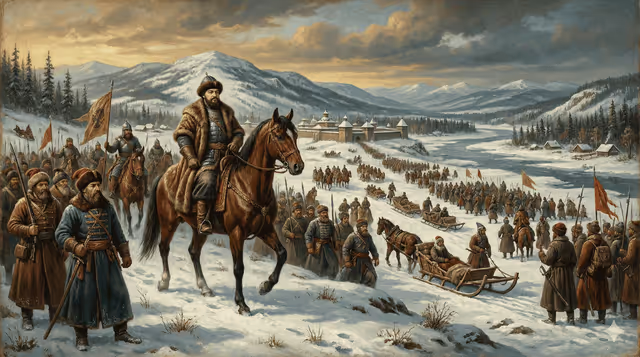
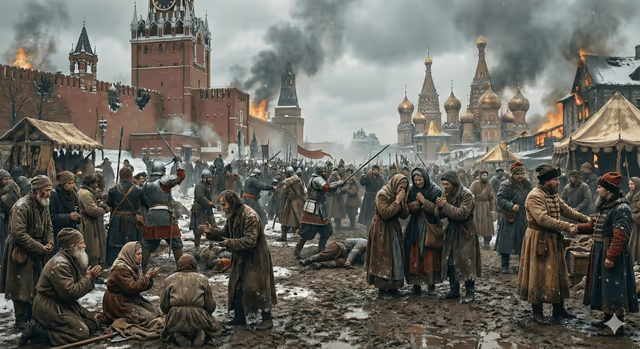
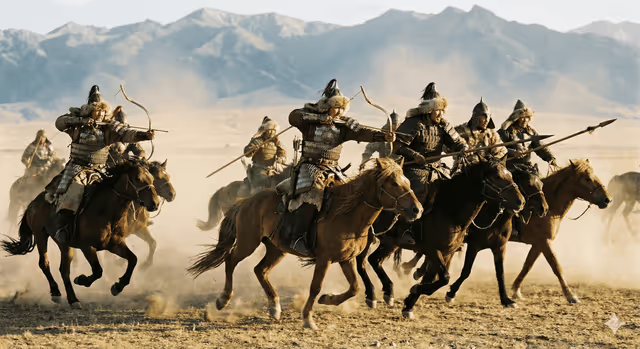
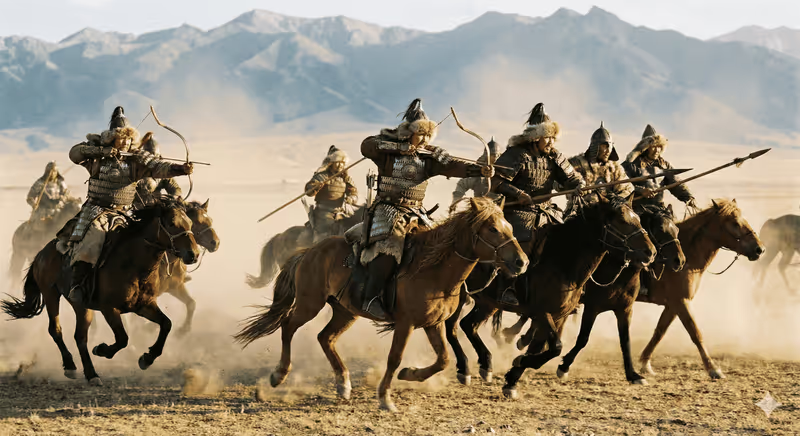
The winter of 1237–1238 saw a military force of terrifying efficiency descend upon the Russian principalities. Batu (Баты́й), grandson of Genghis Khan, unleashed his tumens (тýмены, units of 10,000 cavalry) on the conquest of Eastern Europe. The campaign began in December 1237 with the capture of Ryazan (Рязáнь), whose fortress fell in five days. The Russian chronicles describe how the inhabitants, refusing to pay a tribute of one tenth of their goods, suffered systematic massacre. Prince Yuri Ingvarevich (Юрий Ингварéвич) and his sons died with weapons in hand.
Batu did not stop. In February 1238, his cavalry took Vladimir-on-Klyazma (Влади́мир-на-Кля́зьме), capital of the most powerful Russian state. Grand Prince Yuri II Vsevolodovich (Юрий II Все́володович) attempted to gather an army in the north, but the Mongols caught up with him on the Sit River (река Сить) on 4 March 1238 and annihilated it. Within a few weeks, fourteen major cities burned. Only Novgorod (Нóвгород) escaped destruction: the spring mud halted the Mongol advance a hundred kilometres from the merchant city.
The second wave struck in 1239–1240. This time the south suffered. Kiev (Ки́ев), the “mother of Russian cities”, fell in December 1240 after a fierce siege. Archaeologists would discover centuries later layers of ash several metres deep. From there, Batu pushed westward, crossed Galicia (Гали́ция), invaded Poland and Hungary. In 1242, his advance forces reached the Adriatic. Then, abruptly, the invasion halted: the great khan Ögedei (Угэдэ́й) had just died at Karakorum, and Batu was in principle expected back to participate in choosing a successor.
Sarai on the Volga: capital of a steppe empire
Batu interrupted his campaign but, rather than returning to Mongolia for the election of a successor, chose to settle permanently in the steppes of the Volga. He established his capital at Sarai (Сара́й, meaning “palace” in Turkish), on the lower Volga, near present-day Astrakhan (Астрахáнь). The choice was not arbitrary: the site controlled trade routes between Central Asia and Europe, between the Caspian and Black Seas. Within a few decades, Sarai became a cosmopolitan metropolis where Venetian merchants, Persian craftsmen, Russian slaves and Turco-Mongol nomads crossed paths.
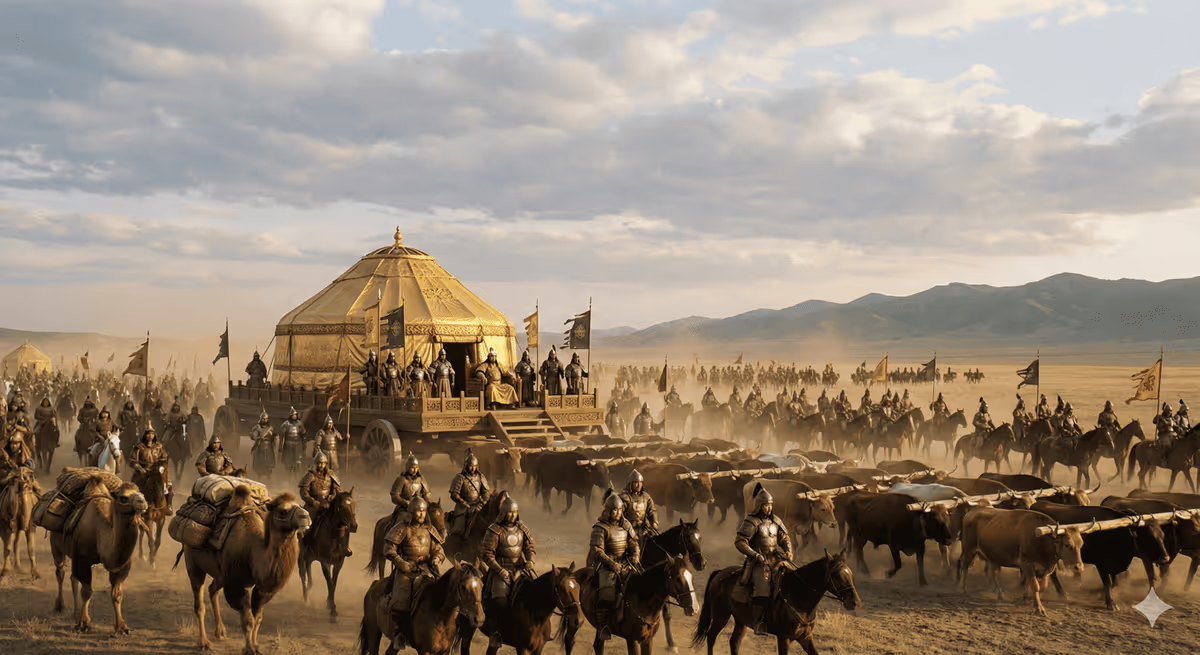
Travellers who visited the city in the 13th century described an enormous permanent encampment. The Franciscan friar William of Rubruck (Гийо́м де Рубру́к), who crossed through the Horde in 1253, spoke of a tent-city several kilometres long. The khan and his wives lived in richly decorated yurts (юрты) of gold and silver, from which the name “Golden Horde” may derive. Around them spread the craftsmen’s quarters, bazaars and caravanserais. Mosques stood alongside Orthodox churches and even a Catholic cathedral founded by Franciscan missionaries.
This mobile capital reflected the peculiar nature of the Mongol state. The Horde did not seek to Russify its conquests or impose direct administration. It allowed the Russian princes to govern their lands, provided they acknowledged the khan’s supremacy and paid tribute. It was an empire founded on permanent movement: the khan’s envoys constantly travelled the roads, verifying that vassals met their obligations, while Russian princes regularly made the journey to Sarai to pay homage.
The system of the yoke: yarlyk and tribute
For Russians, this period entered history under the name of igo (yoke) (и́го), a metaphor for the harness that weighs upon an ox’s neck. The term conveyed both humiliation and the weight of the system the Mongols had put in place. It rested on two pillars: the yarlyk (ярлы́к) and the tribute.
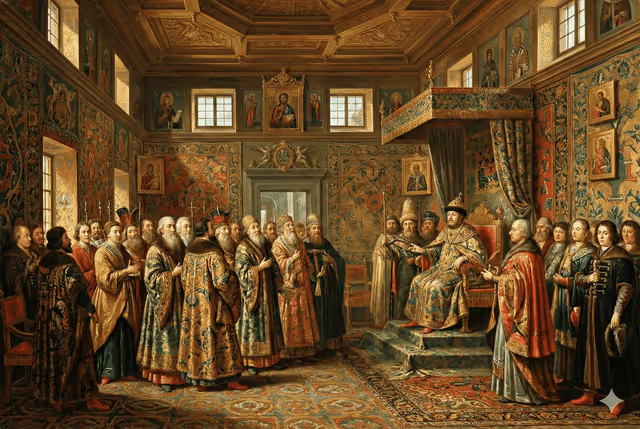
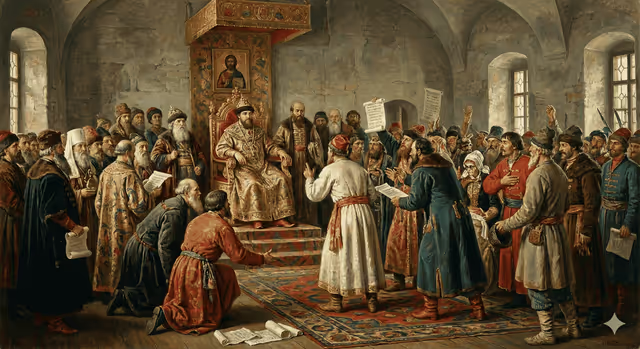
The yarlyk was a patent of investiture, a document sealed by the khan authorising a prince to reign over his principality. Without this precious document, no legitimacy was possible. Princes therefore had to travel to Sarai — sometimes all the way to Karakorum in Mongolia — to request or renew their yarlyk. The journey took months, crossed dangerous territories, and the outcome was never certain. At the khan’s court, Russian princes prostrated themselves according to Mongol ritual, passed between two purifying fires, and competed in intrigue to win the sovereign’s favour.
The most coveted of all yarlyks was that of Grand Prince of Vladimir, which conferred precedence over the other Russian princes. The khans played this competition cleverly. They granted the title now to the prince of Tver (Тверь), now to that of Moscow, maintaining a rivalry that prevented them from uniting against the Horde. In 1327, Khan Özbek (Узбе́к) even used the troops of Moscow’s prince Ivan Kalita (Ива́н Калита́, “Ivan the Moneybag”) to crush a revolt in Tver, afterwards rewarding the collaborating prince with the title of grand prince.
The tribute punctuated daily life. The Mongols imposed the vykhod (вы́ход, “output”), an annual tax levied on the entire population. Initially, Mongol collectors, the baskaks (баска́ки), travelled through Russian lands to census inhabitants and collect taxes. Their arrogance provoked revolts, such as that of Rostov (Росто́в) in 1262. Gradually, the khans delegated this thankless task to the Russian princes themselves, who became collectors of Mongol tribute. This delegation enriched the most efficient princes, particularly Moscow, which kept its commission along the way and thus accumulated the resources for its future rise.
The conversion to Islam and the cultural zenith
During its first decades, the Golden Horde practised Tengrism (тенгриáнство), the celestial religion of the steppes, and tolerated all faiths. The khans even exempted the Russian Orthodox Church from tribute, receiving in exchange the prayers of Orthodox priests for the Mongol sovereign’s health. This policy changed in the 1310s under the reign of Khan Özbek (Узбе́к-хан, 1313–1341).
Özbek came to power after eliminating his rivals, some of whom were Nestorian Christians or Buddhists. He chose Islam as the state religion, built mosques in Sarai and other Horde cities, and invited Islamic scholars (улемá) and Sufis (суфи́и) from Central Asia and the Middle East. The conversion was not imposed on subject populations, but it marked a clear distinction between Muslim Mongols and their Christian vassals. Russian chroniclers began to designate their suzerains as “Tatars” (татáры), a term that blended Mongols and Islamised Turks.
Özbek’s reign represented the Golden Horde’s zenith. Caravan trade flourished along the Silk Road, enriching the Volga cities. Craftsmen produced glazed ceramics, precious fabrics and damascene weapons. Caravans carried Chinese silks, Indian spices and Circassian slaves to Mediterranean markets. The Arab traveller Ibn Battuta, who visited Sarai in 1334, described a splendid metropolis with thirteen cathedral mosques and tens of thousands of inhabitants. Mongol women, free to move about, astonished him with their independence and wealth.
Yet this progressive Islamisation also created tensions. Russian princes, who already had to accept the Mongols’ political supremacy, now saw their masters as infidels. The religious distinction nurtured the idea of legitimate resistance. The Orthodox clergy, while benefiting from tax exemptions, began developing a discourse on the suffering of the Christian people under the Muslim yoke.
The fractures: Kulikovo and the blows of Tamerlane
The years 1360–1380 saw the Golden Horde enter a period of chaos that chroniclers called the “Great Turmoil” (Вели́кая за́мятня). After the death of Khan Berdibeq (Бердибе́к) in 1359, killed by his own brother, no fewer than twenty-five khans succeeded one another in twenty years. Mongol generals made and broke alliances, peripheral principalities stopped paying tribute, and trade disorganised.
It was in this context that Mamai (Мамáй) emerged, a powerful general who, without being a descendant of Genghis Khan, effectively controlled the western Horde. In 1378, he sent an army to punish Moscow for its delayed tribute payments. Grand Prince Dmitry Ivanovich (Дими́трий Ива́нович) surprised the Mongols on the Vozha River (река Вóжа) and defeated them. It was the first significant Russian victory in a century and a half.
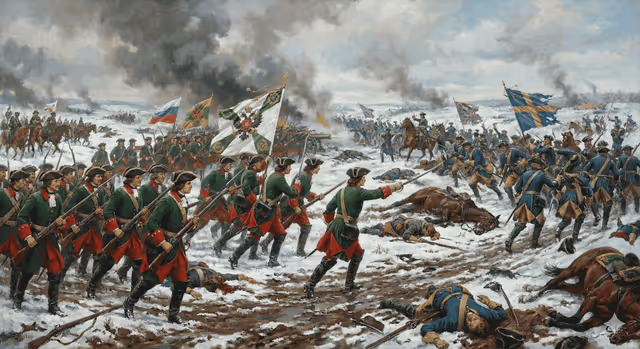
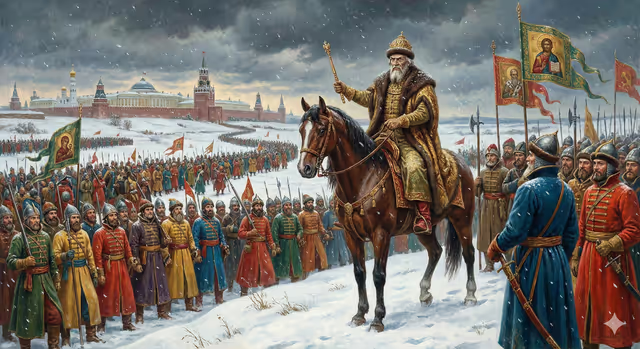
Mamai could not let this affront pass. In 1380, he assembled a considerable army, perhaps 100,000 men, including Genoese contingents, Circassian mercenaries and Lithuanian auxiliaries. Dmitry responded by mobilising the Russian princes. On 8 September 1380, on the Kulikovo Field (Кулико́вское по́ле), near the Don, the two armies clashed in a massive battle. The chronicles recount that the fighting was so fierce that horses had no room to move, that men trampled each other. Dmitry’s hidden reserve, commanded by Prince Vladimir of Serpukhov (Влади́мир Серпухо́вский), charged at the decisive moment and broke Mamai’s army.
The Battle of Kulikovo did not end Mongol domination, but it proved that the Horde was no longer invincible. Dmitry, henceforth nicknamed Donskoy (Донско́й, “of the Don”), returned to Moscow as a hero. Two years later, however, Khan Tokhtamysh (Тохтамы́ш), who had unified the Horde with the help of the Turco-Mongol conqueror Tamerlane (Тимýр), marched on Moscow and sacked the city. The yoke was not broken, but cracked.
The fatal blow came from Tamerlane himself. In 1395, this formidable conqueror, who had built an empire from Samarkand, invaded the Horde’s lands to punish Tokhtamysh, his former protégé turned rival. Tamerlane’s armies systematically ravaged the Volga cities, destroyed Sarai, massacred populations, annihilated commercial infrastructure. The Silk Road diverted southward, depriving the Horde of its principal resources. Tamerlane did not seek to occupy these territories — he left them in ruins.
The fragmentation and the end of the yoke (1430–1480)
In the 15th century, the Golden Horde fragmented into several independent khanates. The Khanate of Kazan controlled the middle Volga, that of Astrakhan the lower Volga, that of Crimea the peninsula of the same name, and that of Siberia the eastern fringes. These successor states sometimes continued to demand tribute from Moscow, but their authority declined as the Muscovite princes grew stronger.
Ivan III of Moscow (Ива́н III Васи́льевич), who reigned from 1462 to 1505, gradually ceased paying tribute. In 1476, he refused to travel to the Horde to renew his yarlyk. Khan Akhmat (Ахмáт), who led what remained of the “Great Horde” (Больша́я Орда́), decided to punish the insubordinate prince. In the autumn of 1480, the two armies faced each other on opposite banks of the Ugra River, a tributary of the Oka. For several weeks, they exchanged cannon fire without daring to cross the river. The first frosts arrived, the ice began to form. Akhmat feared that the Russians would cross on the frozen river. On 11 November, he ordered a retreat.
This “Great Stand on the Ugra” entered Russian history as the official end of the Mongol yoke. No decisive battle had been fought, but the symbolism was powerful: the Prince of Moscow had stood firm against the khan, and the khan had withdrawn. Three years later, Akhmat was assassinated by a rival. The Great Horde disappeared definitively in the early 16th century, absorbed by the Khanate of Crimea.
The other khanates survived longer. Ivan IV the Terrible (Ива́н IV Гро́зный) would conquer Kazan in 1552 and Astrakhan in 1556, reversing the power relationship: it was now Russia that dominated the heirs of the Horde. The Khanate of Crimea, which had become a vassal of the Ottoman Empire, would persist until 1783, when it was annexed by Catherine II (Екатери́на II).
A complex legacy
Two and a half centuries of Mongol domination left deep traces in Russia’s political, economic and cultural organisation. The autocratic system of power, centralised and bureaucratic, owes much to the administrative models of the Horde. The rapid postal relay service, the census-based tax system, certain diplomatic and military practices all find their origins in Mongol institutions. The Russian language itself absorbed hundreds of words of Turco-Mongol origin, relating to trade, administration, clothing and weaponry.
The tax exemption granted to the Orthodox Church allowed it to prosper during the yoke period, reinforcing its role as a national institution and its closeness to princely power. Moscow, a secondary city before the Mongols, took advantage of its position as tribute collector to accumulate the resources that would allow it to unite the Russian lands and create a centralised state in the 16th century. The Volga trade route, consolidated by the Horde, would remain for centuries Russia’s principal economic artery.
Historians still debate the exact nature of this legacy. Did Mongol domination retard Russia’s development by isolating it from Western Europe, or did it on the contrary protect it from invasions from the west while connecting it to Eurasian commercial networks? The brutality of the initial conquests is beyond doubt, but the following decades saw the establishment of a pragmatic coexistence in which Russian princes, the Church and merchants found spaces of autonomy and even profit.
What remains beyond dispute is that without the period of the Golden Horde, Russia would have taken a different shape. The political structures, the territorial borders, the balances between principalities that emerge from this period founded the Muscovite state that would then dominate the northern Eurasian space for centuries.