The Great Northern War: how Peter the Great made Russia a European power
In November 1700, eight thousand Swedes crushed forty thousand Russians in the snow at Narva. The young king Charles XII, eighteen years old, humiliated Tsar Peter I on the battlefield. Europe sneered: Russia remained a barbarian country incapable of rivalling modern armies. Twenty-one years later, in 1721, that same Russia dictated its terms to a defeated Sweden and became the dominant power of the Baltic. The Great Northern War (1700–1721) marks one of the most spectacular reversals of 18th-century Europe. How did a catastrophic defeat transform itself into a strategic triumph?
Three kingdoms against the Swedish lion
At the turn of the 18th century, Sweden dominated northern Europe like a colossus. Since Gustavus Adolphus and the Thirty Years’ War, it controlled the Baltic: the Baltic provinces, Ingria, Karelia, a portion of German Pomerania. Stockholm levied customs duties on the trade crossing this inland sea. Sweden was a great power, feared and respected.
Three ambitious sovereigns decided to break this hegemony. Augustus II (А́вгуст II), Elector of Saxony recently elected King of Poland, wanted to reconquer Livonia, which the Swedes had seized from Poland. Frederick IV (Фре́дерик IV) of Denmark sought to recover Schleswig-Holstein and weaken his Scandinavian rival. Peter I of Russia dreamed of access to the Baltic Sea, that “window onto Europe” which would end his country’s isolation. In 1699, these three monarchs secretly sealed an anti-Swedish alliance.
The trap snapped shut in the spring of 1700. Denmark attacked Holstein in March. Augustus invaded Livonia in February. Peter, having signed peace with the Ottoman Empire in August, declared war on Sweden and marched on Narva. The allies expected to catch the new King of Sweden, Charles XII (Карл XII), off guard — he was only eighteen and seemed inexperienced. They committed a fatal error: this slim young man with a cold gaze was a military genius.
Narva: Russia’s lesson in humility
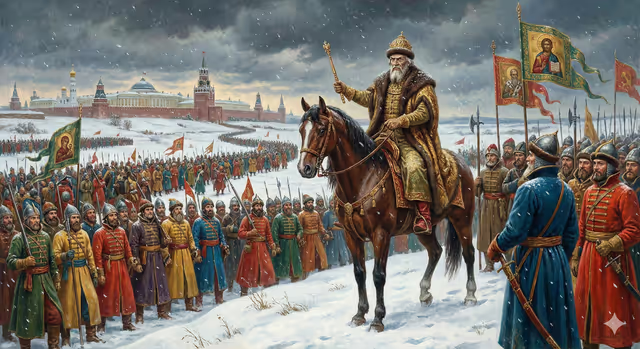
In November 1700, Peter besieged Narva, a Swedish fortress on the Baltic frontier, with forty thousand men. His army was impressive in numbers but mediocre in quality. Russian soldiers still carried mismatched equipment, many officers were incompetent, discipline remained precarious. Peter himself, lacking confidence, left the camp a few days before the battle to seek reinforcements in Novgorod.
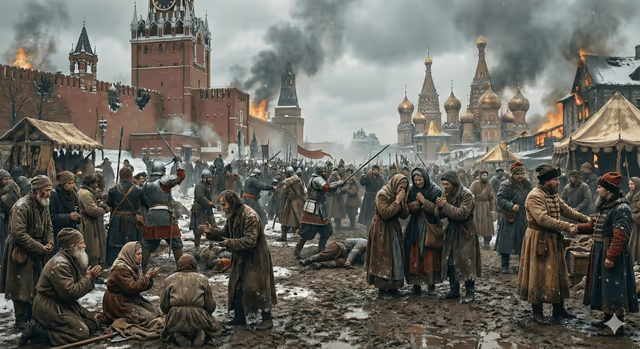
Charles XII landed in Estonia with only eight thousand elite soldiers. On 30 November 1700, in a blizzard that blinded the Russians, he launched a frontal assault against the besieging camp. The Swedes broke through the Russian lines at several points. Panic spread through the Muscovite regiments. German mercenaries in Russian service surrendered en masse. The Russian artillery, superior in numbers, fell into enemy hands.
It was a massacre. The Russians lost six thousand men killed or taken prisoner, abandoned all their artillery, their standards, their baggage. Only the two regiments Peter had trained in the European manner — Preobrazhensky and Semyonovsky — held firm and covered the retreat. Charles XII captured forty Russian generals. European courts openly mocked the barbarian tsar defeated by a handful of Swedes. The Austrian diplomat in Moscow wrote: “The Russians will never be capable of making war in the European manner.”
Peter absorbed the shock without losing heart. He understood Narva’s lesson: his army had to be entirely rebuilt. He would later say: “The Swedes beat us at Narva, it is true. But they taught us how to beat them.”
While Charles conquers Poland, Peter builds an army
Charles XII then committed a major strategic error. Instead of exploiting his victory and marching on Moscow while the Russian army was disorganised, he turned southward. Augustus of Poland seemed to him a more dangerous opponent. For six years, from 1701 to 1706, the Swedish king chased the Saxons and Poles across Poland and Lithuania. He won victory after victory, took Warsaw and Kraków, imposed a puppet king on the Polish throne. He finally forced Augustus to abdicate in 1706.
Peter took advantage of this unexpected respite. He rebuilt his army from the ground up with frantic energy. He created new regiments trained in the Prussian manner by foreign officers. He had monastery bells melted to cast cannons and replace the artillery lost at Narva. He opened military schools to train competent Russian officers. He imposed massive conscription: one conscript per twenty peasant households. In a few years, the Russian empire mobilised a standing army of more than a hundred thousand men.
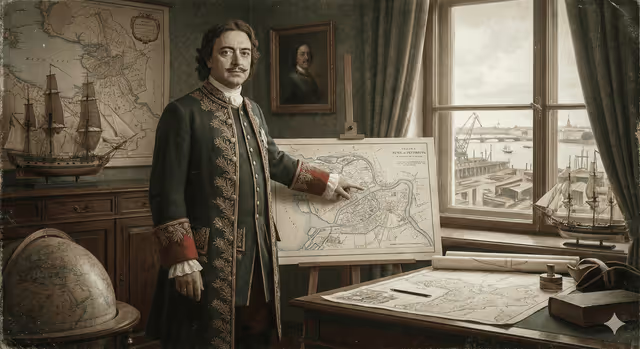
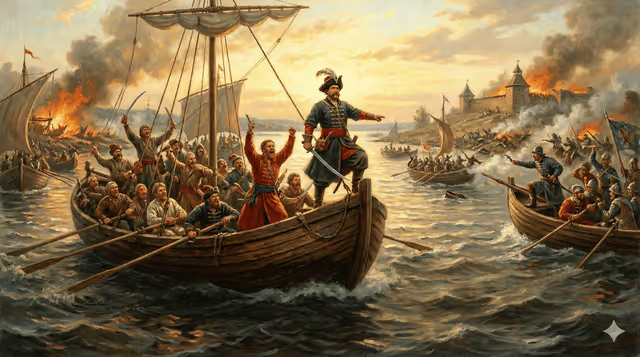
While Charles was occupied in Poland, Peter nibbled away at Sweden’s Baltic possessions. In 1702, he took the fortress of Nöteborg, which he renamed Shlisselburg, “key of the fortress”. In 1703, he seized the fortress of Nienschanz at the mouth of the Neva. On this conquered territory, in May 1703, he founded Saint Petersburg (Санкт-Петербу́рг), his future capital facing West. In 1704, he took Narva, erasing the humiliation of 1700, then Dorpat.
Charles raged at seeing the Russians gnaw at his Baltic possessions, but he could not turn away from Poland as long as Augustus resisted. It was only in 1707, after defeating Saxony and forcing Augustus to make peace, that he could finally march on Russia. But he had given Peter five crucial years to prepare.
Poltava: the Swedish lion broken in the Ukrainian steppes
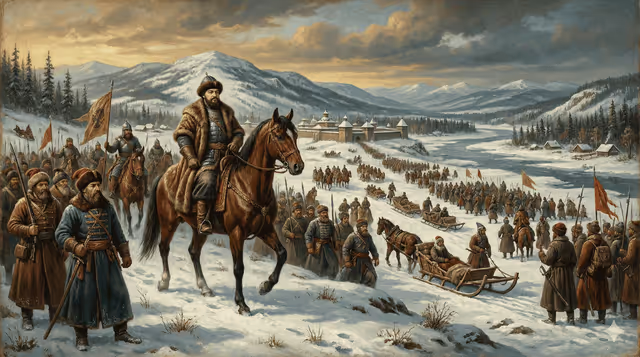
In January 1708, Charles XII left Saxony at the head of forty-four thousand elite soldiers. He crossed Poland and invaded Russia, aiming for Moscow. Peter applied the scorched-earth tactic: his troops fell back, destroying crops and villages as they went. The Swedes advanced through a desert. In September 1708, near the village of Lesnaya, a Russian force destroyed the Swedish supply convoy: sixteen thousand wagons went up in smoke. Winter approached. Charles, rather than retreating, decided to press southward into Ukraine.
He counted on the alliance of the Cossack hetman Ivan Mazepa (Ива́н Мазе́па), who had promised to rally Ukraine to Sweden. But Mazepa brought only a few thousand Cossacks instead of the tens of thousands expected. The winter of 1708–1709 was one of the most severe of the century. Swedish soldiers died of cold and hunger in the frozen steppes. In the spring of 1709, Charles’s army counted no more than twenty-four thousand exhausted men. The king himself had been wounded in the foot during a skirmish and could no longer ride.
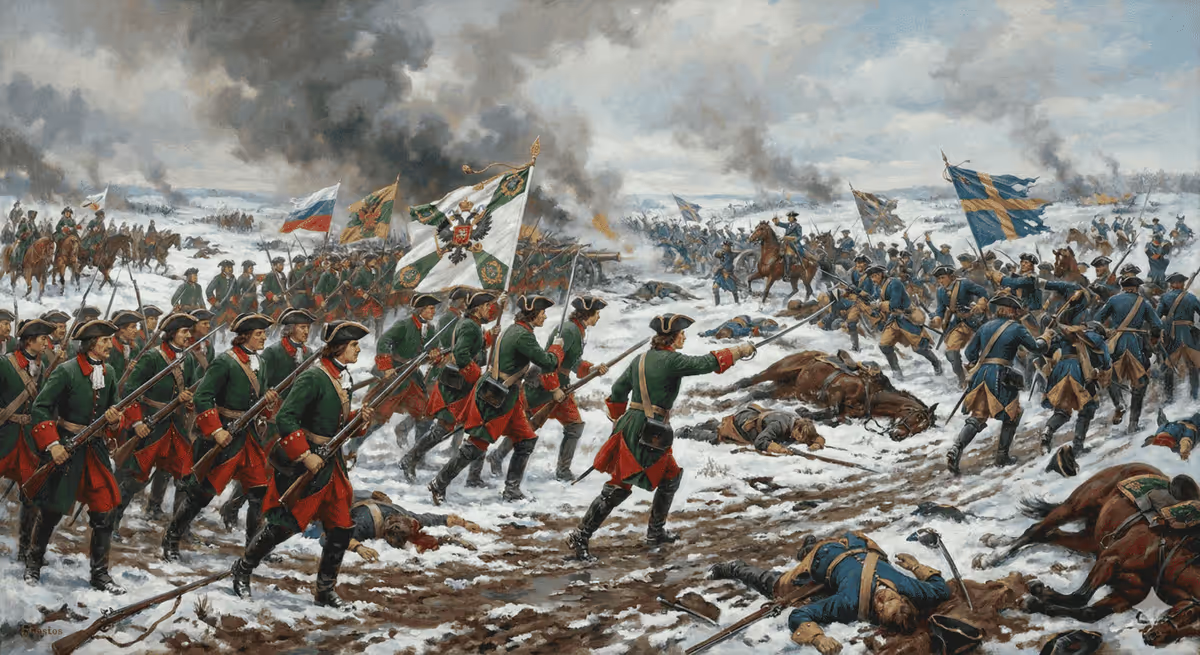
In April 1709, Charles besieged Poltava, a small fortified town in central Ukraine. Peter saw the opportunity. He marched to the town’s relief with forty-two thousand men and seventy-two cannons. On 8 July 1709, the decisive confrontation took place on the plain before Poltava. Charles, carried on a litter, ordered a frontal assault against the fortified Russian positions. It was tactical suicide.
The Swedish infantry charged with its usual courage but ran into Russian redoubts. Peter’s artillery pounded the Swedish lines. Russian regiments, well trained, held their positions and counter-attacked methodically. Within a few hours, the Swedish army was annihilated. The Swedes lost nine thousand men killed or wounded, three thousand as prisoners. The Russians mourned only thirteen hundred dead. It was a complete disaster for Charles XII.
The king fled southward with the remnants of his army, roughly fifteen hundred cavalrymen. He crossed the Dnieper and took refuge on Ottoman territory at Bender in Moldavia. The Swedes remaining in Ukraine, commanded by General Lewenhaupt, surrendered three days after the battle. The Battle of Poltava marked the turning point of the Northern War: Sweden ceased to be invincible, Russia became a first-rank European military power.
Twelve years to finish off the wounded lion
Poltava broke Sweden but did not end the war. Charles XII remained in Ottoman exile for five years, trying to convince the sultan to attack Russia. In 1711, he succeeded: Turkey declared war on Peter. The tsar marched imprudently southward and found himself surrounded on the Pruth River in Moldavia with his army. He had to sign a humiliating peace, returning Azov to the Ottomans. It was one of Peter’s rare setbacks after Poltava.
But the anti-Swedish coalition revived. Denmark rejoined the war in 1709, Saxony in 1709, Prussia in 1715, Hanover in 1715. Sweden, exhausted, had to fight on every front. Charles XII finally returned to Sweden in 1714 and desperately tried to reverse the situation. In 1718, he invaded Danish Norway and was killed by a bullet to the head at the siege of Fredriksten. His death marked the end of Swedish ambitions.
Peter now dominated the Baltic. His fleet, non-existent in 1700, now counted forty-eight ships of the line. It won naval victories over the Swedes at Hanko in 1714 and Grengam in 1720. Russian troops landed on Swedish coasts, pillaging and burning to force Stockholm to make peace. In 1720, an exhausted Sweden sued for peace. Negotiations concluded with the Treaty of Nystad (Ни́штадтский мир) signed on 10 September 1721.
The Baltic becomes a Russian lake
The Treaty of Nystad radically transformed the map of northern Europe. Russia annexed Ingria, Estonia, Livonia and part of Karelia. It obtained direct access to the Baltic Sea with deep-water ports such as Reval (present-day Tallinn) and Riga. Saint Petersburg, founded in 1703 on conquered land, officially became the new capital of the Russian empire in 1712. The “window onto Europe” was wide open.
Sweden lost its Baltic provinces but retained Finland. Above all, it ceased to be a great power. From the kingdom dominating the Baltic, it became a second-rank state. Its army, once reputed invincible, had been bled white: nearly two hundred thousand men lost in twenty-one years of war. The Swedish population, roughly two million inhabitants, took decades to recover from this demographic catastrophe.
In Russia, Peter celebrated the victory in great pomp. The Senate awarded him the title of emperor (импера́тор) and the honorifics “the Great” (Вели́кий) and “Father of the Fatherland” (Оте́ц Оте́чества). The Russian empire officially entered the concert of the great European powers. Western courts, which had mocked Russia in 1700, now had to reckon with it. Dynastic marriages followed: Russian princesses married German princes, Baltic nobles entered the tsar’s service.
The geopolitical balance of northern Europe was overturned for two centuries. Prussia and Russia became the rising powers, while Sweden and Poland declined. The Baltic, formerly controlled by Stockholm, gradually became a Russian lake. This Russian dominance over the Baltic would not be seriously challenged until the 20th century, after the revolution of 1917.
A victory built on perseverance and blood
The Great Northern War demonstrates that an initial defeat does not determine the final outcome of a long conflict. Peter I absorbed the humiliation of Narva in 1700 and transformed his primitive army into a modern force. Charles XII won every battle until Poltava but lost the war through overconfidence and strategic rigidity. Russia triumphed through its capacity to mobilise immense human resources, to learn from its errors and to persevere in spite of setbacks.
This war cost all the belligerents dearly. Russia may have lost four hundred thousand men, mainly peasant conscripts who died of disease, cold or exhaustion during fortification work. Sweden lost proportionally more: nearly ten percent of its male population. The Baltic provinces were devastated by twenty years of incessant fighting. Poland emerged still more weakened, torn between pro-Russian and pro-Swedish factions.
The Northern War marked Russia’s thunderous entry into 18th-century European geopolitics. The country that had been a vague eastern menace became an indispensable actor. A hundred years later, the Russian army would parade through Paris after defeating Napoleon. The roots of that military power lie in the battlefields of the Northern War, from the humiliation of Narva in 1700 to the triumph of Poltava in 1709.