From Mongol vassal to Russian empire: Ivan III and the birth of Moscow
How Ivan III and Vasily III transformed the principality of Moscow into a Russian state between 1462 and 1547: the end of the Mongol yoke, annexations, and the birth of autocracy.
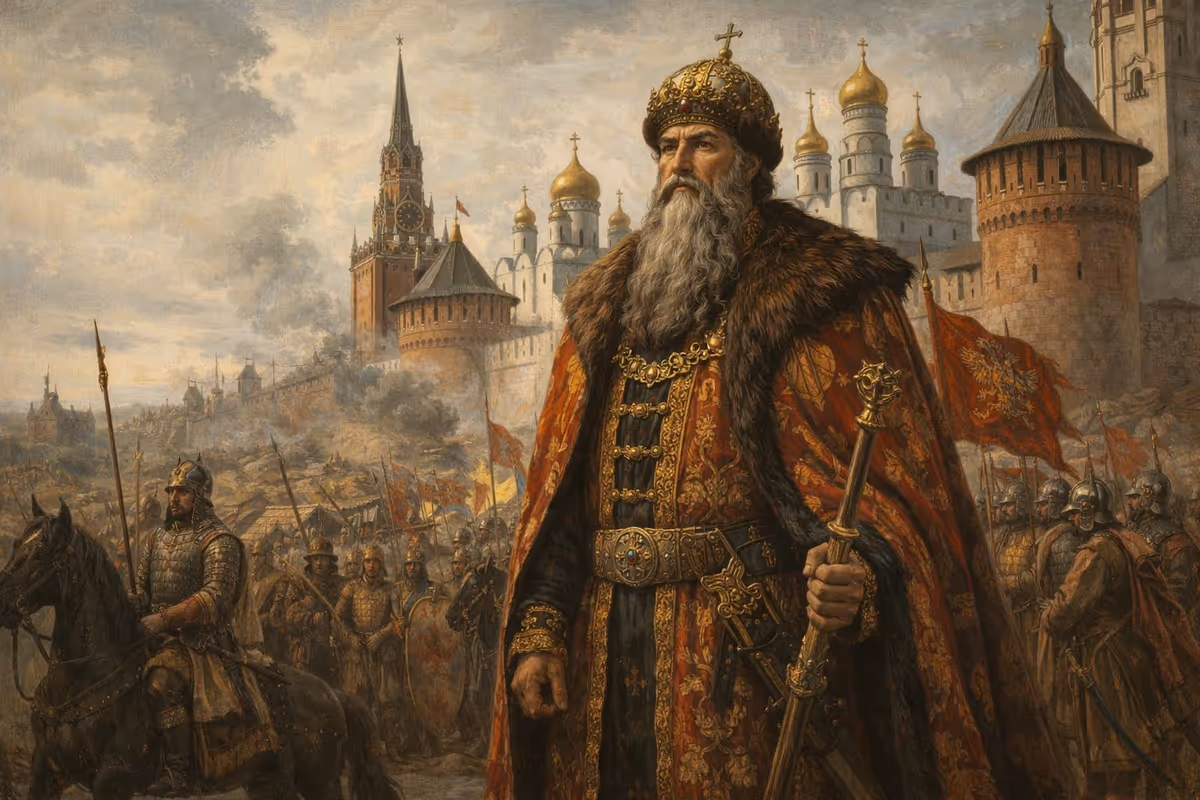
In 1480, a Muscovite grand prince simply decided to stop paying tribute to the Mongols. No great battle, no heroic uprising — just a quiet refusal that ended two and a half centuries of domination. This quiet boldness of Ivan III would transform a peripheral principality into an empire that, seventy years later, would stretch from the Baltic to the Urals. How did this transformation come about? By what means did a vassal prince become the founder of an imperial dynasty?
The grand prince who refused to kneel (1462–1480)
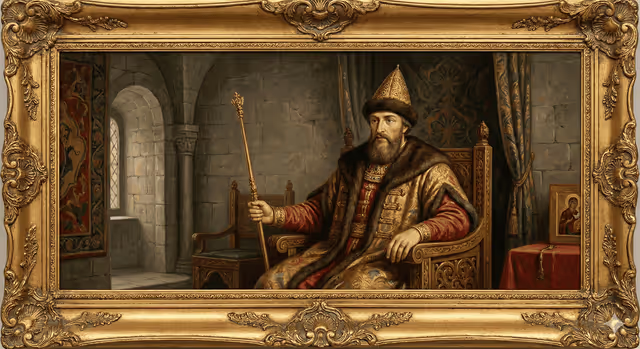
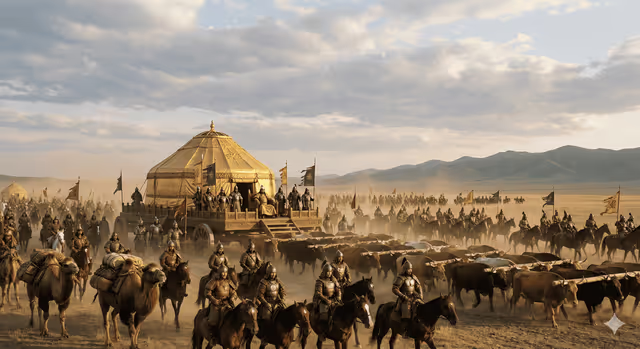
When Ivan III Vasilyevich (Ива́н III Васи́льевич) came to the throne of Moscow (Москва́) in 1462, he inherited a principality already powerful but still formally subordinate to the Horde (Орда́), the Mongol state on the Volga (Волга́). His father Vasily II (Васи́лий II), nicknamed “the Blind” after being captured and mutilated by his rivals, had bequeathed him a large territory but a humiliating position: that of a vassal who had to seek the khan’s investiture to reign.
Ivan III initially played it cautiously. He continued paying tribute, sent embassies to Sarai (Сара́й), the Horde’s capital. But he observed. In 1472, he married for the second time Zoe Palaiologina (Зо́я Палеоло́г), niece of the last Byzantine emperor. This Greek princess, raised in Rome after the fall of Constantinople (Константино́поль) in 1453, arrived in Moscow accompanied by Italian architects, books and a pretension: to be the heiress of the Eastern Roman Empire. The marriage changed Ivan’s perspective. He no longer saw himself as a regional prince but as the successor of the Byzantine emperors.
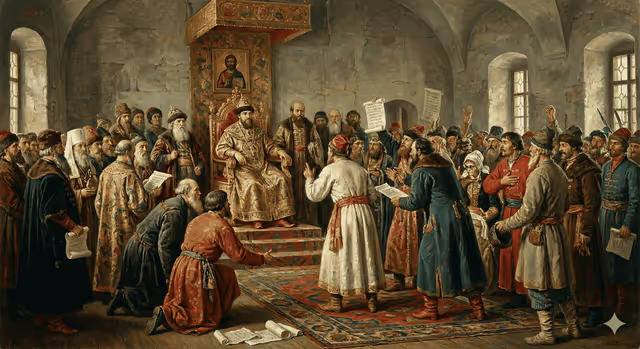
In 1476, Khan Akhmat (Ахма́т) demanded the customary tribute. Ivan kept him waiting. In 1480, a new demand came, accompanied by threats. Ivan convened his boyars (боя́ре, the high nobility) at the Kremlin (Кремль). Some counselled submission, others war. Metropolitan Gerontius (Гео́нтий), head of the Russian Orthodox Church, called for resistance. Ivan decided: he would pay no more.
The confrontation that never happened (autumn 1480)
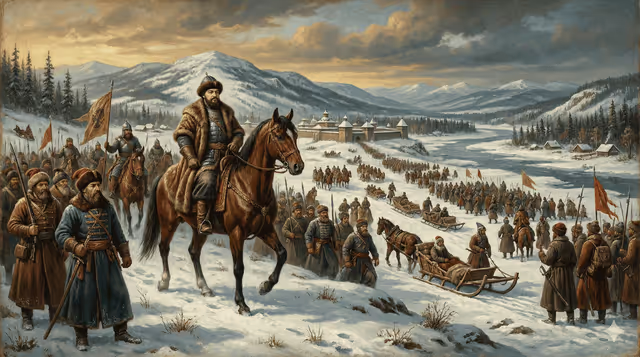
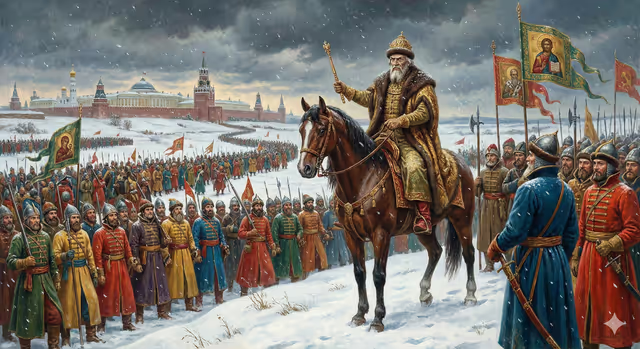
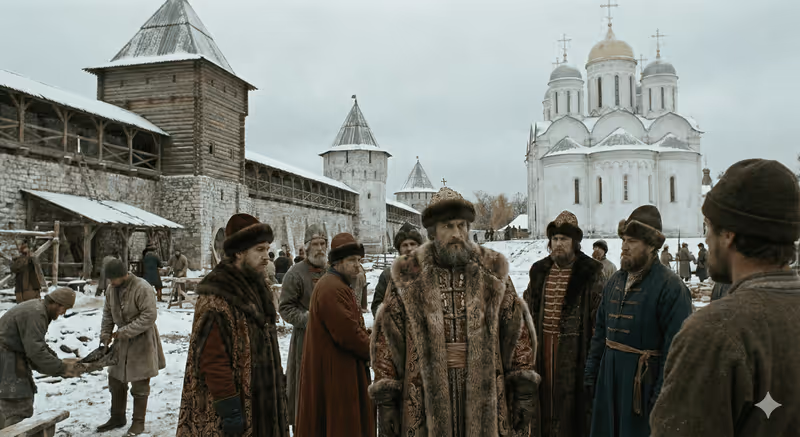
The showdown took shape on the banks of the Ugra River (река́ Угра́), a tributary of the Oka (Ока́), two hundred kilometres south-west of Moscow. The two armies faced each other on opposite sides of the river for several weeks. Akhmat waited for the freeze to cross, Ivan reinforced his positions. Russian chronicles recount that the grand prince hesitated, briefly returned to Moscow, where the population accused him of cowardice. Metropolitan Gerontius sent him a stinging letter: “Where are you fleeing, sovereign?”
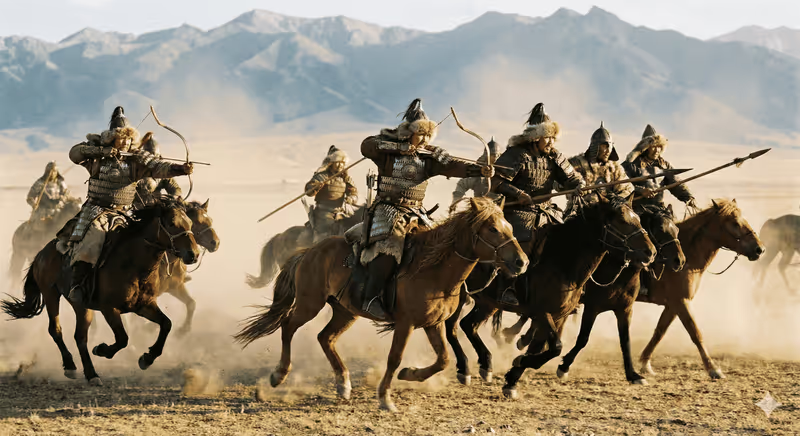
But no battle took place. On 11 November 1480, after skirmishes without consequence, Akhmat ordered a retreat. The reasons remain debated: the early winter, the threat of a rival Tatar attack on his rear, the absence of fodder for the Mongol cavalry. In any case, the Horde withdrew. The following year, Akhmat was assassinated by a rival. The “Mongol yoke” (монго́льское и́го), as Russian historians would later call it, ended not in the thunder of battle but in a face-off where no one blinked.
The swallower of principalities (1478–1485)
Freed from the Mongol threat, Ivan could devote himself to his project: making Moscow the sole Russian capital. Several independent principalities still subsisted, remnants of a fragmented feudal system. Ivan absorbed them methodically.
Novgorod, the great merchant republic of the north, was the first target. This prosperous city, governed by an assembly of merchants and boyars (the veche, вече́, popular council), traded with the Hanseatic League and jealously guarded its liberties. In 1471, some Novgorodian boyars proposed an alliance with Lithuania (Литва́), the rival state to the west. Ivan presented this approach as a betrayal of Orthodoxy — Lithuania being Catholic. He marched on Novgorod with an army. After a military defeat, the city had to accept Muscovite suzerainty while retaining its institutions.
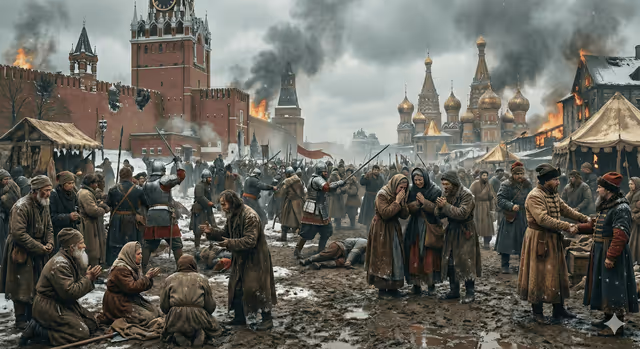
But Ivan did not stop there. In 1478, taking advantage of new unrest, he returned with larger forces. This time, he demanded the abolition of the veche. The boyars resisted, the people revolted. Ivan had the leading families deported to Moscow and other cities, confiscated their lands, and installed his own governors. The bell that convened the veche was dismantled and carried to Moscow — a brutal symbol of the end of urban freedoms. Novgorod, which had been a kind of oligarchic republic for three centuries, became a simple province.
Tver (Тверь), another rival principality west of Moscow, followed in 1485. Its prince Mikhail (Михаи́л) attempted resistance by allying with Lithuania. Ivan surrounded the city, Tver’s boyars defected, and Mikhail fled. In less than twenty-five years, Ivan had unified under his authority a territory stretching from the Baltic to the Urals.
The invention of imperial ceremony
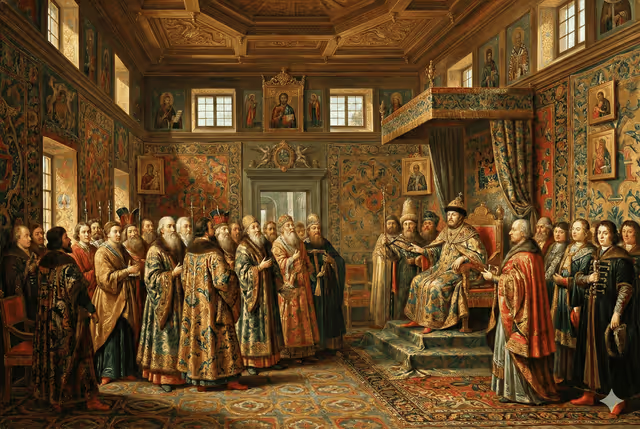
The new power needed symbols. Ivan III gradually abandoned the title of grand prince (вели́кий князь) in favour of sovereign of all Russia (госуда́рь всея́ Руси́). He had coins minted bearing the Byzantine double-headed eagle. Foreign ambassadors noticed the change in protocol: audiences became more solemn, genuflections obligatory.
The Moscow Kremlin was transformed. The Italian architects brought by Sophie Palaiologina — Aristotle Fioravanti, Marco Ruffo, Pietro Antonio Solari — rebuilt the walls and erected new cathedrals. The Cathedral of the Dormition (Успе́нский собо́р), completed in 1479, combined the architecture of Vladimir — the former capital — with Italian Renaissance techniques. It was henceforth here that grand princes were crowned.
Ivan codified the Sudebnik (Судебник), a code of laws promulgated in 1497 that standardised justice across the entire territory and restricted peasants’ rights to leave their lords — the first step toward serfdom. Muscovite power organised itself into prikazy (приказы́), specialised administrative bureaus that prefigured a centralised bureaucracy.
Vasily III: autocracy as inheritance (1505–1533)
At Ivan’s death in 1505, his son Vasily III (Васи́лий III) continued his father’s work with even greater rigour. More authoritarian than his father, he completed the territorial centralisation. In 1510, he annexed Pskov (Псков), the north’s last urban republic, using the same methods as in Novgorod: deportation of elites, abolition of the veche. In 1514, after several campaigns, he wrested Smolensk (Смоле́нск) from Lithuania, expanding the western borders.
Vasily surrounded himself with an even stricter ceremonial. Western ambassadors — Venetian, Imperial, Polish — were struck by the despotism they observed. Sigismund von Herberstein (Сигизму́нд фон Герберште́йн), a Holy Roman diplomat who visited Moscow twice, noted in his Notes on Muscovy (Записки о Моско́вии): “The power this prince exercises over his subjects surpasses that of all the monarchs of the world.” The most powerful boyars could be disgraced and exiled without trial. The prince reigned alone, consulted whom he wished, and decided without oversight.
Vasily repudiated his first wife Solomonia Saburova (Соломони́я Сабу́рова), barren after twenty years of marriage, and forced her to take the veil — a scandal that divided the Orthodox Church. He married Elena Glinskaya (Еле́на Гли́нская), a young noblewoman of Lithuanian origin. In 1530, their son Ivan (Ива́н) was born, the future Ivan IV. Vasily died in 1533 from a leg infection, leaving a consolidated empire but a three-year-old heir.
A chaotic regency and a child who watches (1533–1547)
Elena Glinskaya assumed the regency with authority. She continued monetary reforms, strengthened fortifications. But in 1538, she died suddenly — perhaps poisoned. A ten-year period then opened during which the great boyar families — the Shuiskys (Шу́йские), the Belskys (Бе́льские), the Glinskys (Гли́нские) — fought for power. Young Ivan watched, helpless, the intrigues, arrests and summary executions.
The chronicles report humiliations: boyars feasting in the prince’s apartments, neglecting the young sovereign’s education, openly mocking him. Ivan grew up in this atmosphere of latent violence, learning that power is not shared but imposed by force. In 1547, at seventeen, he decided to end the regency. He had himself crowned not as grand prince but as tsar (царь) — a Slavic derivation of Caesar, the imperial title that his ancestors had not dared to claim officially.
Russia on the eve of Ivan IV’s reign
In seventy years, the principality of Moscow had become a centralised state of approximately three million inhabitants, spanning nearly three million square kilometres. The feudal institutions had been dismantled, the urban republics abolished, the rival principalities absorbed. Power rested henceforth on a simple principle: an autocratic sovereign ruling without sharing authority, assisted by a service nobility (дворя́не, dvoriane) that held its lands in exchange for military and administrative service.
The Tatars (Татары) were no longer an existential threat but remained a permanent danger to the south and east, with the khanates of Kazan (Каза́нь) and Astrakhan (Астраха́нь). To the west, rivalry with Lithuania and Poland (Поль́ша) structured diplomatic relations. Russia was beginning to establish regular contacts with Western Europe, but remained perceived as a distant and strange power, halfway between the Christian West and the Mongol East.
The young tsar Ivan IV inherited an apparatus of power unprecedented in Russian history: a consolidated autocracy, a unified territory, an imperial legitimacy founded on Byzantium. He would make use of it in ways that would forever transform the relationship between sovereign and subjects — but that belongs to another story.