Tsar Mikhail Romanov (1613): the founder of a three-century dynasty
How does a sixteen-year-old boy, sheltering in a remote monastery deep in the provinces, become the founder of a dynasty that will reign for three centuries over the world’s largest empire? In the spring of 1613, Russia was only just emerging from a fifteen-year nightmare. The country had come close to outright disappearance. Claimants to the throne numbered in the dozens, foreign armies occupied Moscow and Novgorod, and armed bands pillaged the countryside. Yet, against all expectations, it was precisely this apocalyptic context that allowed a new lineage to emerge. The story of Mikhail Fyodorovich Romanov (Михаи́л Фёдорович Рома́нов) began in the absolute chaos of the Time of Troubles and ended, thirty-two years later, with a pacified Russia and a solidly anchored monarchy.
A country without a tsar, without law, without hope
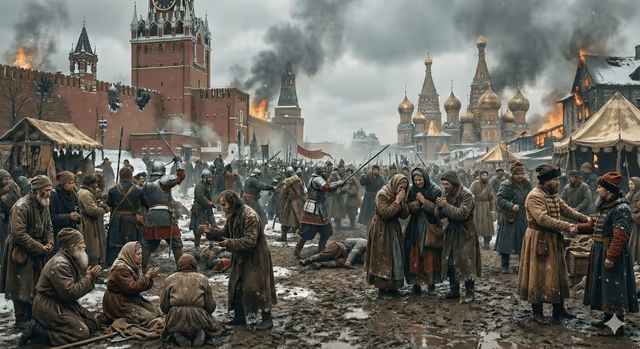
In January 1613, no one gave much for Russia’s future. The Time of Troubles (Смýтное врéмя) was entering its fifteenth year. Since the death of the last tsar of the Rurikid dynasty in 1598, the country had experienced a nightmarish succession: Boris Godunov dead in murky circumstances, three false Dmitrys claiming to be the miraculous son of Ivan the Terrible, Tsar Vasily Shuisky deposed and handed over to the Poles, an interregnum where no one truly governed. In Moscow, a Polish garrison had occupied the Kremlin since 1610. Poland’s King Sigismund III dreamed of placing his son Władysław on the Russian throne. The Swedes controlled Novgorod and demanded their share. Bands of Cossacks, revolting peasants and demobilised soldiers turned the provinces into lawless zones.
The catastrophe was not limited to political chaos. The population had fallen by nearly a third in some regions. Fields lay fallow, cities emptied. Between 1601 and 1603, an apocalyptic famine had killed hundreds of thousands. Moscow had witnessed scenes of cannibalism. Archives mention 127,000 corpses buried in mass graves in the capital alone. Trade collapsed, the currency lost all value. When a Dutch merchant visited Moscow in 1612, he described a city where three-quarters of the houses were empty or destroyed.
Yet something changed in the autumn of 1612. A popular militia from Nizhny Novgorod, led by a meat merchant named Kuzma Minin and a penniless prince, Dmitry Pozharsky, accomplished the unthinkable: it drove the Poles out of the Kremlin. For the first time in years, Moscow belonged to the Russians again. But Moscow without a tsar remained an empty shell. A new sovereign had to be elected, and quickly, before the country sank definitively into anarchy.
The Zemsky Sobor searches for the impossible: a candidate acceptable to all
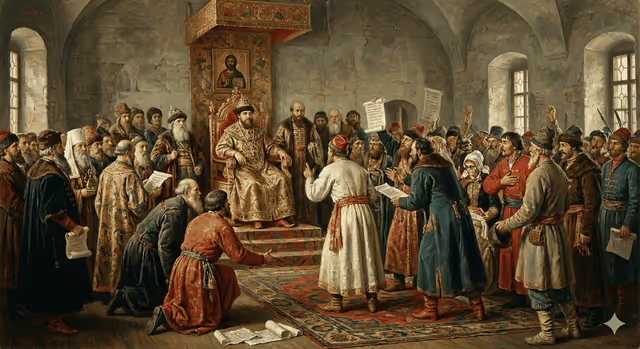
In January 1613, a unique assembly convened in Moscow: the Zemsky Sobor (Земский Собóр), literally “the assembly of all the land”. Seven hundred delegates converged on the capital from all the provinces still under Russian control. There were boyars (the great nobles), clergy representatives, merchants, Cossacks, even free peasants. Each brought his list of grievances and his candidates. The atmosphere in the hall of the Palace of Facets in the Kremlin resembled a free-for-all more than a solemn conclave.
Candidates were not lacking. Several powerful boyars presented themselves. The King of Sweden proposed his son Charles Philip. Władysław of Poland still had his supporters. Some even raised the idea of offering the crown to an English prince or a German ruler. Debates dragged on for six weeks. Each candidate raised insurmountable objections. The powerful boyars alarmed other nobles who feared for their privileges. Foreign princes were unacceptable to the people and the Orthodox clergy. A new foreign tsar, after the Polish experience, seemed unthinkable.
It was from this impasse that the name of Mikhail Romanov emerged. At first glance, the choice seemed strange. The boy was sixteen. He had no political or military experience whatsoever. His family, the Romanovs, descended from an old boyar lineage, but without particular distinction. Mikhail’s real asset lay precisely in his lack of assets: he had no powerful enemies, he belonged to no dominant faction, his youth made him malleable. Above all, his mother had been Ivan the Terrible’s first wife, which gave him a connection, however tenuous, to the old dynasty. Metropolitan Philaret, his father, was a prisoner in Poland since 1610, making him a martyr acceptable to all. Mikhail Romanov represented the perfect compromise: a weak tsar for the powerful who expected to govern in his place, a Russian and Orthodox tsar for the people and the clergy, and a young tsar who could reign for a long time and found a stable new dynasty.
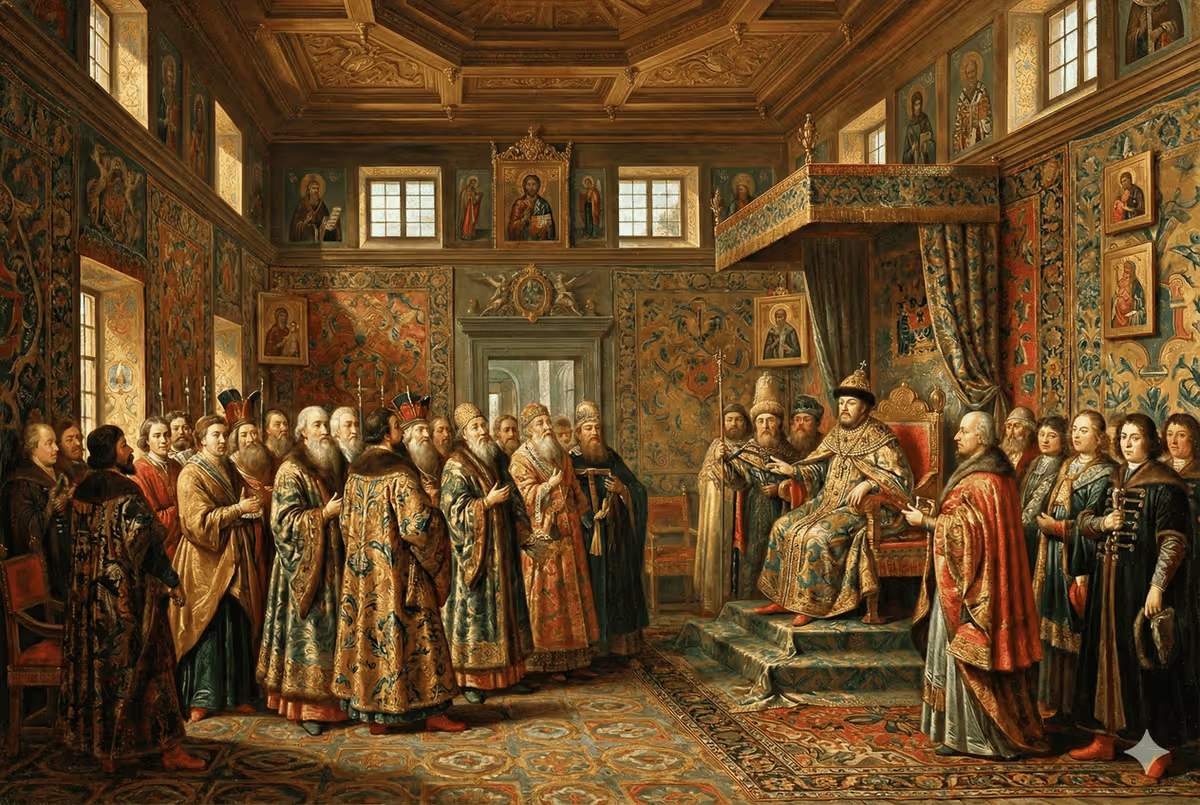
On 21 February 1613, after complex negotiations, the Zemsky Sobor proclaimed Mikhail Romanov tsar of all Russia. The assembly immediately sent a delegation to inform the elected man of his new destiny.
”No, I refuse!” — the refusal at the Kostroma monastery
The Zemsky Sobor’s envoys took several weeks to find Mikhail. The young man and his mother, Marfa Ivanovna, were hiding in the Ipatiev Monastery, near Kostroma, nearly 350 kilometres north-east of Moscow. Since the beginning of the Troubles, the Romanov family had learned to keep a low profile. Mikhail’s father, Fyodor Romanov, who had become the monk Philaret (Филарéт), was languishing in a Polish prison. Several of Mikhail’s uncles and cousins had died in Boris Godunov’s purges or at the hands of the false tsars. Keeping out of sight deep in a monastery seemed a reasonable survival strategy.
When the delegation arrived in Kostroma in early March 1613, it found a gaunt teenager, terrified at the thought of reigning. The scene that followed entered legend. Mikhail and his mother categorically refused the crown. Marfa, a woman of steely character who had seen her family broken by political intrigue, begged the boyars to leave her son alone. She listed the terrible fates of every tsar for the past twenty years: Boris possibly poisoned, his children massacred, Fyodor II strangled, the false Dmitrys assassinated, Vasily Shuisky dead in captivity. Why would her son, a defenceless child, escape that fate?
The envoys did not yield. They deployed religious arguments: to refuse the crown was to disobey the will of God as expressed by the Zemsky Sobor. They invoked patriotism: abandoning Russia in this moment of crisis would be a betrayal. They made barely veiled threats: the assembly had chosen Mikhail, there would be no other candidate, if Russia sank back into chaos, it would be his fault. For several days, the psychological pressure intensified. The local clergy joined the envoys. Crowds of peasants gathered around the monastery, begging young Romanov to accept.
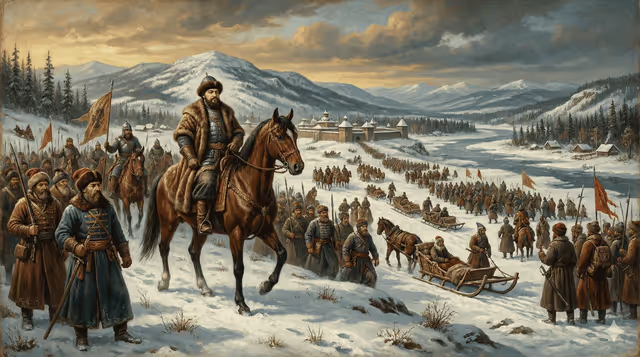
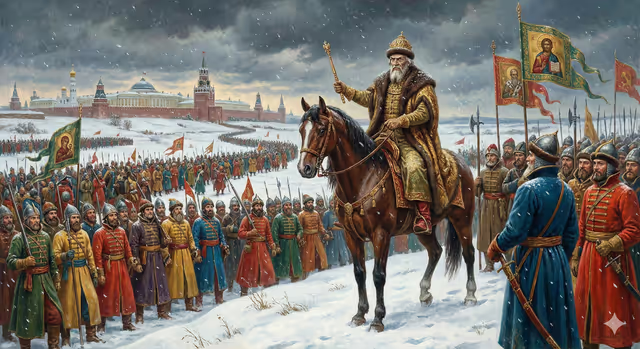
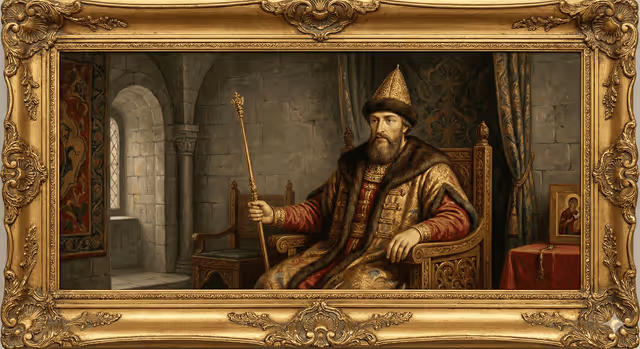
Finally, Marfa gave in. According to the chronicles, she declared: “Since God and the people command it, let God’s will be done.” On 14 March 1613, Mikhail officially accepted the crown. He left Kostroma for Moscow, where he arrived on 2 May after a seven-week triumphal journey through devastated provinces. On 11 July 1613, in the Cathedral of the Dormition in the Kremlin, the young man with the still-boyish face received holy unction and became Mikhail Fyodorovich, tsar and grand prince of all Russia, autocrat of Moscow, Vladimir, Novgorod and all the territories of the North, East and West.
Reigning over ruins: the first seven years of chaos
The coronation solved one problem and created a thousand others. Mikhail found himself at the head of a state that barely existed. The treasury was empty. The regular army counted barely a few thousand demoralised men. The administration had collapsed. In the provinces, dozens of warlords behaved like local lords. The Poles still occupied Smolensk and dreamed of revenge. The Swedes held Novgorod. The worst remained the Cossacks.
In 1614, a Cossack army led by an adventurer named Zaruzky marched on Moscow supporting the third False Dmitry, nicknamed “the Tushino brigand”. Mikhail, with no military experience, had to rely on his generals. Pozharsky and others managed to disperse this threat. Zaruzky ended up impaled, the False Dmitry hanged. But other bands emerged. Seven years of nearly continuous military campaigns would be needed to pacify the central provinces.
The young tsar reigned in theory but governed little in practice. A council of boyars, the Duma (Дýма), made the important decisions. The Zemsky Sobor met almost every year between 1613 and 1622, something unprecedented in Russian history. These assemblies voted the extraordinary taxes needed to finance war and reconstruction. Mikhail signed decrees (указ), received foreign ambassadors, presided over religious ceremonies — but the real decisions were made elsewhere.
Diplomacy achieved modest successes. In 1617, the Treaty of Stolbovo ended the war with Sweden. Russia recovered Novgorod but definitively lost access to the Baltic. In 1618, a truce with Poland was signed at Deulin. Władysław refused to abandon his claims to the Russian throne, but the fighting ceased. Smolensk remained Polish for the time being. These lame peaces nonetheless allowed Russia to breathe and begin internal reconstruction.
The father’s return: Philaret, shadow co-tsar (1619–1633)
In June 1619, an event radically transformed Mikhail’s reign: his father returned from Polish captivity. Fyodor Romanov, who had taken the monastic name Philaret in 1600 when Boris Godunov forced him into holy orders, returned to Moscow after nine years in prison. He was fifty-eight, possessed an iron will forged by years of suffering, and had very clear ideas about how to govern Russia.
Philaret wasted no time. Upon his return, he had himself elected Patriarch of Moscow and all Russia, the highest post in the Russian Orthodox Church. This function gave him immense power. But Philaret went further: he was granted the title of “Veliky Gosudár” (Вели́кий Госуда́рь), the “Great Sovereign”, the same title as his son the tsar. Both men signed all official documents together. Foreign ambassadors had to present their credentials to both sovereigns. In practice, from 1619 to 1633, Russia had two tsars.
This strange situation worked because Mikhail accepted his father’s authority without resistance. The son reigned, the father governed. Philaret reorganised the administration, created new prikazes (прика́зы, ministerial bureaus), restored discipline in the army, and negotiated firmly with foreign powers. He showed remarkable energy for a man fresh from prison. His domestic policy mixed strict religious conservatism and economic pragmatism. He encouraged trade, brought in foreign craftsmen to revive industry, but maintained Orthodoxy in absolute rigidity and persecuted “heretics” zealously.
Under Philaret’s impetus, Russia regained its footing. Treasury revenues gradually increased. Roads became passable again. Cities repopulated. Moscow emerged from its ruins. In 1632, Philaret even launched an offensive to retake Smolensk from the Poles. The campaign ended in humiliating failure in 1634, a year after the patriarch’s death, but showed that Russia could once again project military force beyond its borders.
Philaret died on 1 October 1633. Mikhail, now thirty-seven, finally found himself sole master on board. He had reigned twenty years but governed alone for barely twelve.
Russia recovered: a modest but viable state (1633–1645)
The last twelve years of Mikhail’s reign unfolded without particular brilliance — which was already a victory after the chaos of the preceding decades. The tsar, freed from paternal guardianship, revealed a cautious temperament, little inclined to adventure. He continued the policy of domestic reconstruction, avoided major military conflicts, and developed commercial relations with Europe.
The economy slowly recovered. The population increased again. Peasants returned to abandoned fields. Foreign merchants flocked to Moscow, drawn by Siberian furs and Russian hemp. The state’s coffers filled sufficiently to permit the rebuilding of fortifications, the payment of a regular army, and the maintenance of a functional central administration. By 1645, at Mikhail’s death, Russia had recovered its approximate borders of 1600, its traditional system of government, and its domestic stability.
Mikhail left behind no great reform, no spectacular conquest, no major architectural work. His reign was marked above all by what he avoided: no new civil war, no catastrophic famine, no successful foreign invasion, no victorious usurper. This normality, after the nightmare of the Troubles, was enough to legitimise the dynasty. Contemporaries called Mikhail “the Most Gentle” (Тиша́йший), an ambiguous title that reflected as much his self-effacing personality as the relative peace of his reign.
On a personal level, Mikhail married twice. His first wife, Maria Dolgorukova (Мари́я Долгору́кова), died in 1625 after only three months of marriage. In 1626, he married Yevdokia Streshneva (Евдоки́я Стре́шнева), who gave him ten children. Only three sons and three daughters survived, including the future Tsar Alexis I (Алексéй Михáйлович), born in 1629. The succession was thus secured — a crucial element for stabilising the nascent dynasty.
Mikhail died on 13 July 1645, at the age of forty-nine. His son Alexis, sixteen, succeeded him without opposition. For the first time since 1598, the transfer of power took place peacefully, from father to son, according to traditional dynastic rules.
A transitional reign that lasted three centuries
The balance of Mikhail Romanov’s reign lies in a paradox: this weak tsar founded the longest dynasty in Russian history. Elected in 1613 as a temporary compromise, he passed in 1645 a solidly established crown to his son. His family would reign until 1917 — exactly three hundred and four years.
Historians still debate the reasons for this unexpected success. Mikhail’s self-effacing personality allowed the institutions — the Zemsky Sobor, the boyar Duma, the prikazes — to function without an autocrat crushing everything. His reign marked the zenith of aristocratic power in Russia, before his successors progressively reinstated pure autocracy. The long period of Philaret gave the new regime time to consolidate. General weariness after the Troubles also played a role: Russians wanted stability at any price, even at the price of a mediocre tsar.
Mikhail Romanov does not figure among the great names of Russian history. He had neither Peter the Great’s military genius, nor Alexander II’s reforming ambition, nor even Ivan the Terrible’s controversial charisma. He remains that young man, terrified in a Kostroma monastery, who reluctantly accepted a poisoned crown and managed, without brilliance but without catastrophe, to wear it for thirty-two years and pass it on intact. In Russia’s chaotic history, this simple continuity was already a remarkable achievement.