Peter the Great: the brutal revolution in Russia
In 1697, a two-metre giant arrived incognito in Amsterdam to learn shipbuilding. He hired himself out as a simple carpenter in a shipyard. This tireless worker who slept four hours a night and tried his hand at every manual trade was none other than the tsar of all Russia.
Peter the Great: the brutal revolution that turned Russia toward Europe
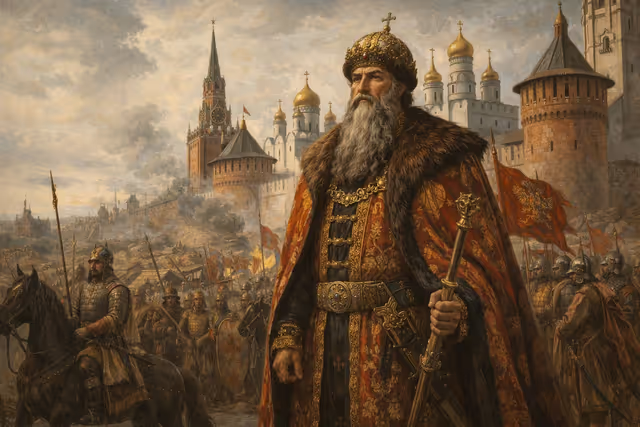
Between 1689 and 1725, Peter I (Пётр I, 1672–1725) would overturn 18th-century Russia by imposing a brutal Westernisation that transformed his medieval country into a European power — at the cost of a violence that would claim hundreds of thousands of lives. How could a single man so radically alter the destiny of an empire?
A tsar shaped by humiliation and rage
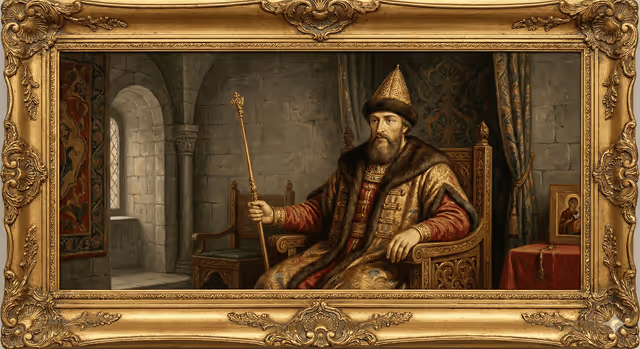
Peter’s story began in violence. He was born in 1672 in a Kremlin palace, the sixth son of Tsar Alexis Mikhailovich (Алексе́й Миха́йлович). His mother, Natalia Naryshkina (Ната́лья Нары́шкина), belonged to a clan opposed to the powerful Miloslavsky family. When Peter was ten, his half-brother Ivan V (Ива́н V) and he were proclaimed co-tsars under the regency of their sister Sophie (Софи́я). Young Peter then witnessed a massacre that marked him for life: in May 1682, the streltsy (стрельцы́) — palace guards in revolt — invaded the Kremlin. Before the horrified child’s eyes, they threw several of his uncles out of windows and impaled them on their pikes in the courtyard.
Pushed aside from power, Peter grew up away from Moscow, in the village of Preobrazhenskoye (Преображе́нское). There he drilled regiments of young nobles at war games, but these games quickly became serious. He frequented Moscow’s German Quarter, the Nemetskaya Sloboda (неме́цкая слобода́), where foreign craftsmen and officers lived. There he discovered Western techniques, learned Dutch and German, and developed a passion for navigation. In 1689, at seventeen, he overthrew his sister Sophie and finally seized real power.
The European apprenticeship of a disguised tsar
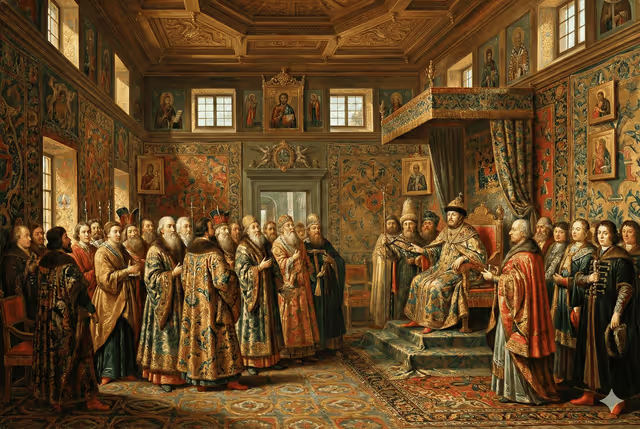
In March 1697, Peter accomplished an unheard-of gesture for a Russian sovereign: he left his country for an eighteen-month journey through Western Europe. He joined a Grand Embassy (Вели́кое посо́льство) of 250 people, officially led by three boyars, but everyone knew that the giant who called himself Peter Mikhailov (Пётр Миха́йлов) was the tsar himself. This transparent disguise allowed him to work with his hands free of protocol.
At Zaandam and then Amsterdam, he hired himself out in the shipyards of the Dutch East India Company. For four months, he learned to build ships, nailing planks, cutting masts, sleeping in a carpenter’s hut. The Dutch saw him arrive at dawn with an axe on his shoulder, ready to work until evening. At Deptford, near London, he continued his training in the royal arsenals. He visited factories, hospitals and astronomical observatories. He hired hundreds of technicians, engineers and doctors to bring back to Russia.
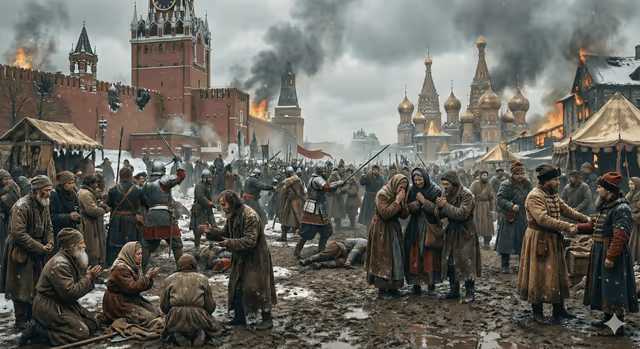
But in July 1698, catastrophic news forced him to return: the streltsy had revolted in Moscow. Peter came back furious and turned his revenge into a spectacle of terror. More than a thousand rebels were tortured and executed on Red Square. Peter himself took part in the beheadings, forcing boyars to wield the axe. He had corpses hung in the windows of the convent where his sister Sophie was imprisoned. The message was clear: the old regime had to die.
The Great Northern War and the birth of an empire
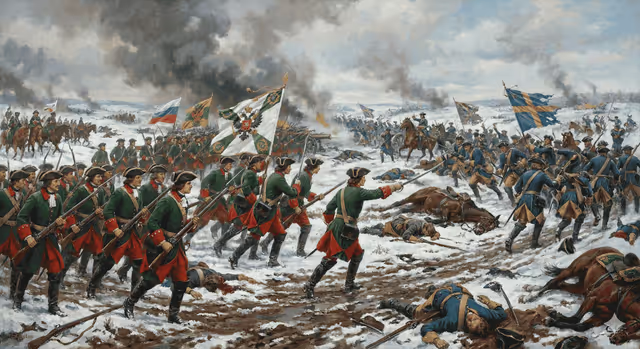
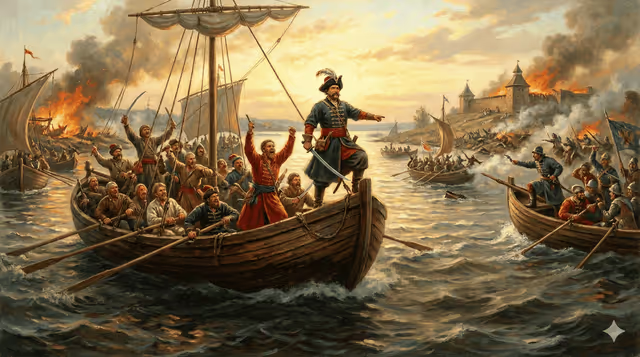
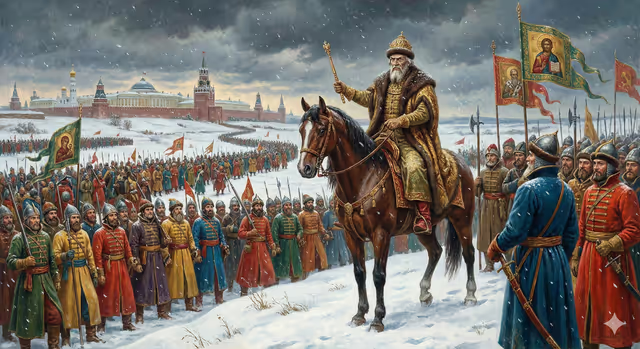
In 1700, Peter declared war on Sweden, then mistress of the Baltic. He wanted a “window onto Europe” (óкно в Евро́пу), access to the sea that would free Russia from its isolation. While Louis XIV dominated Western Europe, Peter intended to make Russia a power of the North. The first battle, at Narva in November 1700, turned into a disaster: the Swedish army of the young king Charles XII (Карл XII), four times smaller, crushed the poorly trained Russian troops. Forty Russian generals were taken prisoner. Europe sneered: Russia remained a barbarian country.
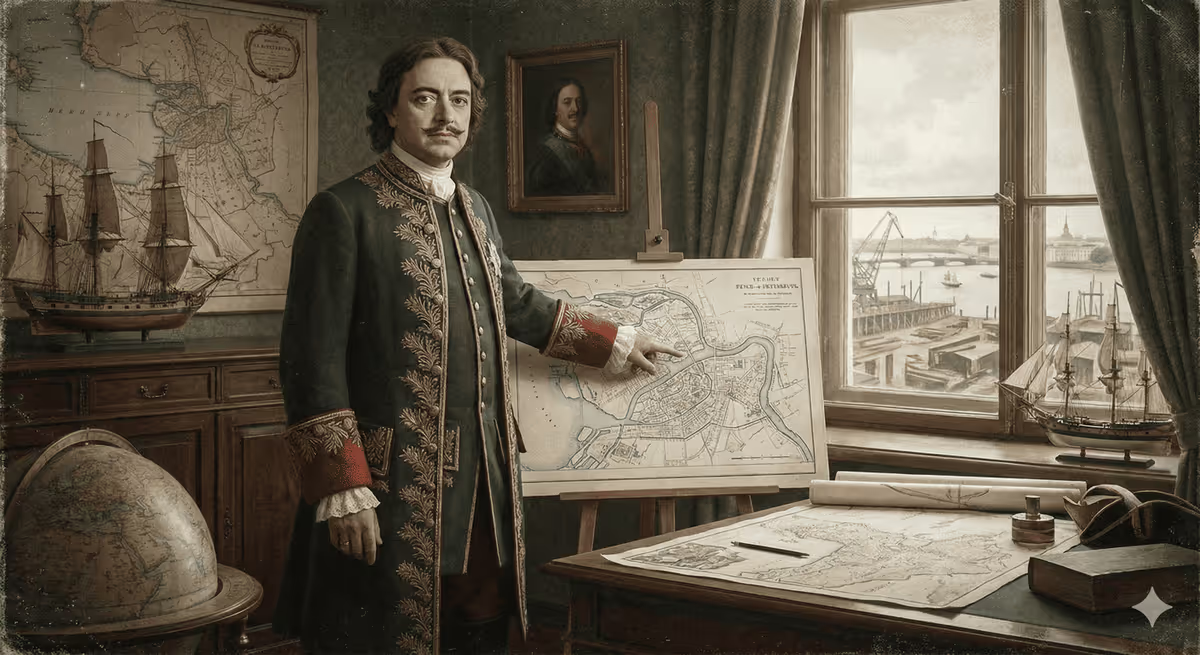
Peter was not discouraged. While Charles XII pursued the Poles and Saxons, the tsar rebuilt his army from the ground up with frantic energy. He created European-style regiments, had church bells melted to cast cannons, opened artillery and navigation schools. He imposed a tax on beards (налóг на бо́роды) to finance the war, forcing boyars to shave or pay. In 1703, he founded Saint Petersburg (Санкт-Петербу́рг) on marshes seized from the Swedes, at the mouth of the Neva.
The war stretched over twenty-one years. In 1709, Charles XII made the mistake of invading Ukraine in the middle of winter. At Poltava (Полта́ва), on 8 July, the Russian army won a crushing victory. The Swedes lost 9,000 men, the Russians 1,300. Charles fled to Turkey. This battle marked the turning point: Sweden ceased to be a great power, Russia became a major player in the European concert. In 1721, the Treaty of Nystad (Ни́штадтский мир) sealed the Russian victory. Peter took the title of emperor (импера́тор) and his Russia officially became an empire. The Russian empire now stood as a great European power, on the same footing as Louis XIV’s France or the Habsburg Austria.
A modernisation imposed at the point of the knout
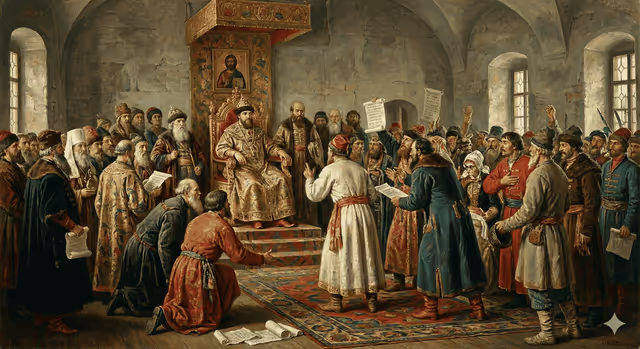
Peter did not content himself with winning wars. He wanted to transform every aspect of Russian society. Peter the Great’s reforms touched the administration, the army, the Church and even daily life. This policy of forced Westernisation aimed to align the Russian empire with European standards. In 1722, he promulgated the Table of Ranks (Табе́ль о ра́нгах), which revolutionised the nobility. Henceforth, status depended not on birth but on service to the state. A talented commoner could become a noble through military or administrative merit. The old boyar families lost their hereditary privileges.
He reorganised the administration by creating colleges (колле́гии) on the Swedish model: each ministry was directed not by one man but by a council of eleven members. He divided the empire into eight governorates (губе́рнии), each administered by a governor. He ordered the first census of the population to establish a poll tax (подушна́я по́дать). He created the Holy Synod (Святе́йший Сино́д) in 1721, placing the Orthodox Church under direct state control and suppressing the patriarchate.
Daily life changed brutally. Peter banned traditional Russian long coats and ordered nobles to wear European clothes. He imposed the Julian calendar, making the year begin in January rather than September. He founded Russia’s first newspaper, the Vedomosti (Вéдомости), in 1703. He compelled noblemen’s sons to study mathematics and navigation, refusing to let them marry if they failed their examinations. He opened schools of artillery, medicine and engineering. At his death, Russia had fifty printing presses where before it had had one.
A capital built on corpses
In May 1703, on a marshy island in the Neva, Peter laid the foundation stone of the Peter and Paul Fortress (Петропа́вловская кре́пость). This was the beginning of Saint Petersburg, his most audacious and most deadly creation. The site was appalling: mosquito-infested marshes, flooded six months of the year, swept by icy winds from the Baltic. But Peter wanted his European capital, facing West, far from old Moscow.
Tens of thousands of peasants were requisitioned each year to drain the marshes, drive in piles, and transport stone. They worked barefoot in icy water, slept in brushwood huts, and died of fever, dysentery and exhaustion. Estimates vary, but between 30,000 and 100,000 people perished during the twenty years of construction. Peter did not count lives. He ordered that every boat arriving at Saint Petersburg bring stones as a tax. He banned stone construction elsewhere in the empire to reserve materials for his city.
In 1712, he decreed that Saint Petersburg was the new capital. He forced nobles to settle there, assigning them plots where they had to build palaces to approved plans. Aristocratic families reluctantly abandoned their Moscow properties to crowd into unfinished residences surrounded by mud. Peter himself lived in a small three-room wooden house near the fortress, refusing all luxury. He wanted his capital to look like Amsterdam: canals, granite quays, brick facades. In twenty years, a city of 40,000 inhabitants sprang from nothing.
The human cost of a revolution from above
Peter ruled by terror as much as by reform. His right-hand man was Alexander Menshikov (Алекса́ндр Ме́ншиков), a groom’s son who became prince and generalissimo thanks to the Table of Ranks. Together, they created the Secret Chancellery (Та́йная канцеля́рия), a political police force that hunted opponents. A mere word of criticism against the tsar was sufficient grounds for torture and Siberian exile.
His own son, Tsarevich Alexis (царе́вич Алексе́й), embodied the old world Peter hated. Alexis preferred religious books to fortification manuals, took refuge in traditional Orthodox piety. In 1716, he fled to Austria. Peter had him brought back with a promise of pardon, then threw him in prison. In June 1718, after weeks of torture, Alexis died in his cell in the Peter and Paul Fortress. Did Peter order his execution? Did he attend his final moments? Documents disappeared, but the tsar showed no public remorse.
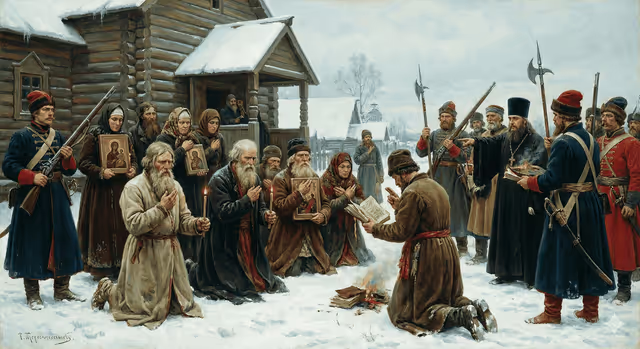
War, forced labour and famines provoked by requisitions may have killed a million people during Peter’s reign. The empire’s population stagnated despite territorial conquests. Peasants fled toward the southern steppes to escape military conscription and the poll tax. The Old Believers (старообря́дцы), attached to traditions, saw in the shaved, German-dressed tsar the incarnation of the Antichrist.
The legacy of a giant seen as demon or god
Peter died in February 1725, at fifty-two, from a urinary infection. To the very end, he refused to rest. In November 1724, spotting a ship in distress on the Neva, he plunged into the icy water to help save the crew. This recklessness worsened his illness. He died without having clearly designated a successor, triggering a period of instability that would last decades.
He left a Russia unrecognisable. The country now possessed the most powerful navy in the Baltic with 48 ships of the line and 800 galleys. The Russian navy, non-existent in 1700, rivalled those of Sweden and Denmark. The permanent army counted 200,000 troops trained in the European manner. The Russian empire stretched from the Baltic to the Caspian Sea, encompassing Estonia, Livonia, Ingria and part of Karelia wrested from Sweden. Saint Petersburg became the symbol of a Europeanised Russia, attracting Italian and French architects. Russian autocracy was reinforced, but modernised.
But this modernisation remained superficial. The vast majority of peasants continued to live as in the Middle Ages. Serfdom had even hardened to finance the wars and construction projects. The nobles spoke French and wore wigs, but governed their estates like despots. Peter’s Russia was a colossus with feet of clay: a Westernised elite ruled over millions of illiterate serfs who detested the novelties imposed by force. This fracture would run through all of Russian history until the revolution of 1917.
Peter created the modern Russian imperial state, but at the cost of a brutality that speaks volumes about the means employed to transform a society at forced march. Neither angel nor demon, he remains an autocrat who used violence as a tool of modernisation, convinced that Russia had to be whipped into entering European history.