The Time of Troubles in Russia (1598–1613): false tsars, famine and invasions
When Russia nearly ceased to exist: fifteen years of chaos that forged Russian mistrust of anarchy.
How could an empire that had just completed the conquest of Siberia find itself, in barely fifteen years, on the brink of total disintegration? Between 1598 and 1613, Russia experienced the Time of Troubles (Смýтное врéмя), a period when all reference points collapsed simultaneously: the dynasty died out, three impostors proclaimed themselves tsar, the Poles occupied the Kremlin, the Swedes took Novgorod, and famine killed a third of the population. For fifteen years, no one truly knew who governed Russia — or even whether Russia still existed.
The death of a child that shook an empire
On 15 May 1591, in the small town of Uglich on the Volga, Tsarevich Dmitry (Дми́трий), aged eight, died in murky circumstances. The youngest son of Ivan the Terrible, the child was in exile with his mother since his half-brother Fyodor (Фёдор) had been reigning in Moscow. The official version spoke of an epileptic seizure: Dmitry was playing with a knife with companions when he fell and cut his own throat. The child’s mother cried murder. An enraged mob massacred the presumed assassins. An inquiry led by Vasily Shuisky concluded it was an accident.
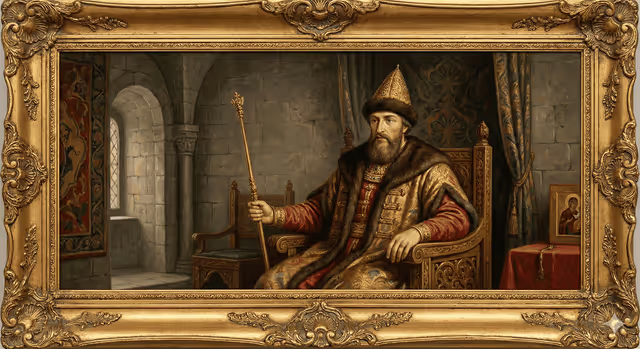
No one truly believed it. Rumours pointed to Boris Godunov, the tsar’s brother-in-law who effectively governed the country. Fyodor, pious and simple-minded, spent his days ringing church bells. It was Boris, a skilled politician and capable administrator, who held the reins. With Dmitry’s death, the last male heir of the Rurikid dynasty (Рю́риковичи), which had reigned for seven centuries, disappeared. When Fyodor died childless in 1598, the line went extinct. An elected tsar, Boris Godunov, ascended the throne — an unprecedented event that shook the very legitimacy of power.
The years of ash and hunger
Boris governed well at first. He sent young nobles to study in Europe, encouraged trade, maintained peace with Poland and Sweden. But in 1601, the climate turned. The summer rains would not stop. The harvests rotted in the fields. Winter came early and brutal. The following summer, another freeze in the middle of August. For three consecutive years, the harvests were lost. Russia plunged into a famine of unprecedented scale.
In the countryside, people ate bark, then grass, then nothing at all. Peasants abandoned their estates, wandered the roads. Bands of brigands sprang up everywhere. In Moscow, corpses piled up in the streets. Boris opened the tsar’s granaries, organised grain distributions, launched public works to employ the hungry. Nothing helped. Some two million dead were spoken of — a third of the population. In a deeply Orthodox country, this catastrophe could only be divine punishment. The elected tsar was paying for a crime attributed to him: the murder of the child Dmitry, twelve years earlier.
The first impostor emerges from Poland
In 1603, a young man presented himself at the court of the Polish magnate Adam Vishnevetsky (Адам Ви́шневецкий). He claimed to be Tsarevich Dmitry, miraculously saved from the Uglich massacre. The story he told held together: a devoted servant had substituted another child in his place. Dmitry had hidden for twelve years before fleeing to Poland. Vishnevetsky and other Polish nobles immediately saw the opportunity: installing a tsar who would owe them everything.
This False Dmitry was probably Grigory Otrepyev, a former runaway monk. No matter. He knew details about the Moscow court, spoke with confidence, and charmed by his manner. He secretly converted to Catholicism, promised to unite the Orthodox Church with Rome, and secretly married the daughter of a Polish nobleman. In October 1604, he crossed the border with a small army of Polish mercenaries and Cossacks.
The reception astonished him. City after city rallied to his cause. Starving peasants saw in him the legitimate tsar, the one who would end the divine punishment. Boris’s armies melted away or deserted. In April 1605, as the impostor approached Moscow, Boris Godunov died suddenly — perhaps poisoned, perhaps struck down by an attack. His son Fyodor, sixteen, reigned for a few weeks before being strangled with his mother. On 20 June 1605, False Dmitry entered Moscow in triumph. The crowd cheered him.
A reign of eleven months and a fatal wedding
The new tsar surprised everyone. Energetic and intelligent, he governed with astonishing competence. He reduced taxes, amnestied exiles, modernised the administration. But he made blunders. He kept around him Polish mercenaries who looted and provoked Muscovites. He neglected Orthodox fasts, ate veal — a suspect meat for Russians. He refused to nap after lunch, a sacred custom of the tsars. These details accumulated, feeding doubts.
The fatal mistake came in May 1606. Dmitry publicly married Marina Mniszech (Мари́на Мнишек), a Polish Catholic. Thousands of Polish nobles flooded Moscow for the wedding. They behaved like conquerors, drinking and brawling in the streets. The boyar Vasily Shuisky — the very one who had investigated Dmitry’s death fifteen years earlier — organised a coup. At dawn on 17 May 1606, conspirators entered the Kremlin to the sound of bells. Dmitry tried to escape through a window, crashed to the ground. The conspirators finished him off. His body, displayed on Red Square with a jester’s mask, was burned. His ashes were loaded into a cannon and fired westward, toward Poland whence he came.
Anarchy takes hold
Vasily Shuisky had himself proclaimed tsar by an assembly of boyars. But his authority barely extended beyond Moscow. In the south, a former slave named Ivan Bolotnikov raised a motley army of revolted serfs, Cossacks and disgruntled nobles. He besieged Moscow for months before being defeated and executed. Barely had this revolt been crushed than a second False Dmitry appeared in 1607.
This one, whose real identity no one knew, settled at Tushino, a village fifteen kilometres from Moscow. He set up there a complete rival court with its own boyars, its own patriarch, its own army. Marina Mniszech, widow of the first impostor, recognised him as her husband — miracle or political cynicism. Russia found itself with two tsars, two governments, two administrations levying taxes on the same territories. Populations no longer knew whom to obey. Civil war became total.
In 1609, the King of Poland, Sigismund III, decided to intervene directly. He besieged Smolensk, key to the road to Moscow. Vasily Shuisky called the Swedes to his aid, ceding territories in the north. Poland and Sweden, hereditary enemies, thus found themselves both at war on Russian soil. The second False Dmitry fled Tushino disguised as a peasant when the Poles approached. He would be assassinated by one of his own Tatar guards in December 1610.
Foreign occupation
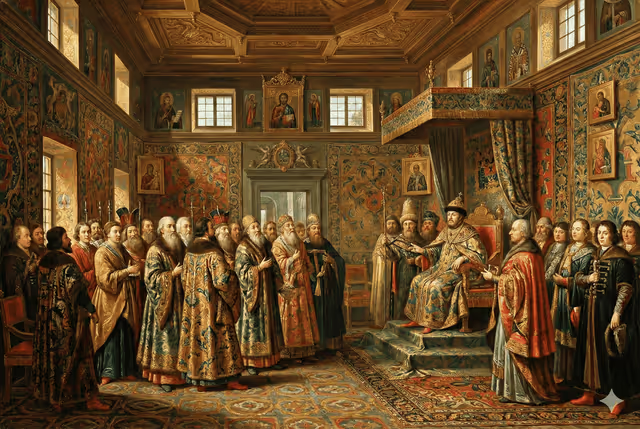
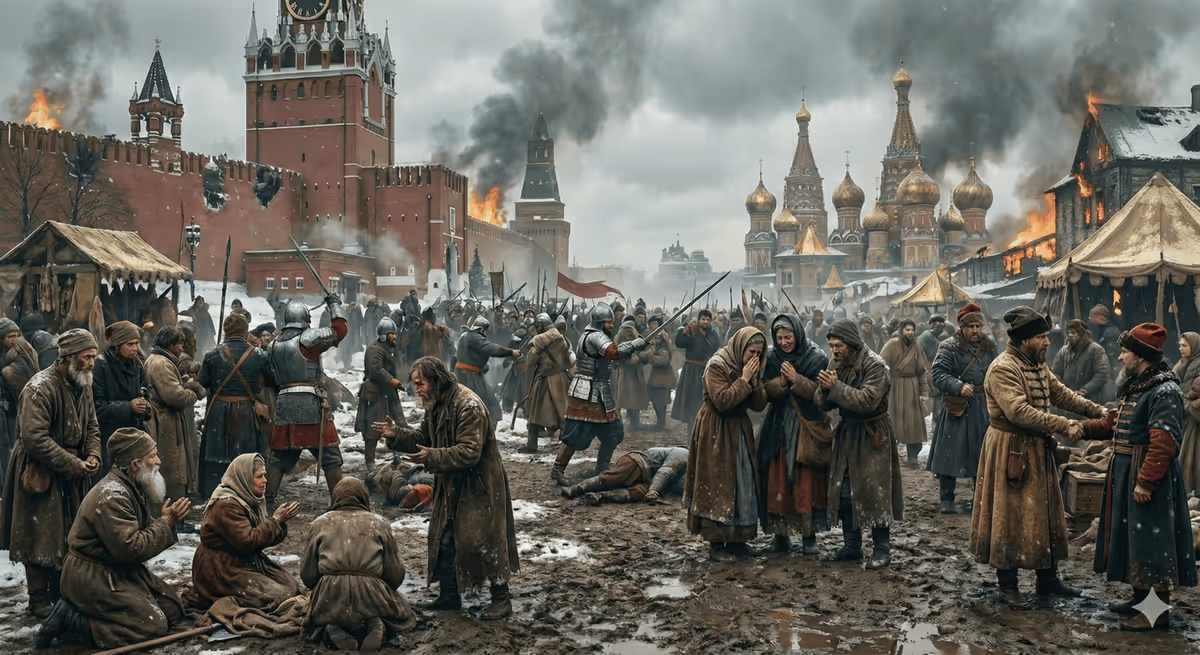
In July 1610, the Moscow boyars overthrew Vasily Shuisky and forced him to take the monastic habit. They offered the crown to Sigismund’s son, Prince Vladislav (Владисла́в), fifteen years old, on condition that he convert to Orthodoxy. Sigismund agreed — but it was he who wanted to reign. In September 1610, Polish troops entered Moscow. The Kremlin was occupied by a foreign garrison. Smolensk fell in June 1611 after a twenty-one month siege. The Swedes took Novgorod. Russia no longer existed as an independent state.
Armed bands of all nationalities roamed the country. Polish, Swedish and German adventurers carved out personal fiefdoms. Cossacks pillaged indiscriminately. Some cities changed hands five or six times in a few months. Peasants hid or fled into the forests. The population of certain regions fell by half. The collapse seemed irreversible.
The national resistance organises
The recovery came from the north. In September 1611, a butcher from Nizhny Novgorod (Ни́жний Нóвгород), Kuzma Minin, called for the formation of a militia to liberate Moscow. He persuaded the inhabitants to give a third of their goods to equip an army. A thirty-two-year-old boyar, Prince Dmitry Pozharsky, took military command. For months, they gathered forces, recruited from the Volga cities, and organised a provisional government.
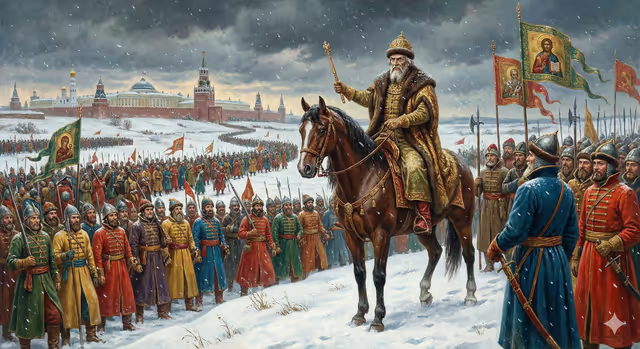
In August 1612, the Minin and Pozharsky militia arrived beneath the walls of Moscow. The Poles held the Kremlin but were running out of supplies. The siege lasted months. In the starving Kremlin, the besieged first ate their horses, then their dogs, then their dead. On 4 November 1612, the Russian militias stormed the Kitai-gorod (Кита́й-го́род) fortress adjoining the Kremlin. Five days later, the Poles capitulated. Moscow was liberated.
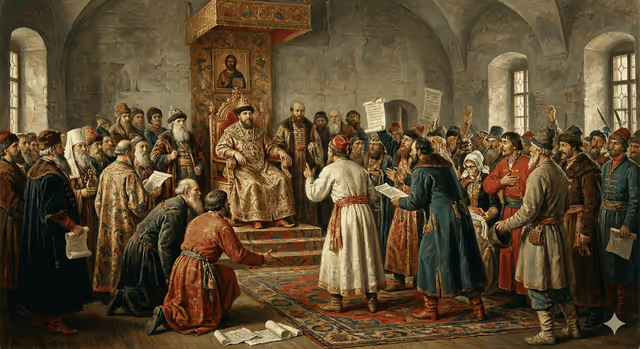
But who would reign? The country had had no tsar for two years. In January 1613, a Zemsky Sobor (Земский собóр), an assembly of the land representing all social classes, convened in Moscow. Seven hundred delegates from across the country debated for weeks. They eliminated foreign candidates, compromised boyars and adventurers. On 21 February 1613, they elected Mikhail Fyodorovich Romanov (Михаи́л Фёдорович Романóв), sixteen years old, grand-nephew of Tsar Ivan the Terrible through his first wife.
The final convulsions
The election of Mikhail did not instantly end the chaos. The young tsar first had to be found: he was hiding with his mother in a monastery near Kostroma (Костромá), terrified at the thought of ascending this cursed throne. Polish bands hunted him for assassination. A peasant named Ivan Susanin (Ива́н Сусáнин) led them astray in a marshy forest where they perished of cold — an exploit that would enter national legend.
Even crowned, Mikhail barely controlled the territory around Moscow. Another three years of fierce fighting were needed to drive out the last Polish and Swedish garrisons. Peace with Sweden was signed in 1617: Russia lost access to the Baltic. Peace with Poland came in 1618: Smolensk and other western towns remained Polish. But the essential was preserved: an independent Russian state existed once more, unified under a dynasty that would reign for three centuries.
Fifteen years that changed everything
When calm returned around 1620, the Russia that emerged from the Time of Troubles was no longer the one of before 1598. Serfdom had hardened: peasants who had taken advantage of the chaos to flee the estates were now bound to the land by stricter laws. The tsar’s power, contested for fifteen years, rebuilt itself on more authoritarian foundations. The boyars, the traditional old nobility, had lost their luster to a lesser service nobility that had saved the country.
The Time of Troubles left in collective Russian memory an enduring terror of the absence of power. For fifteen years, Russians had lived the nightmare of total anarchy: famine, civil war, invasions, impostors. This experience forged a deep mistrust of anything that might shake the established order. Stability, even at the price of freedom, became a cardinal value. The militias of Minin and Pozharsky, celebrated as saviours of the nation, also show that in the absence of central power, it was organised people who preserved the state. A paradox whose consequences would unfold for centuries.