The Russian Old Believers: the great Orthodox schism of 1666
How correcting a few liturgical gestures caused the greatest religious fracture in Russian history
In 1666, in a Moscow cell, a priest with wild hair traced fiery lines on parchment. Archpriest Avvakum Petrov (Аввакýм Петрóв) was writing his autobiography — the first text of its kind in the Russian language. Outside, the Orthodox Church condemned him as a heretic. His crime? Refusing to change the way the faithful made the sign of the cross. This seemingly trivial quarrel tore Russia into two irreconcilable camps and caused tens of thousands of deaths. How did a liturgical reform intended to unify the Orthodox Church produce the deepest schism in its history?
An isolated Russian Church, proud of its particularities
At the beginning of the 17th century, the Russian Orthodox Church celebrated its offices according to rituals that had drifted, over the centuries, from the original Greek practices. The faithful made the sign of the cross with two fingers, pronounced Isous (Исýс) instead of Iisous (Иисýс) for the name of Jesus, and conducted religious processions clockwise. These Russian particularities disturbed no one: after the fall of Constantinople in 1453, Moscow considered itself the “Third Rome”, guardian of the true Orthodox faith.
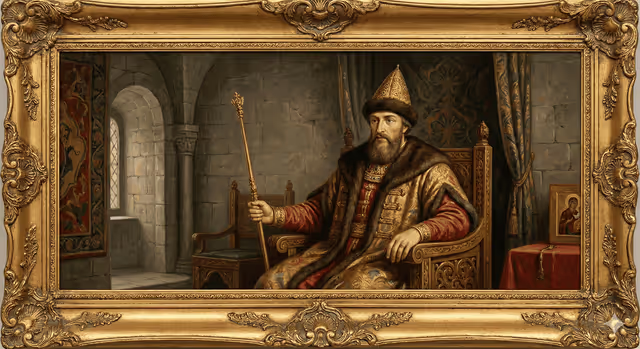
But in the 1640s, a group of zealous reformers around Tsar Alexis Mikhailovich (Алексéй Михáйлович) noticed that Russian liturgical books were riddled with copyist errors accumulated over centuries. The young priest Avvakum was part of this circle of piety zealots. All wanted to purify religious practices. History’s irony: Avvakum would soon fight against the very people with whom he had initially shared a desire for reform.
Nikon unleashes the storm (1652–1658)
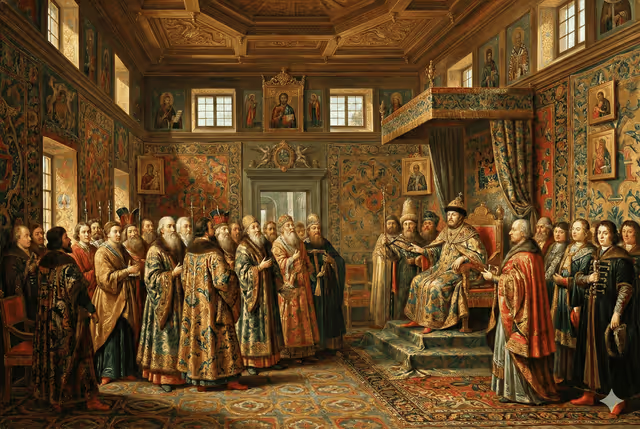
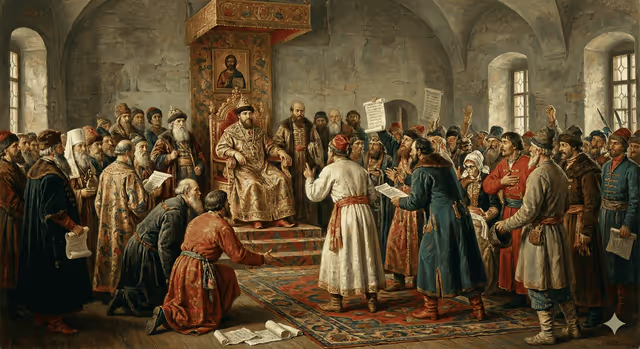
In 1652, Alexis appointed his friend Nikon (Никóн) as Patriarch of Moscow. This former monk with an authoritarian temperament immediately launched a radical reform. His objective: to harmonise Russian practices with those of the Greeks, which he considered purer and more ancient. In 1653, he published a decree changing gestures and words that had been transmitted for generations.
The changes seemed minuscule. The sign of the cross was now to be made with three fingers instead of two. Jesus’s name was spelled with two “i”s. Processions turned counter-clockwise. The alleluias (аллилýйя) were repeated three times instead of two. But for millions of Russians, these modifications touched the sacred. How could practices transmitted by their ancestors since the baptism of Rus’ (Русь) in 988 be wrong?
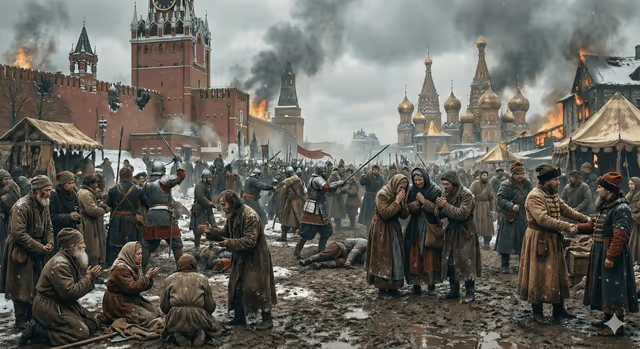
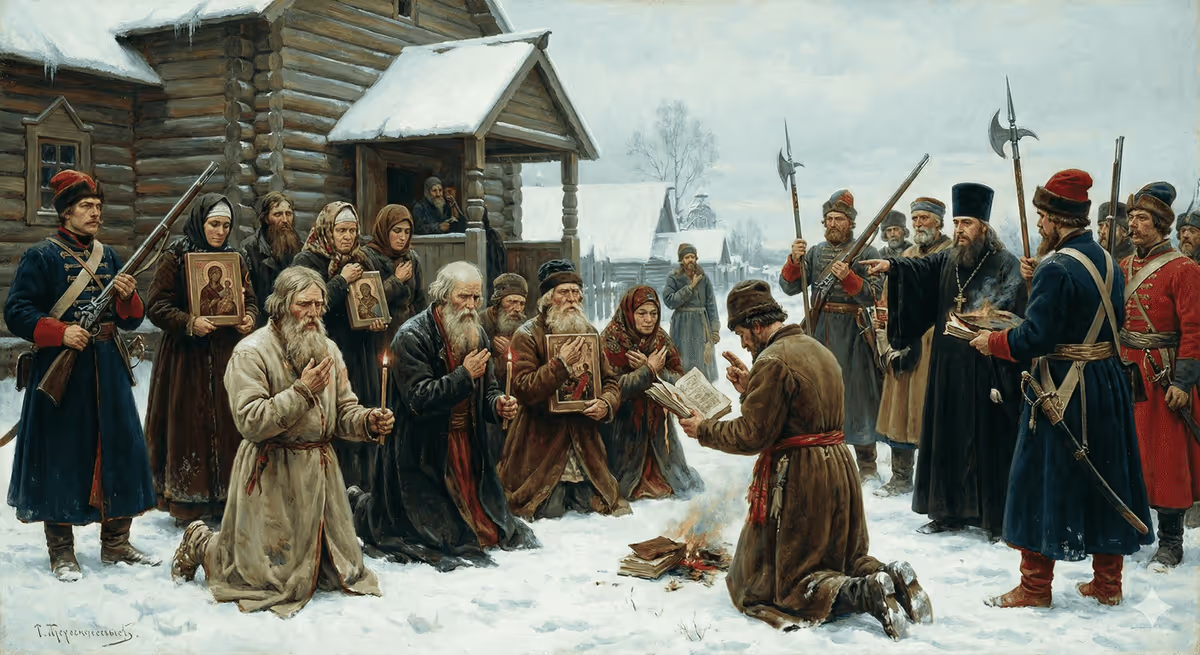
Nikon did not merely decree: he imposed. His envoys crossed the country to burn old liturgical books and arrest recalcitrant priests. Archpriest Avvakum, who refused to submit, was exiled to Siberia in 1653. Others suffered the same fate. The patriarch, certain he possessed the truth, crushed all resistance.
”Better to burn than to bend”: resistance organises
Exile did not silence Avvakum. From the eastern Siberia where he survived in appalling conditions, he wrote incendiary letters that circulated clandestinely. For him and his supporters, Nikon’s reforms did not correct errors — they betrayed the true faith. To change the two-finger sign of the cross was to reject the symbol of Christ’s two natures, divine and human. To accept Greek innovations was to submit to a Church compromised by the Ottoman Turks.
The Old Believers (старообря́дцы), literally “those who keep the ancient faith”, multiplied in every layer of society. Influential boyars, prestigious monks, merchants, craftsmen and peasants refused the new rituals. The boyar nun Morozova (боя́рыня Морóзова), close to the imperial family, became one of the key figures of resistance. Arrested in 1671, she died of starvation in an underground prison in 1675, refusing to the very end to raise three fingers for the sign of the cross.
The movement had no centralised organisation, but shared a conviction: Nikon’s reforms heralded the coming of the Antichrist (Антихри́ст). The Old Believers drew on apocalyptic texts to interpret events: the heretical patriarch, the tsar who supported him, the persecution of true believers — all corresponded to the prophecies of the end of days.
The purifying fire: when persecution led to collective suicide
In 1666–1667, a council of the Russian Church definitively condemned the ancient practices and anathematised those who clung to them. Avvakum, brought back from Siberia to be tried, refused to recant. He was sent back into exile, this time to the fortress-monastery of Pustozersk (Пустозéрск), beyond the Arctic Circle. There he wrote his autobiography, a text of exceptional literary power that made him a living martyr.
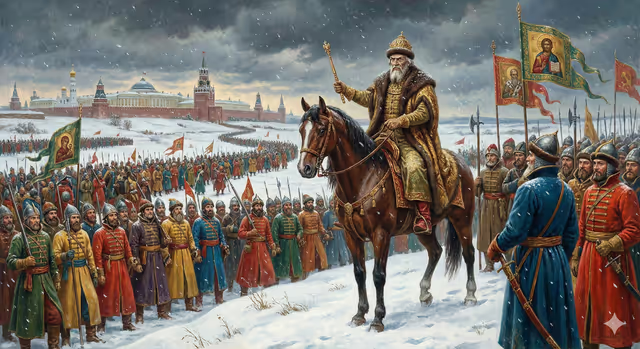
Repression intensified under Tsar Fyodor III (Фëдор III) and especially under Peter the Great (Пëтр I). Old Believers who refused to submit lost their civil rights, paid double taxes, and had their children taken away for “re-education”. Faced with this persecution, certain communities chose a terrible way out: collective self-immolation (самосожжéние).
Between 1670 and 1690, thousands of Old Believers barricaded themselves in wooden churches or isbas (избы́, traditional houses) and set them on fire. Men, women and children preferred to burn alive rather than accept the “faith of the Antichrist”. In 1679, at the Paleoostrov monastery (Палеóстров) on Lake Onega (Онéга), 2,700 people perished this way. These collective immolations marked the apex of the schism: for radical Old Believers, the old world had ended and only a purifying death could save souls.
In 1682, Avvakum and his last companions at Pustozersk were burned on the tsar’s orders. The authorities hoped to behead the movement. The opposite effect occurred: the archpriest became a saintly martyr whose writings circulated underground for centuries.
Survival on the margins of the empire
Old Believers who escaped death or forced conversion organised their survival. Some fled to remote regions: the forests of the North, Siberia, the Ural mountains (Оурáл), the empire’s distant reaches where the tsar’s authority weighed less heavily. Others went into exile outside Russia — to Poland-Lithuania, the Balkans, even Ottoman Turkey.
These communities developed separate ways of life. Refusing priests ordained by the official Church which they considered heretical, some groups — the priestless (беспоповцы́) — organised services without clergy. Others — the priestly (поповцы́) — sought out priests ordained before the schism or who had rallied to their cause. The Old Believers rigorously maintained the ancient rituals, wore beards that Peter the Great had forbidden, refused tobacco and alcohol, and kept traditional clothing.
Paradoxically, this marginalisation favoured their economic development. Excluded from official functions, the Old Believers devoted themselves to trade and craftsmanship. In the 18th and 19th centuries, many of them became wealthy merchants, financed textile industries, and actively participated in Russia’s economic modernisation while rejecting its religious and cultural modernisation.
A schism that never heals
The schism (Раскóл) that tore the Russian Church apart in the 17th century did not close. In 1905, after the revolution, Tsar Nicholas II (Николáй II) finally granted freedom of worship to the Old Believers. They could build churches, publish their books, and practice openly. At that date, there were between 10 and 20 million Old Believers in the empire.
The Bolshevik revolution of 1917 struck both Orthodox Churches equally — official and Old Believer. But the Old Believer communities, accustomed for two and a half centuries to surviving in clandestinity and persecution, sometimes resisted Soviet repression better.
Today, communities of Old Believers still survive in Russia, Romania, South America and elsewhere, preserving liturgical rituals identical to those of 17th-century Russia. The two-finger sign of the cross that Avvakum defended until death lives on in these enclaves of frozen time.