The Stenka Razin revolt on the Volga (1670–1671)
When a Cossack brigand defied the tsar
In June 1671, a man was drawn and quartered in a public square in Moscow before thousands of spectators. His name: Stepan Razin, known as Stenka. A few months earlier, this Cossack chieftain had controlled a territory the size of France, and his supporters threatened the capital itself. How could a simple ataman of the Don set the entire Volga ablaze and endanger the young Romanov dynasty? And why, more than three centuries after his death, do Russians still sing of his exploits?
A Cossack in a changing Russia
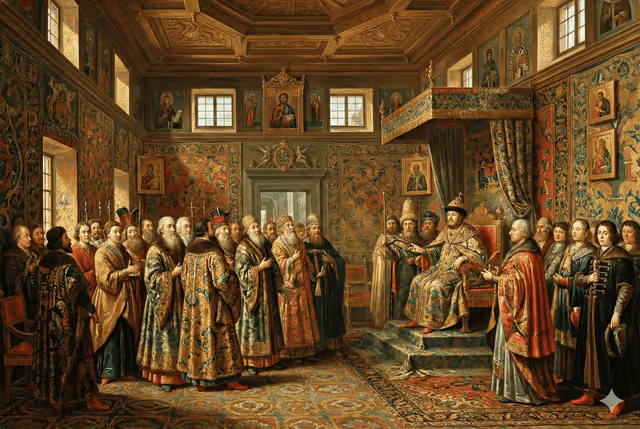
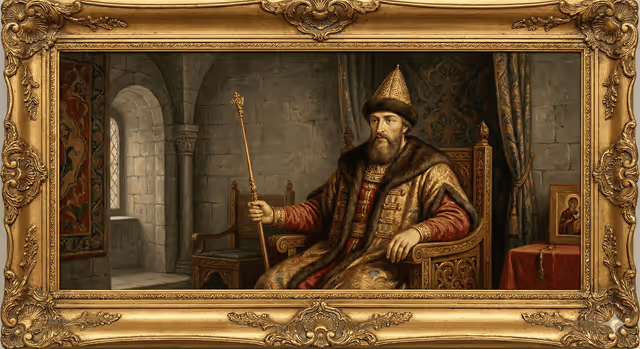
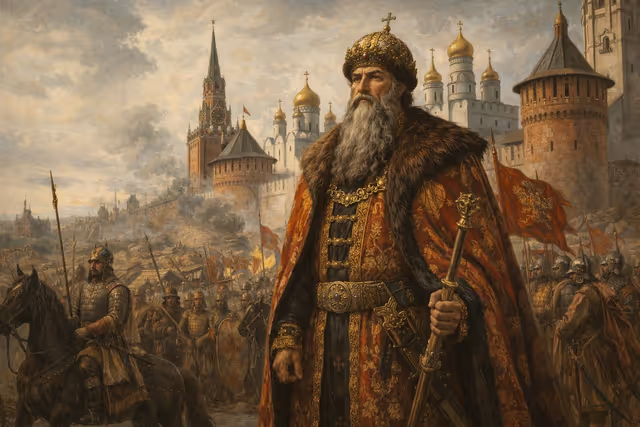
Stepan Timofeyevich Razin was born around 1630 in a stanitsa (станица), a Cossack village on the Don. At that time, the Don was a semi-autonomous border region where Cossacks lived by their own laws. These warrior-peasants knew neither serfdom nor lords: they elected their chiefs and rejected all outside authority. Tsar Alexis Mikhailovich (Алексе́й Миха́йлович) tolerated this independence as long as the Cossacks defended the southern borders against the Tatars and Ottomans.
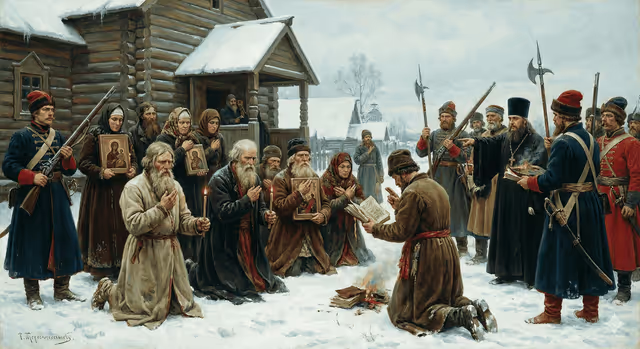
But in the 1660s, the situation changed. Moscow was progressively imposing its control over these free lands. The tsar’s officials settled in cities, collected taxes and demanded obedience. Worse still: in 1649, a new code of laws, the Ulozhenie (Уложе́ние), permanently bound peasants to the land. Tens of thousands of serfs then fled toward the Don, hoping to find freedom there. But Moscow now demanded their extradition.
Stenka Razin grew up in this explosive context. Unlike most illiterate Cossacks, he could read and write. He travelled, engaged in trade, participated in embassies to Moscow. In 1665, his elder brother Ivan was executed on the orders of a Moscow governor. This event marked a turning point. The man who had sung and drunk in the Don taverns became a man of vengeance.
The Persian expedition: from piracy to legend
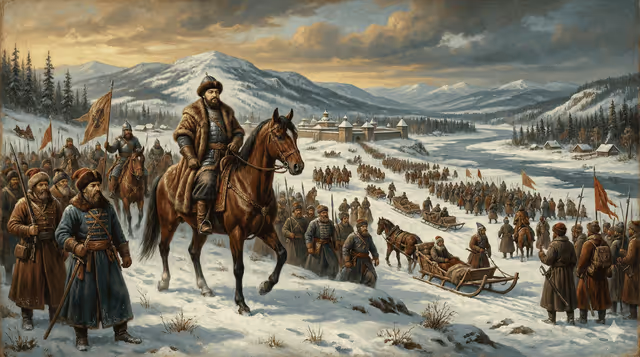
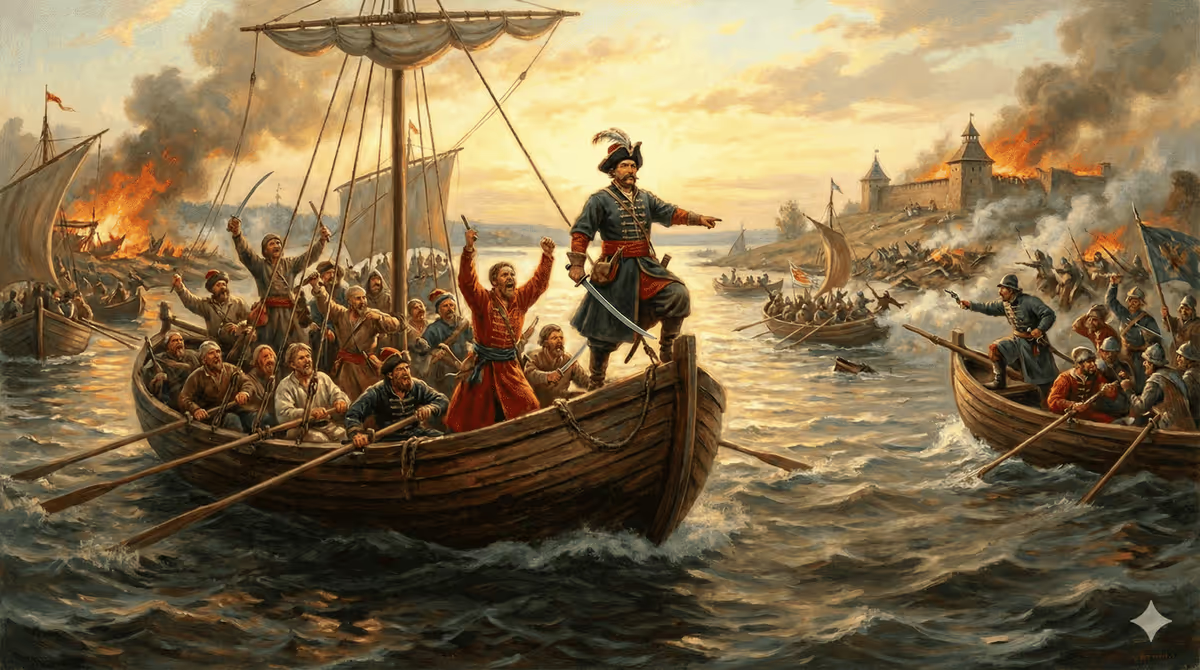
In 1667, Stenka gathered a few hundred discontented Cossacks and descended the Volga. Officially, he was going to fight the Tatars. In reality, he looted. At Tsaritsyn (Цари́цын, future Stalingrad), he attacked the Moscow garrison and seized cannons. Then he sailed downriver to the Caspian Sea.
For two years, Razin’s fleet terrorised the Persian coasts. He attacked Derbent, pillaged Baku, captured merchant ships laden with silk and spices. Legend has it that he abducted the daughter of a Persian prince and made her his mistress. Popular songs would later immortalise this moment: “For your love, for your freedom, I have given up everything, oh Volga my mother.”
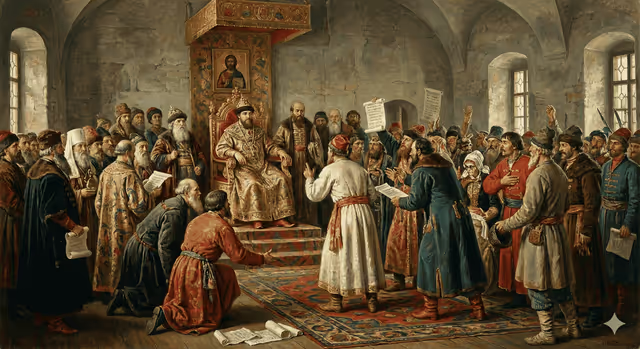
In 1669, Stenka returned victorious to the Don. His boats overflowed with treasures. Thousands of fugitive serfs, army deserters and social outcasts joined him. The tsar sent envoys to negotiate. Razin played along: he swore loyalty, surrendered part of his loot, and asked for a pardon. Alexis Mikhailovich hesitated, then granted it. A fatal mistake.
The Volga in flames: the summer of all hopes
In the spring of 1670, Stenka struck again. This time, it was no longer a looting expedition — it was a social war. His army now numbered several thousand men: Don Cossacks, serf peasants, revolting streltsy (стрельцы́) soldiers, oppressed non-Russian minorities — Chuvash, Tatars, Mordvins. All shared one thing in common: hatred of Moscow and its boyars.
In May, Razin took Tsaritsyn without firing a shot: the garrison rallied to him. In June, it was Astrakhan (Астраха́нь), the great fortified city at the Volga delta, that fell. The governor was thrown from the ramparts. The merchants’ warehouses were distributed to the poor. The cadastral archives — registers recording the serfs — went up in flames. Stenka proclaimed freedom for all.
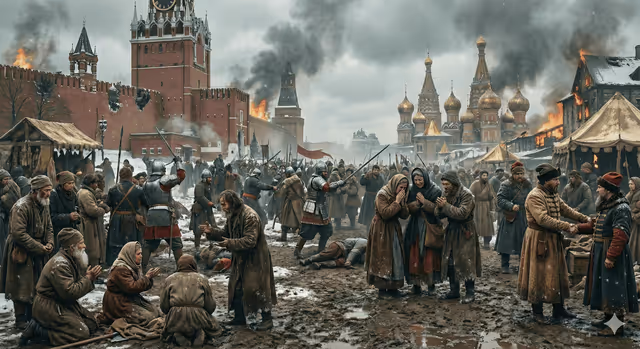
The shockwave travelled back up the Volga at terrifying speed. Saratov, Samara, Simbirsk: city after city, populations rose up. Peasants massacred their lords and burned their manors. The tsar’s officials were hanged or drowned. Razin sent fiery letters: “Come all of you, I give you freedom! No more boyars, no more taxes!” Entire regions slipped out of Moscow’s control.
The Razin system: anarchy or revolution?
In the conquered territories, Stenka established a strange order, a mixture of Cossack justice and violent chaos. He convened popular assemblies, the krugi (круги́), where anyone could speak. Decisions were made by consensus. The wealthy were stripped of their goods, redistributed. But this equality came with terrible violence: nobles, priests and merchants were often summarily executed.
Razin presented himself as the envoy of the “true tsar”. According to him, Alexis Mikhailovich was dead (which was false) and had been replaced by an impostor in the hands of treacherous boyars. He claimed to have with him the deceased tsarevich and the deposed Patriarch Nikon. This political fiction allowed him to rebel not against the tsar, but against his “evil advisers” — a classic pattern of peasant revolts.
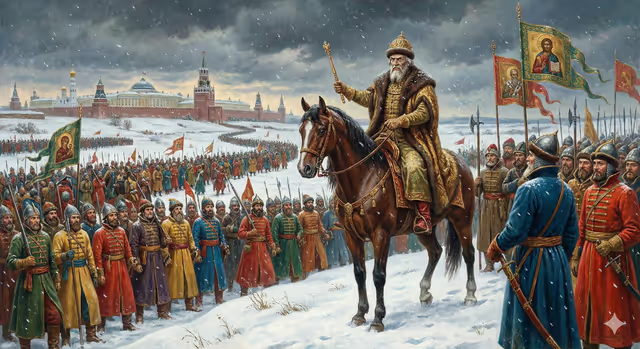
In September 1670, the rebel army reached Simbirsk (Симби́рск), halfway to Moscow. The city held out. Stenka besieged it for a month, but his forces, consisting mainly of poorly armed peasants, could not take it. This was the turning point. The tsar’s regular troops, commanded by Prince Yuri Baryatinsky (Ю́рий Баря́тинский), were approaching.
The collapse: from defeat to betrayal
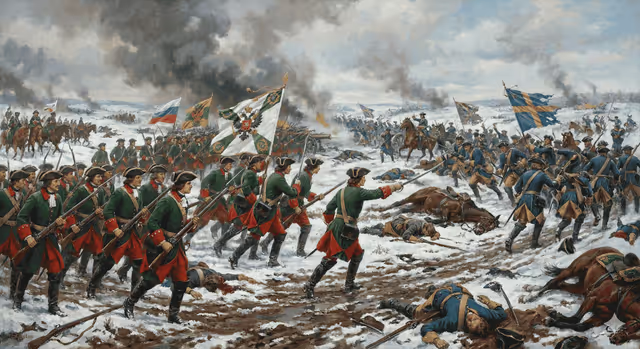
On 4 October 1670, the armies clashed beneath the walls of Simbirsk. The fighting was fierce. Razin was wounded in the leg and head. His men, less disciplined and less well equipped, fell back. The defeat turned into a rout. Stenka fled south with a few hundred loyal followers.
The winter of 1670–1671 saw the methodical reconquest of rebel territories. The tsar’s troops showed no mercy. At Arzamas, General Dolgoruky (Долгорýкий) had a “forest” of gallows erected: thousands were hanged, broken on the wheel, impaled. Entire villages were burned. Prisoners were branded with hot irons, their noses and ears cut off, then sent home as living warnings.
Razin took refuge in his native region on the Don, hoping to rebuild his forces. But the prosperous Cossacks, the starchiki (ста́рички), the “elders”, had never truly supported this revolt which threatened their own power. On 14 April 1671, the new ataman of the Don, Kornila Yakovlev (Корни́ла Я́ковлев), captured Stenka by treachery and handed him over to the Muscovites. Legend has it that Razin did not cry out, did not beg, but remained silent in his chains.
The execution: birth of a myth
On 6 June 1671, Moscow witnessed a spectacle the city would not forget. Stenka Razin, shackled on a cart, crossed the city to the Lobnoye Mesto (Ло́бное ме́сто), the execution platform on Red Square. The crowd was immense. Some wept, others cursed him.
His crimes were read out: rebellion against the tsar, murder of boyars, looting of imperial cities. Razin asked for no mercy. According to witnesses, he remained impassive. The executioner began his work: first his right arm was cut off, then his left leg. Finally he was beheaded. His quartered body was exposed to the crows. His brother Frol, captured with him, suffered the same fate the following day.
But the execution did not kill the legend — it fed it. From the 1680s onward, songs circulated: Stenka became the hero of the oppressed people, the free Cossack who had dared to defy the powerful. Centuries later, in the Soviet era, poets and filmmakers would still celebrate him as a revolutionary before his time. Historical reality mattered less than the myth: that of a man who refused to submit.
A revolt that changed Russia
The Stenka Razin revolt left deep traces in the Muscovite state. Militarily, it revealed the fragility of the tsar’s control over his immense territories. Garrisons were reinforced along the Volga. The streltsy system — those semi-professional soldiers who had often rallied to the rebels — was reformed. Peter the Great, a few decades later, would abolish them entirely after their own revolt in 1698.
Socially, the crushing of the uprising accelerated the subjugation of the peasants. Moscow’s power hardened serfdom, strengthened mechanisms of control, and further restricted possibilities for escape. The dream of freedom carried by Razin closed like a trap on millions of Russians.
The Don itself lost its autonomy. The Cossacks, compromised by their initial support for Stenka, had to accept a permanent Moscow military presence. The era of elected atamans and sovereign krugi gradually came to an end. Within a few decades, these free warriors became soldiers in the tsar’s service.
Yet in popular memory, 1670 remained the year when tens of thousands of men and women believed, for a few summer months, that a different life was possible.