Vasily III of Moscow (1505–1533): the prince who transformed a principality into a state
Between Ivan III the Great and Ivan IV the Terrible, Vasily III consolidated Russia by annexing Pskov, Smolensk and Ryazan. The little-known reign of the autocratic grand prince who laid the foundations of the tsarist empire (1505–1533).
Vasily III: the invisible architect of the Russian empire
In the shadow of a glorious father and a terrible son, how does a discreet prince transform a principality into an autocratic state? Between 1505 and 1533, Vasily III (Васи́лий III) ruled Moscow without provoking a revolution, without conquering Constantinople, without shedding blood en masse. And yet, at his death, Russia’s map had expanded, the last independent principalities had disappeared, and Muscovite autocracy imposed itself as a matter of course. History remembers the name of his father Ivan III the Great, and that of his son Ivan IV the Terrible. But between the two, it is Vasily who completed the work: transforming the principality of Moscow (Моско́вское кня́жество) into an empire in the making.
The heir of an unfinished work
In October 1505, Ivan III died having freed Moscow from the Mongol yoke and having married Sophie Palaiologina, niece of the last Byzantine emperor. His son Vasily, twenty-six years old, ascended to the throne of Grand Prince of Moscow (вели́кий князь моско́вский). The inheritance was imposing: an enlarged territory, reinforced power, but also a delicate situation. The neighbouring principalities of Pskov (Псков) and Ryazan (Ряза́нь) retained their autonomy. To the west, Lithuania still controlled Smolensk (Смоле́нск), the gateway to the Russian lands. To the south, the Khanate of Crimea (Кры́мское ха́нство) regularly launched devastating raids.
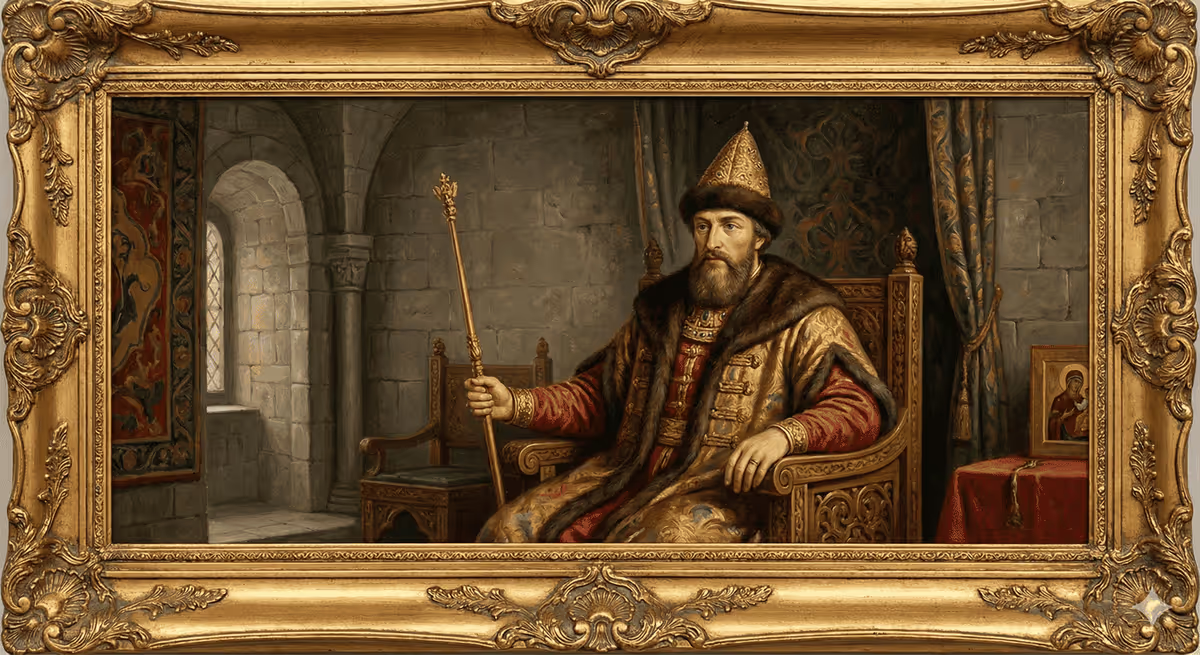
The new grand prince was nothing like a flamboyant conqueror. Chroniclers described him as a reserved, methodical, sometimes severe man. But beneath this austere appearance lay an iron determination. Vasily knew he had to complete what his father had started: eliminate the last pockets of independence, centralise power, establish Moscow’s absolute authority over all Russian lands. From the very first months of his reign, he kept his brothers away from any share of power. The era of rival princes was drawing to a close.
Pskov: the republic that refused to die
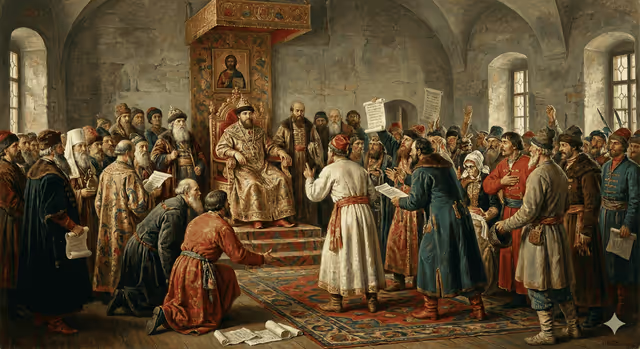
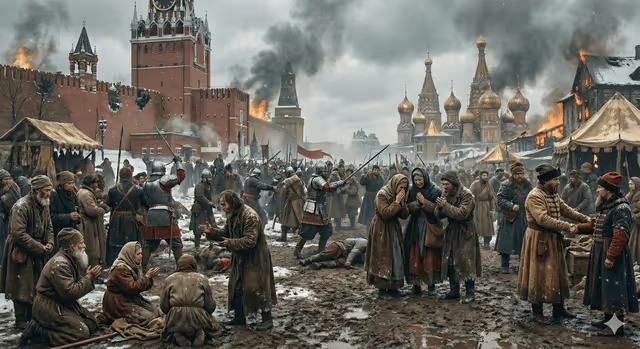
In January 1510, a delegation from Pskov arrived in Moscow to settle a dispute. This north-western city, with its popular assembly (veche, вече) and its centuries-old republican traditions, still believed it could negotiate as an equal with the grand prince. It was mistaken. Vasily summoned the representatives and announced his decision: Pskov would cease to exist as an autonomous entity. The veche bell, symbol of the city’s freedom, would be dismantled and taken to Moscow.
The Pskovians protested, pleaded, wept. Nothing worked. On 13 January 1510, Muscovite troops entered the city. The bell was lowered from its belfry and transported to the capital. Three hundred families of boyars (боя́ре) and merchants were deported to the interior of Muscovy, their property confiscated. In their place, Vasily installed loyal Muscovites. Within a few weeks, a free city became a simple province. The Pskov chronicler noted bitterly: “Our greatness is gone, our glory extinguished.”
But Vasily saw no tragedy in this. He saw a state being built, a territory being unified. Pskov was not viable as an independent enclave amid his domains. The logic of centralisation prevailed over sentiment. The grand prince did not seek to justify his act with grand political theories. He simply acted, methodically.
Smolensk: twenty years of stubbornness
The conquest of Smolensk became the obsession of the reign. This strategic city, located on the road between Moscow and Europe, had belonged since 1404 to the Grand Duchy of Lithuania. Its return to Moscow represented far more than a territorial victory: it was the reconquest of Russian land, the closing of a gap in the state’s defences.
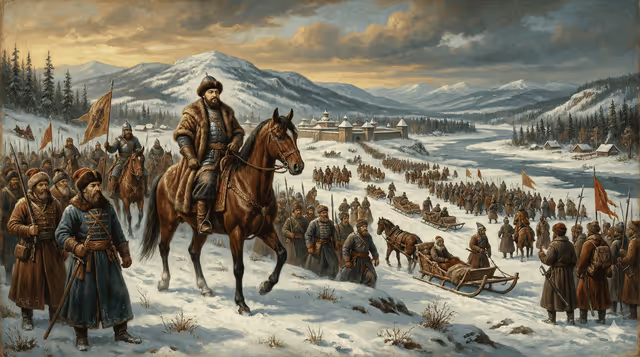
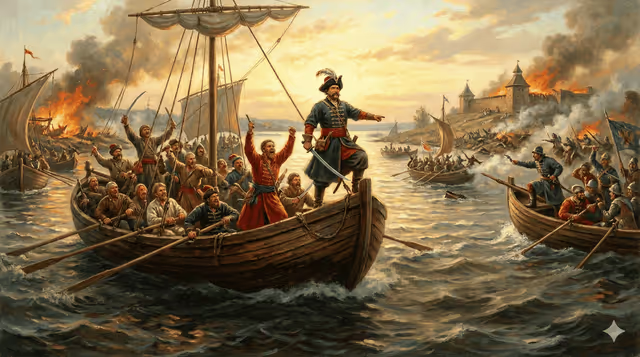
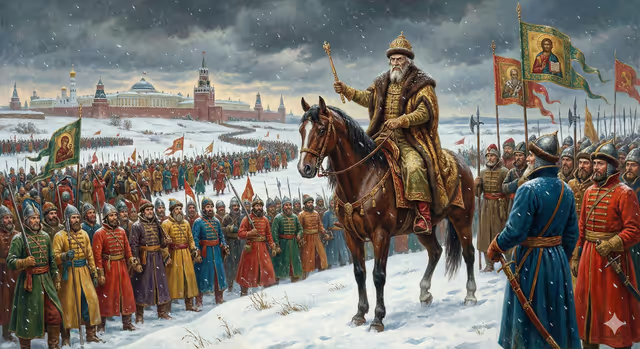
The first campaign began in 1512. Vasily mobilised tens of thousands of men, besieged the city, bombarded its walls. The defenders held out. Winter approached; the Muscovite troops withdrew. In 1513, another attempt, another failure. The grand prince did not give up. He reorganised the army, improved the artillery, reinforced logistics. In July 1514, he launched his third campaign. This time, after a six-week siege, the defenders surrendered. On 1 August 1514, Vasily entered Smolensk.
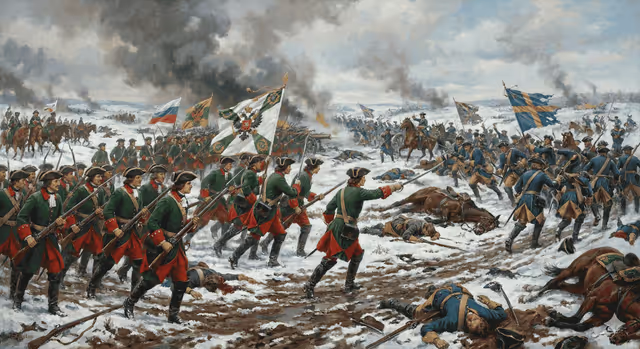
The victory was celebrated as a historic triumph. But it came at a price. A few weeks later, at Orsha (Óрша), the Muscovite army suffered a crushing defeat at the hands of the Lithuanians commanded by the hetman Konstanty Ostrogski. Thousands of Russian soldiers perished. Vasily had to accept a peace that left him Smolensk but stabilised the border. The war would resume sporadically until 1522. The grand prince kept the conquered city, but at a considerable military and financial cost. He had won his wager: Smolensk would never return to Lithuania.
An autocrat without equals
In 1525, an unprecedented event shook Muscovite society. Vasily, married for twenty years to Solomonia Saburova (Соломо́ния Сабу́рова), still had no heir. For a state under construction, this was an existential threat. The grand prince made a radical decision: he repudiated his wife and had her confined to a monastery under the name Sister Sophie (сестра́ Софи́я).
The Orthodox Church was scandalised. Metropolitan Daniel (Даниил) reluctantly agreed, but several ecclesiastics protested openly. The monk Maxim the Greek (Ма́ксим Грек), a respected scholar, publicly condemned the divorce. Vasily had him arrested and imprisoned. The message was clear: even the Church had to bend to the will of the grand prince. The sovereign’s authority tolerated no challenge, even in the name of religious morality.
A few months later, Vasily married Elena Glinskaya (Еле́на Гли́нская), a young noblewoman of Lithuanian origin. In 1530, she gave birth to a son, Ivan (Ива́н), the future Ivan IV. The following year, a second boy, Yuri (Ю́рий), was born. The succession was secured. The divorce, which had seemed a violation of divine law, became in hindsight an act of raison d’état. Vasily had broken a taboo, but saved the dynasty.
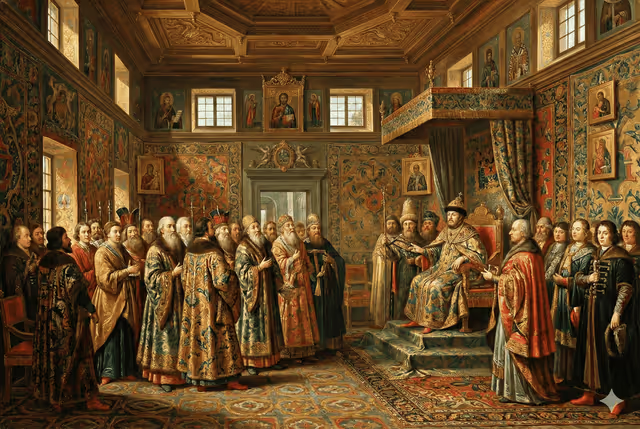
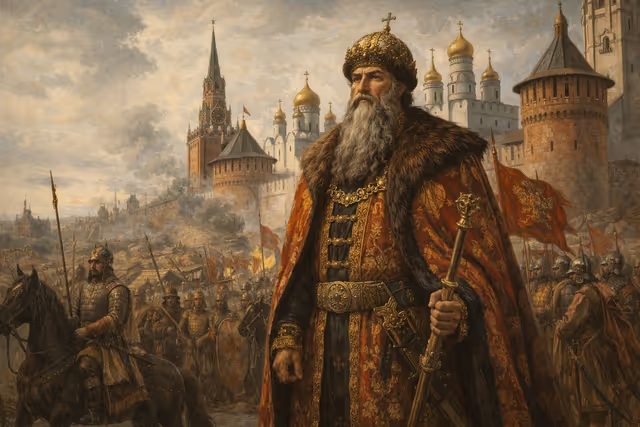
This episode reveals the nature of the power Vasily exercised. In Moscow, the grand prince was no longer a primus inter pares among the boyars. He was an autocrat (самоде́ржец), a sovereign whose will was law. The last consultative institutions, such as the boyar council (боя́рская ду́ма), lost their importance. The prince decided alone, acted alone, governed alone. When the Holy Roman ambassador asked why he did not consult his advisers, Vasily replied simply: “I am free to reward my servants and free to punish them.”
Building the state, stone by stone
While Vasily annexed territories and reinforced his authority, he also built — literally. The Kremlin (Кремль) of Moscow was transformed. Italian architects, continuing the work begun under Ivan III, erected new churches and fortifications. In 1508, the Alévizov moat (Алеви́зов ров) was dug in front of the eastern walls, turning the Kremlin into an impregnable fortress on an artificial island.
Churches multiplied throughout the country. In 1532, at Kolomenskoye, near Moscow, the Church of the Ascension (це́рковь Вознесе́ния) rose up, an architectural masterpiece whose stone spire reaches toward the sky. Tradition holds that Vasily had it built to celebrate the birth of his son Ivan. Architecture and politics intertwined: these churches affirmed the grand prince’s power and the divine protection he enjoyed.
Vasily also continued the administrative organisation of the territory. The conquered lands were integrated into the system of appanages (удéлы) controlled by Moscow. Governors (намéстники) appointed by the grand prince administered the provinces. The old feudal system of autonomous principalities gave way to a centralised structure. Each reform, each appointment, each construction reinforced Moscow’s power and weakened local particularisms.
In 1521, Ryazan, the last independent Russian principality, fell without a fight. Its prince, Ivan Ivanovich (Ива́н Ива́нович), was simply summoned to Moscow and… never returned. His lands were annexed. After Novgorod under Ivan III, after Pskov and now Ryazan, the process of gathering the Russian lands (собира́ние земе́ль) was complete. There was now only one Russian state, and one sovereign.
The final years and an uncertain legacy
In September 1533, Vasily fell ill during a hunting expedition. An abscess on his leg became infected rapidly. At the time, such a wound was often fatal. The grand prince hurried back to Moscow, but his condition worsened. On 3 December 1533, sensing his end, he had himself tonsured a monk under the name Varlaam (Варлаа́м) and died a few hours later, at fifty-four.
He left a complex legacy. His son Ivan was only three years old. A regency organised itself around Grand Princess Elena, but the boyars tore each other apart for power. The years that followed were marked by instability, plots and assassinations. The child Ivan grew up in this climate of violence and mistrust, an experience that would deeply mark the future terrible tsar.
But beyond the succession struggles, Vasily left a transformed state. In twenty-eight years of reign, he had enlarged the territory of Muscovy by nearly a third. Pskov, Smolensk, Ryazan: the last obstacles to unification had fallen. Autocracy had established itself as a mode of government. Muscovy was no longer one principality among others; it had become the undisputed centre of all Russian lands.
A consolidation without revolution
Vasily III did not overturn Russia as his father Ivan III had done, having expelled the Mongols and married a Byzantine princess. He did not terrorise his country as his son Ivan IV would, creating the oprichnina (опри́чнина) and having himself called tsar. Between these two spectacular reigns, Vasily simply continued, deepened, consolidated. He turned Ivan III’s conquests into lasting possessions, autocratic pretensions into political reality, and the principality of Moscow into a centralised state.
His reign demonstrates that a major historical transformation does not necessarily require a dramatic revolution. Pskov lost its freedom without an epic battle, Ryazan disappeared without resistance, autocracy took hold without any elaborate political theory. Vasily acted methodically, year after year, annexation after annexation, reform after reform. At his death in 1533, Russia stood on the threshold of empire. Fourteen years later, in 1547, his son Ivan would be crowned the first tsar of all Russia (царь всея́ Руси́). That imperial crown — it was Vasily who prepared its advent, without fanfare, without glory, but with formidable effectiveness.