Zemsky Sobor: the assembly that advised the Russian tsars
How could an autocratic empire convoke a representative assembly? Russia of the 16th and 17th centuries answered this paradox with the Zemsky Sobor (Земский собóр), literally “the assembly of all the land”. This unique institution brought together, for nearly two centuries, representatives of the nobility, clergy, merchants, and sometimes even peasants to advise the tsar on the major decisions of the realm. Neither a Western-style parliament nor a mere rubber-stamping chamber, the Zemsky Sobor embodied an original form of dialogue between autocratic power and Russian society. Its history reveals how the Russian empire sought to govern by involving — at least symbolically — the various layers of the population in the crucial moments of its history.
Ivan the Terrible invents an assembly to reform the empire
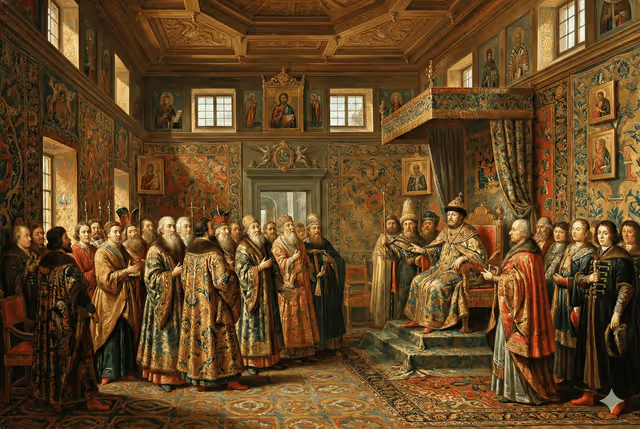
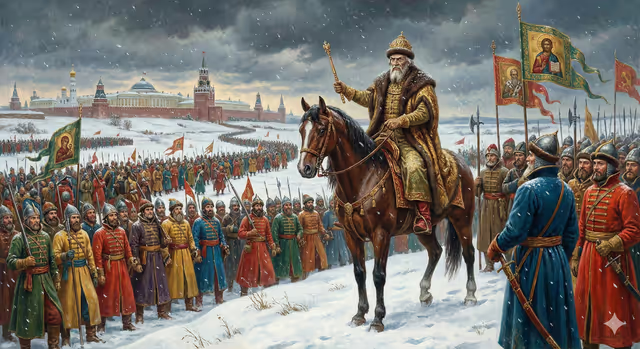
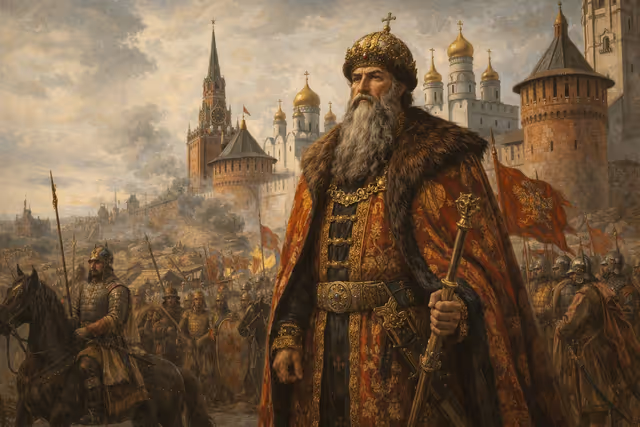
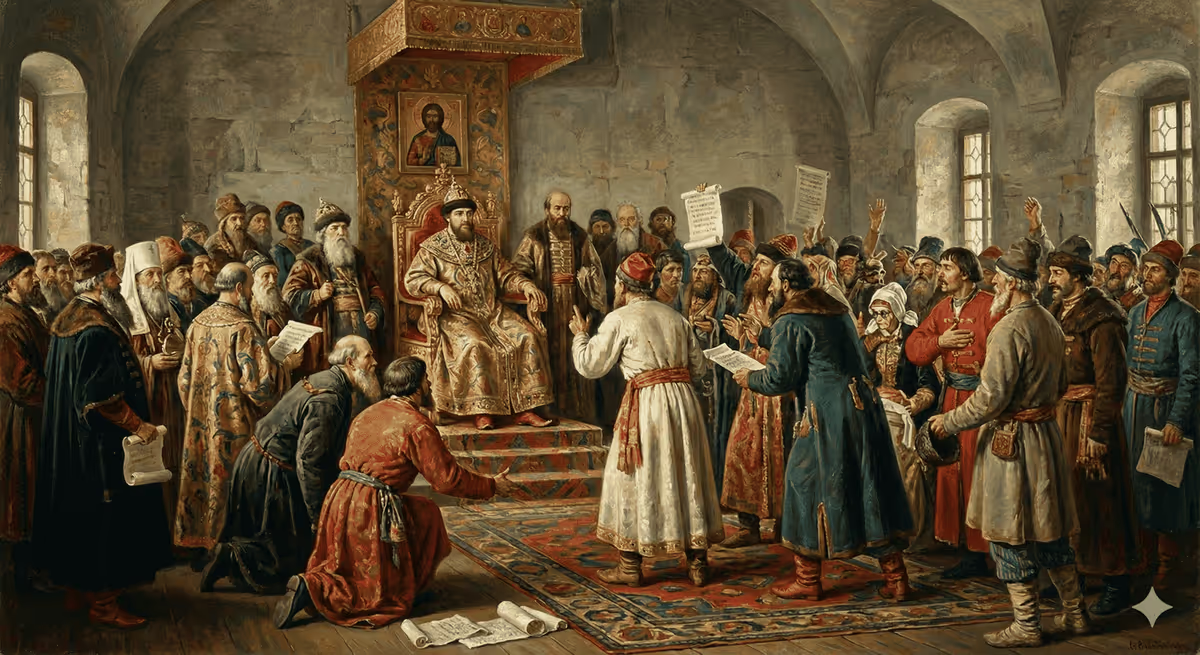
In 1549, the young tsar Ivan IV (Ива́н IV Васи́льевич), who had not yet earned his nickname “the Terrible”, convoked an unprecedented assembly in Moscow. For the first time in Russian history, the sovereign gathered around him not only boyars and clergy but also representatives from the provinces and cities. This first meeting of the Zemsky Sobor marked a turning point: Ivan sought to bypass the traditional Moscow aristocracy by relying directly on the service nobility and urban communities.
The nineteen-year-old tsar delivered a solemn speech before the assembly. He denounced the abuses committed during his minority by the great boyar families and announced his intention to reform the administration and justice. This convocation was not a sign of weakness: it was a skilful political manoeuvre. By associating different social strata with his centralisation project, Ivan strengthened his legitimacy against the Moscow boyars who had humiliated his childhood.
The assembly of 1549–1550 participated in drafting the Sudebnik (Судéбник), a new code of laws that modernised Russian justice. It also approved the creation of the streltsy (стрельцы́), Russia’s first permanent professional soldiers. The Zemsky Sobor did not legislate on its own, but its presence lent symbolic weight to the tsar’s reforms. The message was clear: the sovereign governed by listening to “all of Russia”, not just the Moscow elite.
This first experiment remained embryonic. The exact composition of the assembly remained vague, and the chronicles gave no detail on how representatives were chosen. But Ivan had just created a precedent: in moments of crisis or major reform, power could convoke an enlarged assembly to legitimise its decisions.
The Time of Troubles transforms the assembly into a kingmaker
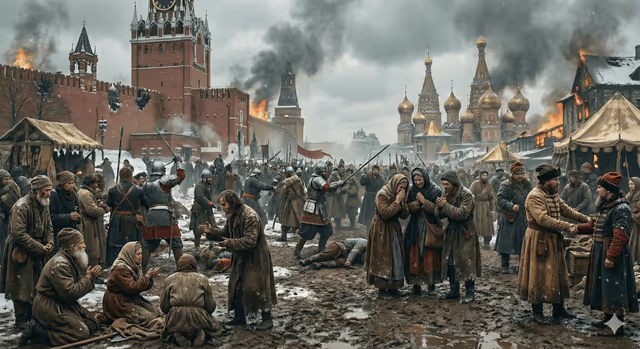
In 1613, Russia emerged bloodless from fifteen years of chaos. The Time of Troubles (Смýтное врéмя) had seen three false tsars, two Polish invasions and the occupation of Moscow by Catholics. The country was disintegrating. In this power vacuum, the Zemsky Sobor suddenly became the institution capable of saving the Russian state from disappearance.
In January 1613, an extraordinary Zemsky Sobor convened in Moscow. This assembly was the broadest ever convoked in Russia: nearly 700 to 800 delegates represented all orders of Russian society — clergy, military nobility, merchants, Cossacks, and even peasant delegates from liberated provinces. Each city had sent representatives elected by their communities. For the first time, the assembly did not merely advise: it had to choose a new tsar.
Debates lasted several weeks. Candidates were not lacking: powerful boyars, princes of Rurikid origin, even the son of Sweden’s King Gustav Adolf. But the delegates were looking for a candidate who could reconcile all Russian factions without being linked to the years of troubles. On 21 February 1613, the assembly elected Mikhail Romanov (Михаи́л Фёдорович Рома́нов), a sixteen-year-old whose father, Patriarch Philaret (Филарéт), had been imprisoned by the Poles.
This choice was brilliant: Mikhail belonged to a respected but not overly powerful family, had taken part in none of the Time of Troubles intrigues, and his youth allowed all factions to project themselves onto him. The Zemsky Sobor of 1613 did not simply elect a tsar: it literally refounded the Russian state by giving popular legitimacy to a new dynasty. The Romanovs would reign for three centuries, drawing on this election.
The assembly of 1613 remained in almost continuous session until 1622. It helped the young tsar and his father rebuild the administration, levy extraordinary taxes to pay armies, and negotiate peace with Sweden and Poland. The Zemsky Sobor temporarily became a quasi-permanent organ of Russian government.
Alexis I governs with the assembly at his side
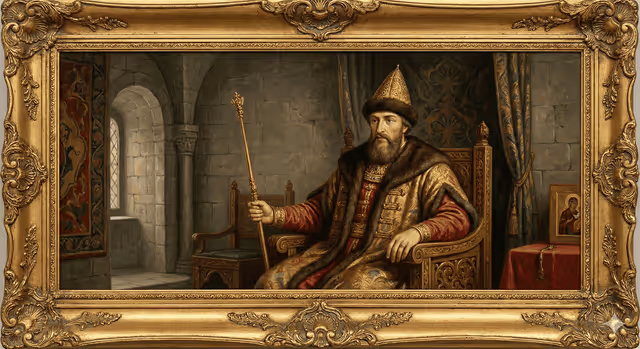
Under the reign of Alexis I (Алексéй Миха́йлович, 1645–1676), the Zemsky Sobor reached its zenith. The Most Serene Tsar regularly convoked the assembly for major decisions that committed the country’s future. Between 1645 and 1653, at least eight sobors met in Moscow.
In 1648–1649, Alexis convoked a Zemsky Sobor to respond to the riots that shook Moscow following the rise in the price of salt. The assembly participated in drafting the Sobornoye Ulozheniye (Собóрное уложéние), the great code of laws of 1649 that would structure Russian society for the following two centuries. This legal code, containing nearly a thousand articles, definitively fixed serfdom, organised the administration and regulated religious life. Significantly, the text bore the name of the assembly that approved it: the “Code of the Sobor”.
In 1653, Alexis convened the Zemsky Sobor for a crucial decision: to accept the request for integration into Russia put forward by the Cossack hetman Bohdan Khmelnytsky (Богда́н Хмельни́цкий) and his Ukrainian territories. This decision committed Russia to a long war against Poland. The tsar wanted this major territorial expansion to be approved by the representatives of “all of Russia”. The assembly voted for union with Cossack Ukraine, giving collective legitimacy to what would become one of the most important territorial acquisitions in Russian history.
But the composition of the Zemsky Sobor under Alexis revealed its limits. Delegates were not truly elected: cities sent representatives chosen among their notables, and the tsar could strongly influence the selection. The assembly had no legislative power of its own and could not meet without the sovereign’s summons. It approved, advised and legitimised — but never limited the autocracy. The Zemsky Sobor was an instrument of the tsar, not a counterweight.
Peter the Great buries the assembly in silence
After 1653, convocations of the Zemsky Sobor became rarer. Under the reign of Fyodor III (Фёдор III Алексéевич, 1676–1682), a few assemblies still met on dynastic or fiscal questions. But the institution gradually lost importance. The last confirmed convocation dated from 1684, on a taxation matter.
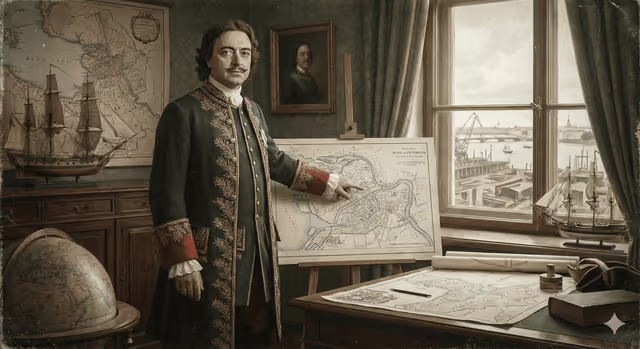
Peter the Great (Пётр I Алексéевич), who came to power in the 1690s, had no intention of consulting a traditional assembly. The young tsar was building a modern Western-style state, with colleges (коллéгии) and a Senate (Сенáт) inspired by Swedish and Prussian models. For Peter, the Zemsky Sobor represented the old Muscovite world he wanted to destroy: an institution rooted in Orthodox traditions, dominated by the clergy and landowning nobility, hostile to his Westernising reforms.
Peter did not formally abolish the Zemsky Sobor: he simply let it die through non-convocation. No edict abolished the institution, no proclamation announced its disappearance. The reforming tsar created so many new administrative structures that the old assembly became obsolete. The Imperial Senate, composed of dignitaries appointed by the sovereign, definitively replaced the Zemsky Sobor as the supreme consultative body.
This silent disappearance reveals the deep nature of the institution: the Zemsky Sobor had never had its own legal existence, fixed regulations, or guaranteed rights. It existed solely because the tsars of the 16th and 17th centuries found it useful to convoke it. When Peter judged that this consultation no longer made sense, the assembly evaporated without leaving any institutional trace.
An autocratic assembly, symbol of a Russian path
The Zemsky Sobor embodies a paradox: how could a “representative” assembly function within an autocratic system? For nearly 150 years, Russian tsars resolved this contradiction by making the sobor an instrument of legitimation rather than an organ of control. The assembly approved major decisions; it never imposed them.
This institution reveals a specificity of Russian state-building. Unlike the French Estates General or the English Parliament, which emerged to limit royal power, the Zemsky Sobor was born to strengthen autocracy by giving it a broader social base. It allowed the tsar to bypass the Moscow aristocracy by relying on the service nobility, merchants and urban communities. When this function became unnecessary under Peter the Great, the assembly disappeared naturally.
The Zemsky Sobor’s legacy remains ambiguous in Russian memory. In the 19th century, some Slavophiles would see in it proof that Russia had developed an original form of consultative democracy before Peter. Other historians would argue on the contrary that this assembly never challenged autocracy and served only as an instrument of tsarist power. These historiographical debates reflect a broader question: did Russia ever have institutions capable of limiting autocratic power? The Zemsky Sobor, a consultative assembly without real power, may embody the complex answer to this question.