The meeting at Tilsit (1807): Napoleon and Alexander I divide Europe
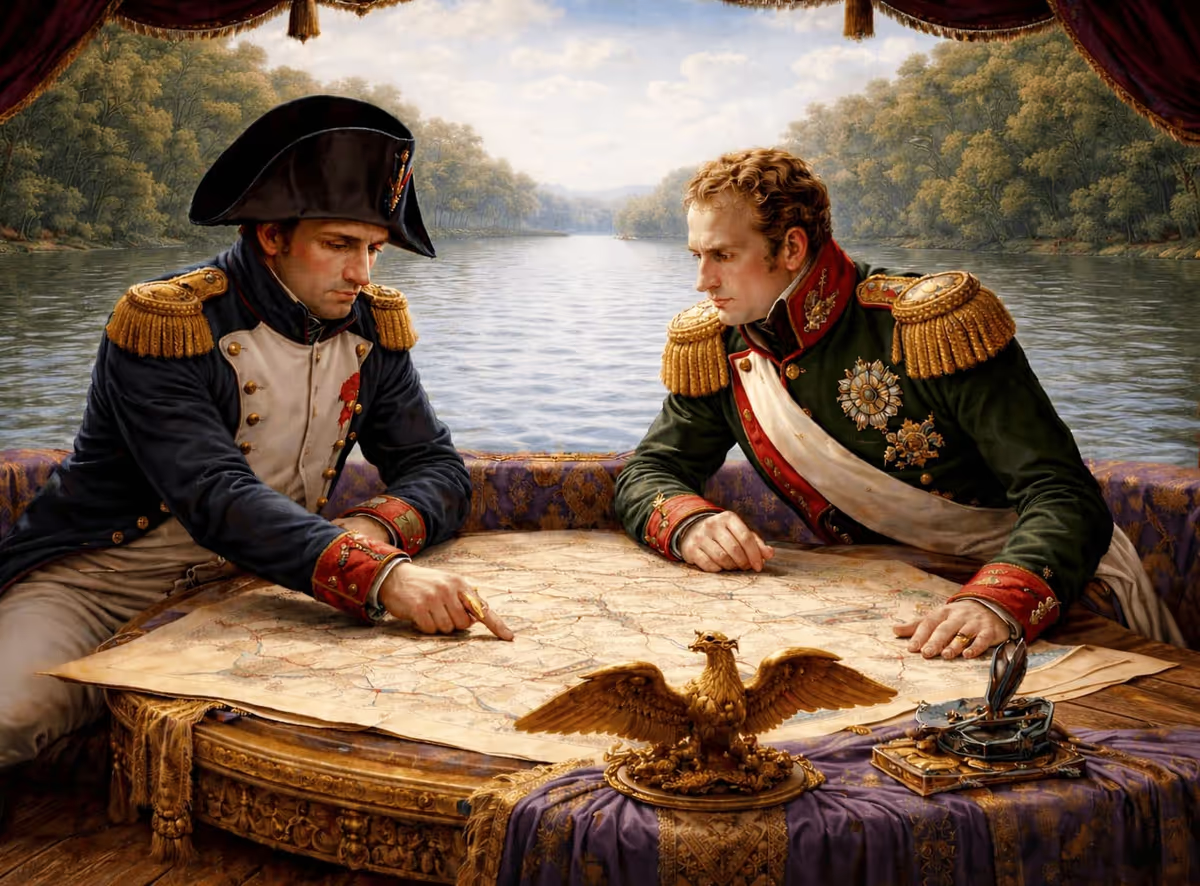
On June 25, 1807, Europe holds its breath. In the middle of the Niemen River (Не́ман), which then marks the border between the remnants of Prussia and the Russian Empire, an unusual structure draws every eye. It is neither a warship nor a simple ferry, but a monumental raft topped by two richly decorated pavilions.
This is Tilsit (Тильзит), and the fate of a continent is being decided here. Napoleon I (Наполео́н I), at the peak of his glory after crushing the Russian army at Friedland, is about to meet the young Tsar Alexander I (Алекса́ндр I).
The setting: a raft in the middle of the Niemen
Why a raft? Napoleon, a master of stagecraft, understood the importance of ego. Meeting the tsar on the French bank would have been a humiliation for Russia; going to the Russian bank would have been an admission of weakness for France. The middle of the river offers that “no man’s land” where two emperors can embrace as equals.
Witnesses of the time describe an almost surreal scene: both sovereigns leave their respective banks simultaneously in richly decorated boats. Napoleon, quicker off the mark, arrives first on the raft and welcomes Alexander. The tsar’s first words were reportedly: “Sire, I hate the English as much as you do.” To which Napoleon is said to have replied: “In that case, peace is made.”
The seduction of Tilsit
For two weeks, the two men are inseparable. They spend hours alone together, without ministers or advisors. Napoleon, the revolutionary “upstart,” deploys all his charm to win over this mystical, indecisive Romanov.
Napoleon’s temperament: He sees in Alexander a man who can be manipulated through emotion and grand geopolitical schemes. He calls him “my brother” and flatters his ambitions.
Alexander’s temperament: More complex, the tsar is fascinated by the Corsican’s military genius, but remains a Byzantine diplomat. Beneath an apparent submission, he conceals a fierce determination to protect Russia’s interests.
Napoleon writes to Joséphine: “He is a very handsome, good and young emperor; he has more intelligence than people think.” For his part, Alexander confides to those close to him that he was dazzled — while remaining on his guard.
Dividing Europe: the terms of the Treaty of Tilsit
Behind the banquets and military parades, the negotiations are surgically cold. The Treaty of Tilsit redraws the map of Europe:
The dismemberment of Prussia: The kingdom of Frederick William III is cut in half. Its Polish provinces become the Grand Duchy of Warsaw — a direct threat on Russia’s doorstep.
The Continental Blockade: This is the crucial point for Napoleon. In exchange for peace, Alexander agrees to close his ports to British ships. Russia becomes France’s ally against England.
Spheres of influence: Napoleon implies to Alexander that he can seize Finland (at Sweden’s expense) and expand toward the Ottoman Empire. In short: the West to France, the East to Russia.
A house of cards
On paper, the Treaty of Tilsit is a masterstroke. For the first time, Napoleon has pacified the continent by allying with his greatest rival. But this friendship is built on sand.
The Russian aristocracy takes a very dim view of this alliance with the French “Antichrist,” and the Continental Blockade quickly begins to ruin the Russian economy, which is heavily dependent on trade with the English. The nobility of Saint Petersburg, who had adopted French as their drawing-room language since the days of Peter the Great, could not forgive Alexander for bowing to a Bonaparte.
For his part, Napoleon grows impatient: he realizes that Alexander is less malleable than he had hoped.
The illusion of Tilsit
The meeting at Tilsit will go down in history as a mirage: that of a bipolar Europe where two men might have divided the world between them. In 1810, Russia quietly reopens its ports to neutral ships — a pointed snub to the Blockade. Tensions mount. Napoleon sees it as betrayal; Alexander sees it as economic necessity.
In June 1812, five years after the embraces on the Niemen, the Grande Armée crosses that same river in the opposite direction. The Russian campaign begins — the greatest military catastrophe in the history of the Empire. Geopolitical realities and personal ambitions had shattered the dream of Tilsit, and with it Napoleon’s bid for mastery of Europe.